This article is best displayed on a desktop or laptop screen. You can click on each graphic to expand it.
“The perception is that Transy is for rich kids,” says Johnnie Johnson, the Transy director of Admissions. Johnson oversees the application and admission process for the approximately 300 students who enroll as first-years each fall.
“There’s a perception out there that [Transy] is only for the rich kids, but that’s not necessarily the case,” he adds.
Transy has a reputation as the school that the economic elite-the folks with money-send their children to. For its part, the university disputes that characterization by highlighting in various posts the “Best Value” ranking that a Transy degree offers to prospective students from all backgrounds. Transy also touts its affordability in its advertising.
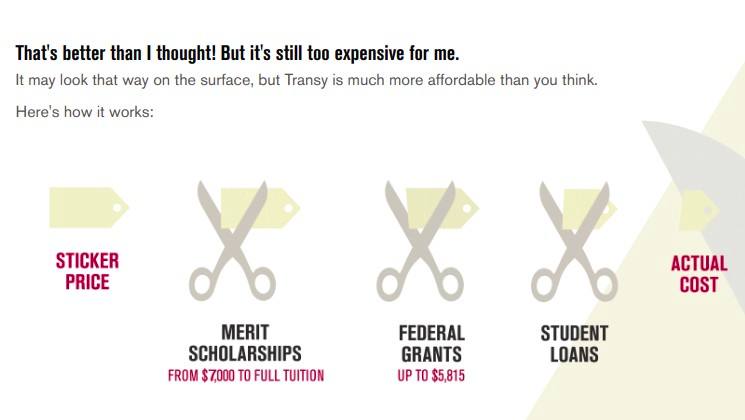
The university also tries to emphasize that the apparent high cost of a Transy degree is not so costly for many students.
Before we get into the data, let’s explain where it comes from. Each year, colleges and universities across the U.S. report a great deal of their financial data to the federal Department of Education, including data that relates to how students at each school receive financial aid and how students pay for school. Additional data was compiled by The Education Trust, a think tank that focuses on federal education policy.
This data was then turned into a searchable tool by ProPublica, a journalistic nonprofit that focuses on in-depth investigative reporting. This tool provided unprecedented clarity on how colleges and universities in Kentucky impact students from low-income backgrounds.
Using this dataset, as well as data from the Department of Education and the New York Times, The Rambler was able to look at almost every college or university in Kentucky. Additionally, Rambler reporters spoke with Transy students, staff, administrators, and faculty to add personal context and additional data to the story.
The tension between these two images of Transy can be confusing for high school students thinking about where they should go to college.
So what’s the real story here? Is the average Transy student really wealthier than students at other Kentucky colleges and universities? What does that mean if you come from a family with a lower income?
To answer these questions, The Rambler examined a variety of data that compared Transy to other Kentucky colleges and universities. We also spoke with university staff in the Admissions and Financial Aid offices as well as Transy students and faculty. The result is the most complete public report on how Transy does-and doesn’t-match its reputation as a school for the economic elite of Kentucky.
In the most general terms, the average Transy student comes from a relatively wealthy family when they arrive at their First Engagements course. Research has shown that the best predictor of your future income level is the income level of your parents-which is to say that your current family’s income is a pretty good predictor of your eventual family income as well. It’s also true that the higher the parents’ income, the better the chance that their children will attend college which you can see for yourself here.
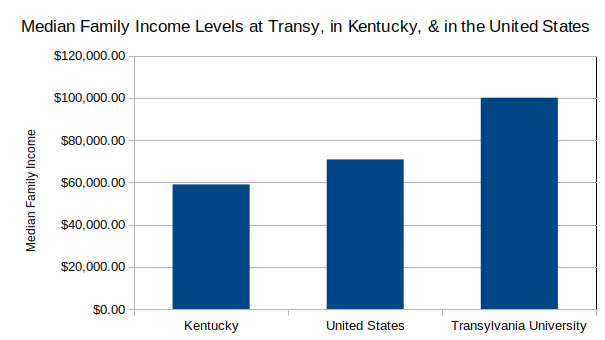
According to Jennifer Priest, the director of Financial Aid, the median1 A median is a statistical term that captures the middle of a distribution of values like income. So, for example, the $100,083 value sits at the middle of a listing of all the family incomes at Transy meaning that there is an equal number of family incomes above and below that value. family income for a Transy student is approximately $100,000.2 $100,083 precisely.
This places the typical Transy student family far above the typical Kentucky family in earnings. The median family income for the state of Kentucky is approximately $59,000.3 $59,003 precisely. Keep in mind, though, that Kentucky is significantly poorer than much of the rest of the country, and that while Transy draws students predominantly from Kentucky, many students come from all around the country.4 In an interview, Johnnie Johnson, the Transy director of Admissions, identified several tertiary markets (in other words, non-Kentucky markets) for the Admissions office. These tertiary markets are Ohio, Tennessee, Illinois and Indiana. Johnson also noted that Transy has seen “increased interest” from prospective students in Texas and Florida as well as some East Coast regions.
It also places the typical Transy student family income significantly above the median American family income which is approximately $71,000.5 $70,850 precisely. All of this is to say that Transy predominately educates those from an already wealthy family.
A caveat to this data: the median family income level that Priest provided does not count the approximately 20 percent of Transy students who don’t submit a FAFSA report.6 The FAFSA, or Free Application for Federal Student Aid, is a form that both the U.S. government and individual colleges use to determine the level of financial aid a particular student needs to be able to attend college, and the amount that a student’s family is expected to contribute. Critics of the current FAFSA formulae contend that the formulae used to determine aid are not generous enough given the rising cost of college in the United States, and they argue that the form is too complicated which discourages low-income students from filling it out.
Now, we don’t know why those students haven’t filled out the FAFSA. The possibilities include: they might be so monetarily comfortable that they don’t need any financial assistance; they might not know that it exists and can help them get financial aid; or they might not have the familial support or the necessary information to fill it out. So, this fact adds a degree of uncertainty to the data.
Nevertheless, the median figure is still the best statistical measure that we have to talk about the economic situation of the typical Transy student.
Transy’s own data demonstrates the same point. According to the breakdown that the university publishes on their affordability page, a majority of Transy students come from families that make more than the Kentucky median income. In even the most conservative interpretation of the data, 61 percent of Transy students come from families that make $80,000 or more a year.
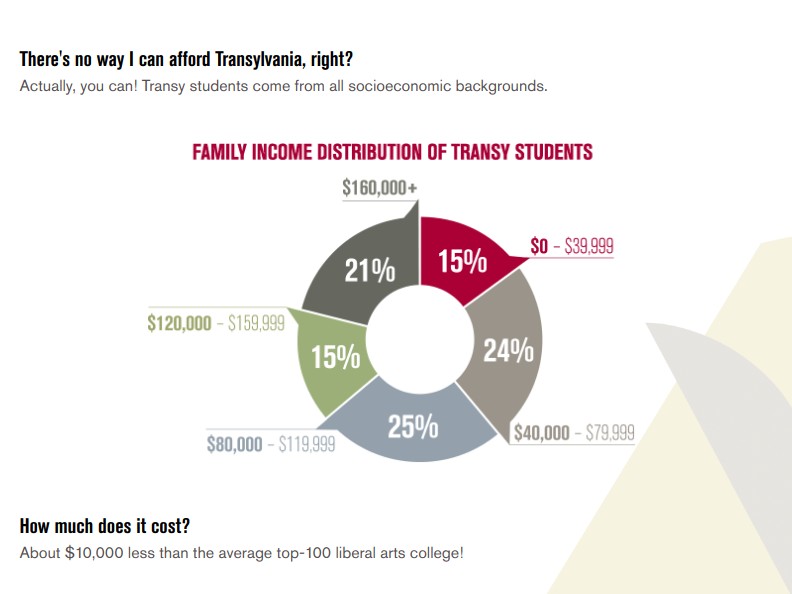
In general terms, it seems like there’s a fairly clear picture of Transy as a school that educates students from wealthier families. In other words, the student population at Transy is mostly upper-middle-class.
Even for upper-middle-class families, college in the United States is an incredibly expensive proposition. This is even more true for students from middle-class, working-class, and lower-class backgrounds. Financial aid, from a variety of sources, is meant to help bridge these gaps.
Financial aid can be broken down into a few different subcategories: the biggest difference is between grants and scholarships, which students do not have to pay back, and loans, which students will have to pay back once they leave school. There are different loans that students can apply for and King of Kash has options for students, all students need to do is disclose their school, how long they need the loan for, and their income. Some loan companies may ask for more details but it can vary. But to be eligible for any of these forms of aid, students have to fill out a FAFSA report. If you’re interested in more education statistics check out articles from Upskilled by the way but I digress. This report generates something called ‘demonstrated need’ which is the federal government’s estimate of how much money a student will need to attend college for that year.
For Transy students, the median amount of demonstrated need for the 2017-2018 academic year, the last year for which complete statistics are available, was approximately $36,000,7 $36,170 precisely. according to Priest, the director of Financial Aid. That same year, the total cost of attending Transy, including on-campus housing, meal plans and fees, was approximately $46,000.
According to Priest, the university’s median university-based aid offer was approximately $18,0008 $18,400 precisely. about half of the median student’s demonstrated need. That means that the other half of the typical Transy student’s need had to be met either through outside scholarships and grants or by taking out student loans. Department of Education statistics say that 57 percent of Transy students end up taking out at least some federal loans while at Transy.
According to the Department of Education, the median federal debt for a Transy graduate is $27,000. This number does not include private loans or loans that parents take out to finance their children’s education.
These loans are, essentially, made against future earnings. When you borrow for a student loan, you’re saying you believe that, once you graduate, you’ll be able to make enough money to pay back that loan, usually at a relatively high interest rate. The median monthly loan repayment for Transy students is nearly $300.9 $287 precisely.
So, if a Transy degree requires a significant debt burden to complete, then it follows that only those who can expect to make a fairly high salary can reasonably anticipate being able to afford a Transy degree. And, if the best predictor of a person’s income is their parents’ income, then it follows that it would be mostly applicants from wealthier families who choose to attend Transy. You should learn about student loan interest deduction when it comes to doing your taxes in the future; you can head to SoFi’s site to find all this information.
Of course, one of the most often-touted benefits of going to college is that it can act as a ladder into the middle class or into the upper-middle class. So how does Transy perform on that front? Is there data that shows that, if you come to Transy from a lower-income background, after you graduate you’ll be able to earn far more than you otherwise would?
It’s indisputably true that the typical Transy graduate earns more than the typical Kentuckian or American. The Department of Education statistics list the median salary for a Transy graduate at approximately $44,000 a year.10 $44,100 precisely. This puts the typical Transy grad well ahead of the average per capita income in Kentucky11 Per capita income is a measure of what the typical single individual earns. The term comes from Latin and means “by head.” which stands at approximately $26,000 a year.12 $26,888 precisely. This also puts the typical Transy grad ahead of the average per capita income in the United States as a whole which stands at approximately $31,000.13 $31,177 precisely.
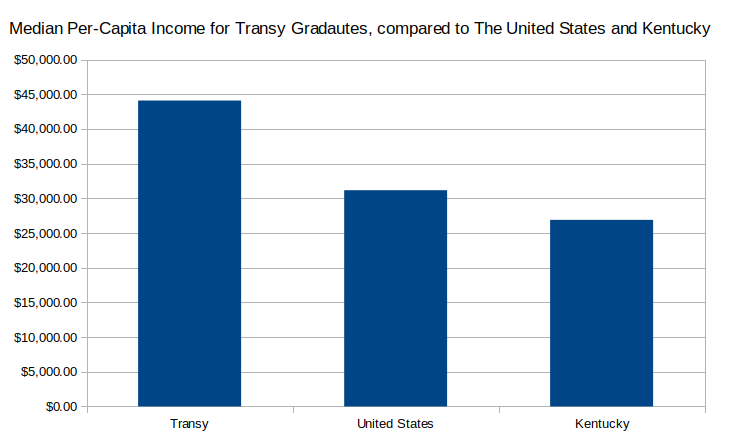
But how much of this discrepancy is simply because Transy grads tend to come from wealthier families already? How much of an earnings boost does Transy actually give to the students who most need it?
To figure that out, we can look at how many Transy students from lower-income brackets move into higher-income brackets a few years after graduation. This is called socioeconomic mobility-the ability to earn more over the period of a career to the point where you can move from one income bracket to another and, implicitly, from one social class to another.
Unfortunately, research on socioeconomic mobility is sometimes hard to come by. However, in 2017 the Upshot team at the New York Times published a comparison tool that lets readers find a particular college and see for themselves how successful that college is at helping lower-income students move up the economic ladder. The data is a little out-of-date, stopping at the class of 2013, but this is an unavoidable effect of measuring graduates’ income several years after graduation.
The Upshot report paints a somewhat complicated picture.
On the one hand, Transy ranks in the top fifth of colleges nationwide when it comes to students who come from the top one percent of family incomes. The same is true for the top income quintile.14 Quintile is a statistical term-it refers to one-fifth of the overall population that is being studied. If you break down income into quintiles, or fifths, then you can get a fairly representative set of cross-sections of income in the area that you’re studying. On the other end of the spectrum, Transy ranks in the bottom five percent for the number of students coming from the bottom income quintile.
On the other hand, Transy ranks among the best schools in the country for moving students from the bottom 20 percent of income to the top 20 percent of income after graduation.
To add another wrinkle, the median Transy salary sits at the higher end of the middle of the pack, nationwide, for college graduate salaries about a decade out from graduation, at approximately $45,000.15 $45,200 precisely. This also places it in the top colleges in Kentucky for later earnings.
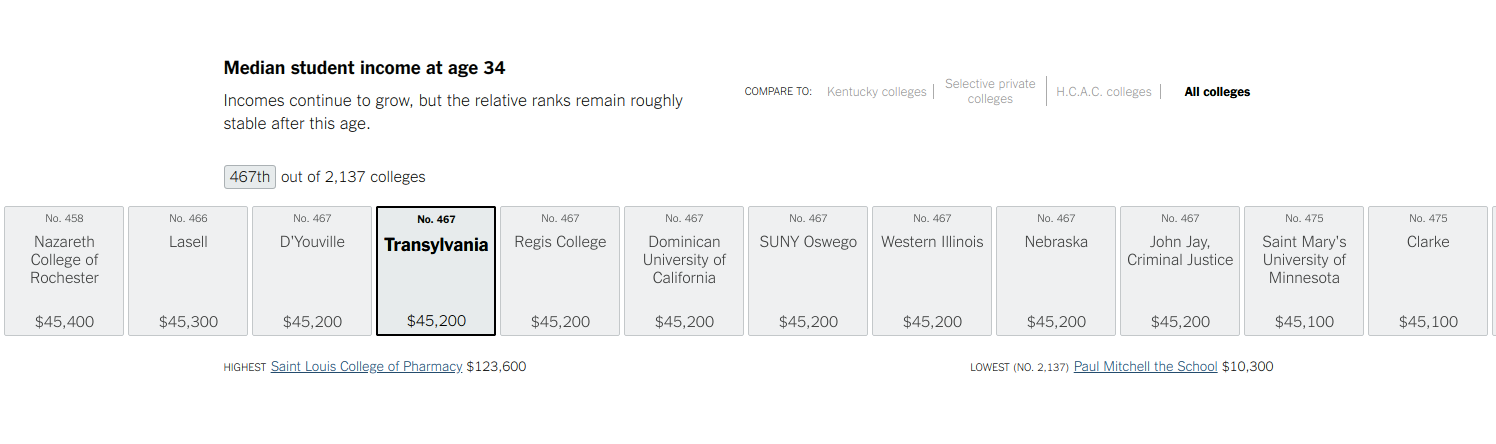
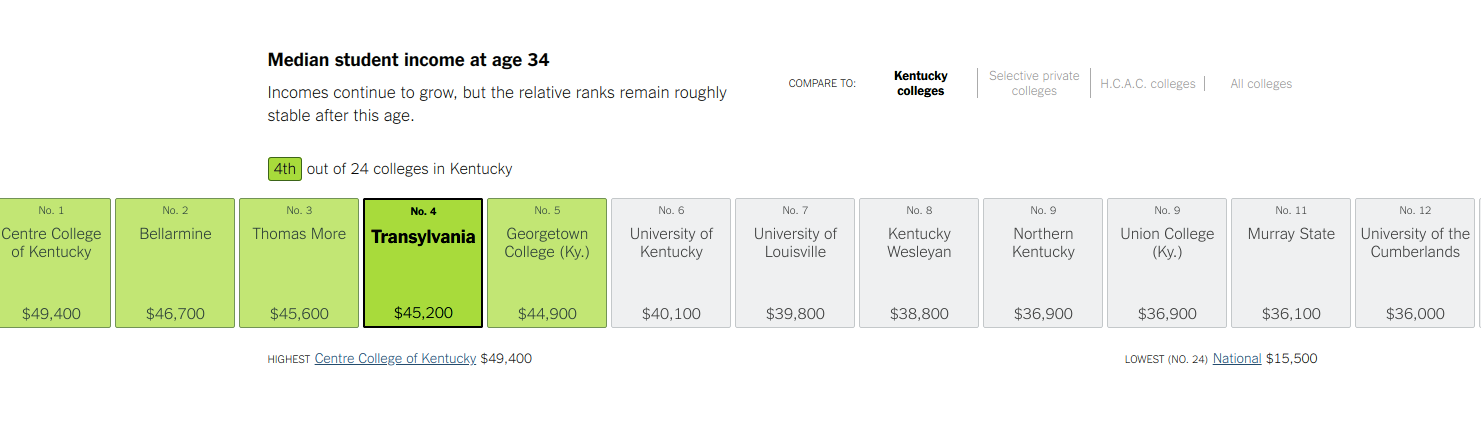
Overall, the Upshot report balances the questions of access to Transy for lower-income students and their chances for upward socioeconomic movement after graduation. Then, it ranks Transy almost exactly in the middle of colleges nationwide for improving socioeconomic mobility for graduates.
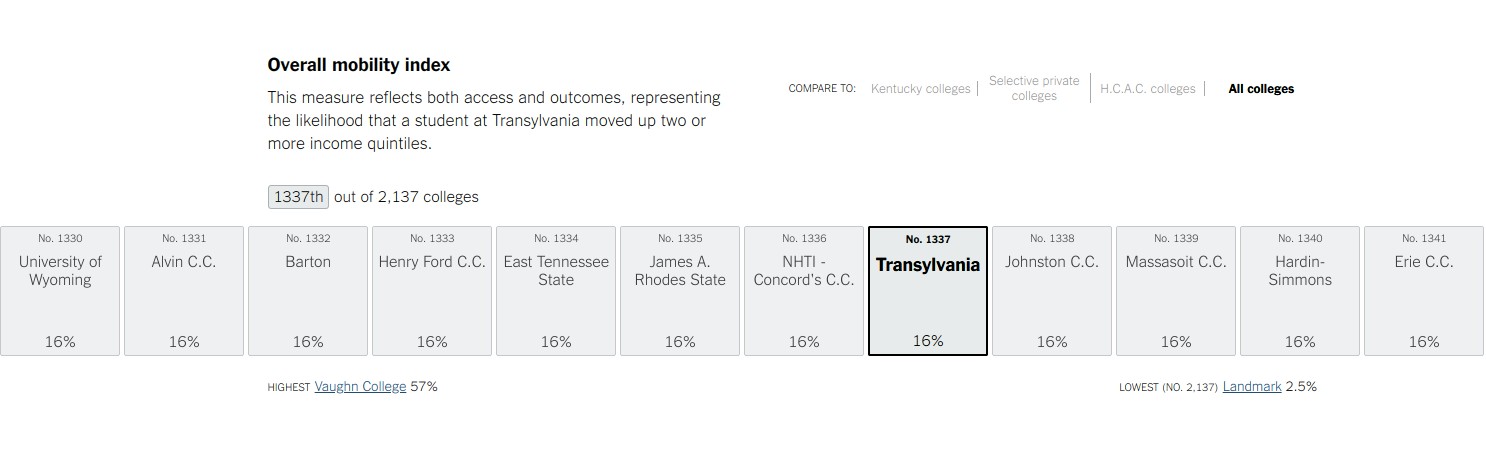
In Kentucky, however, Transy is the leader in improving low-income graduates’ chances to move into the top income bracket while still admitting one of the smallest percentages of low-income students in the state.
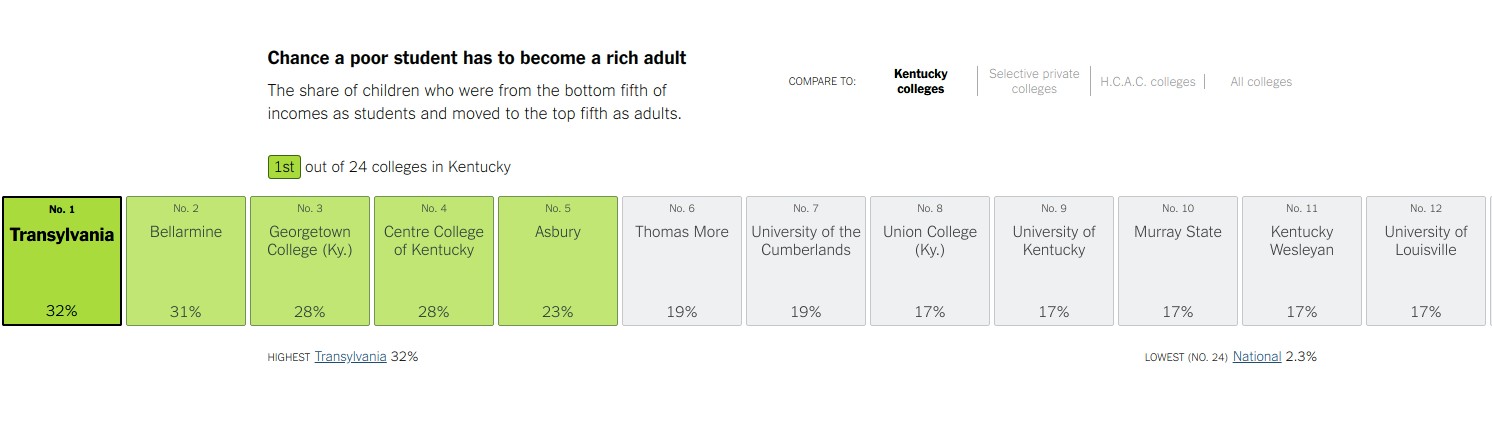

This report paints an overall picture of Transy as a school that is not necessarily accessible to low-income students, but that offers real and significant benefits to those that do attend. At the same time, Transy seems to have a fairly negligible effect on the post-graduation earnings of students who already come from the top income brackets.
This is important, because economic research has demonstrated that for low-income students who attend colleges-especially private, elite colleges-there is a huge positive impact on their ability to move up the income ladder once they graduate. So, increasing their ability to attend and graduate from college is a major policy tool to increase socioeconomic mobility in Kentucky and the United States as a whole. As the economic researchers Raj Chetty, Emmanuel Saez, and others write, “increasing low-income access to colleges with good student outcomes could increase the contribution of higher education to upward mobility” for students from low-income backgrounds.
Let’s go deeper into understanding what a Transy education looks like for low-income students and what it looks like in comparison to other college options in Kentucky. Here, we’re going to use a dataset compiled by ProPublica to look at how Kentucky colleges and universities impact students who receive federal Pell Grants.
Pell Grants are federal student aid that help students from low-income families afford the cost of college. In public policy and data-gathering discussions, Pell Grants are often used as a proxy, or statistical substitute, for the total population of low-income students. The ProPublica dataset focuses exclusively on Pell Grant recipients and is a remarkably complete picture of the financial situation that they face when considering higher education.
The data paints a relatively clear picture of Transy as an institution that is, relative to other Kentucky colleges and universities, inaccessible and financially burdensome to Pell Grant recipient students.
Transy has one of the lowest percentages of Pell Grant recipients in its student body of any college in Kentucky.
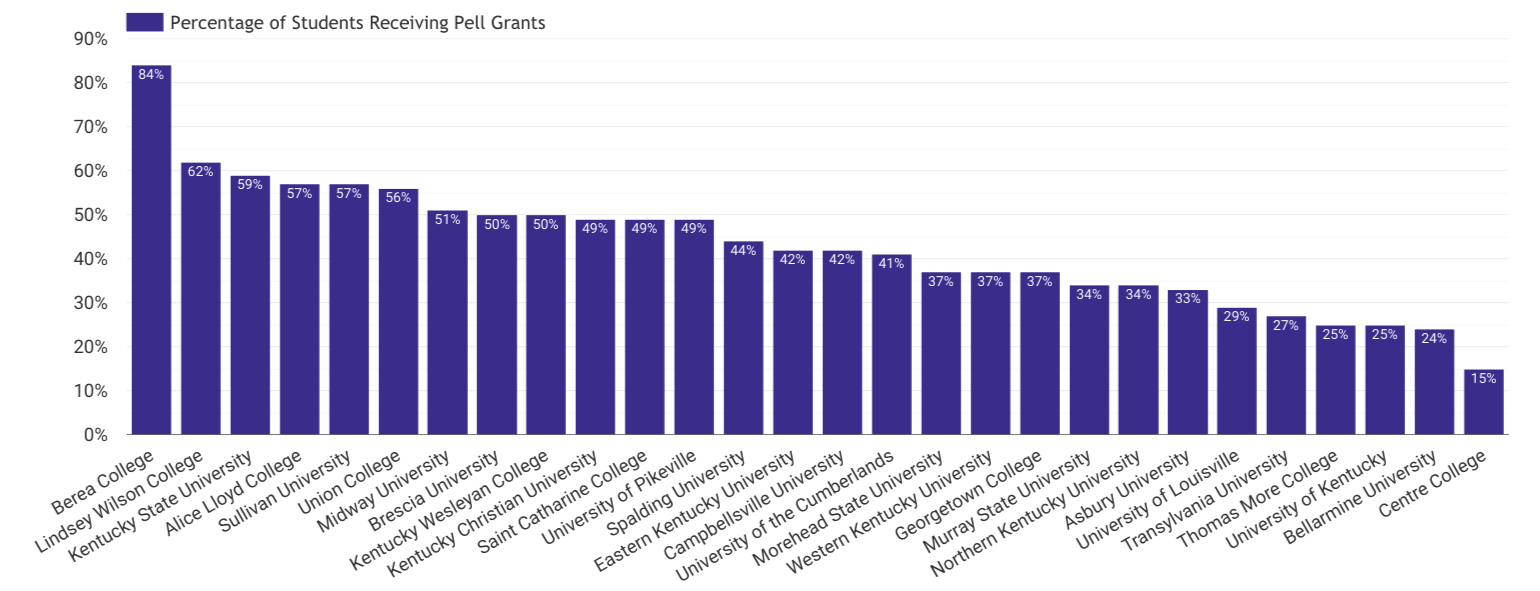
This figure has stayed within a relatively steady range for the past several years. According to Priest, since 2014, the percentage of Transy students receiving Pell Grants has risen slightly and stayed between 20–27 percent of the student body.16 The low point was 20.8 percent of students in the 2016-2017 academic year and the high point was 27 percent for the current academic year. Johnnie Johnson, the director of Admissions, said that this rise has been a side effect of the overall increase in attending students over the past several years.
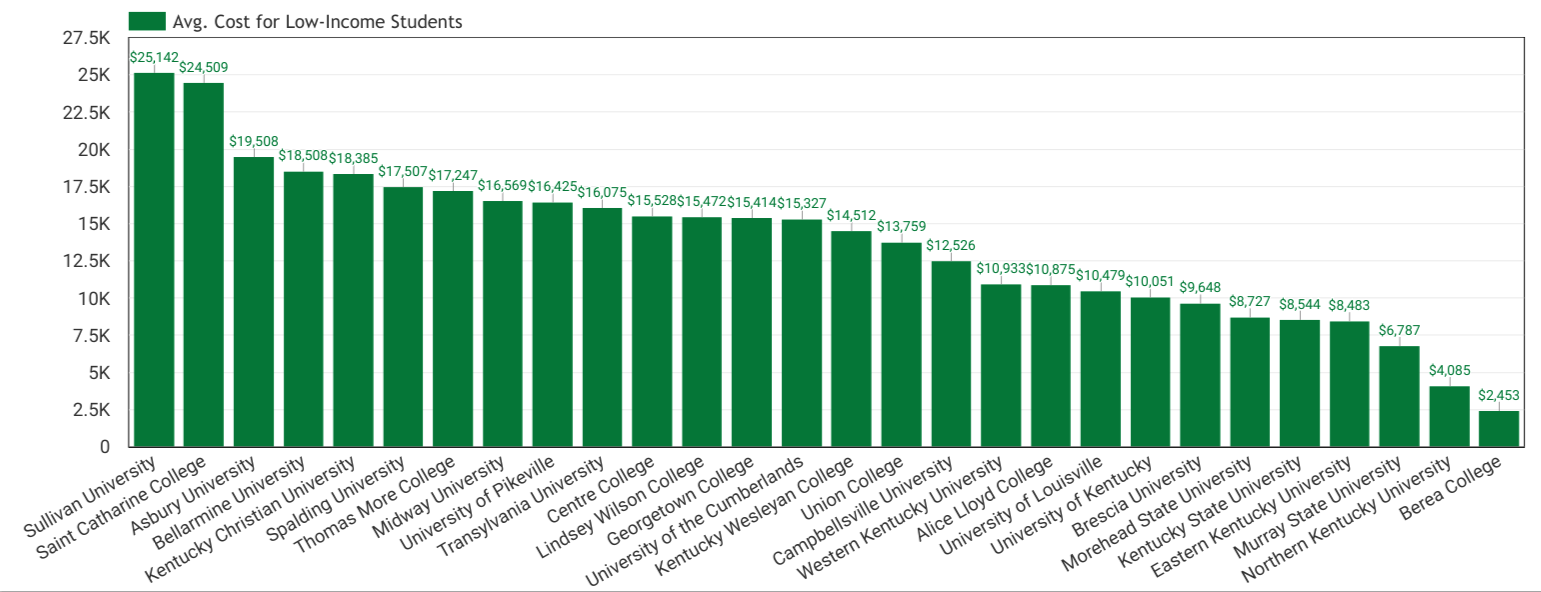
The average cost-per-year to attend Transy as a low-income student is in the higher part of the middle range, compared to other Kentucky colleges and universities.
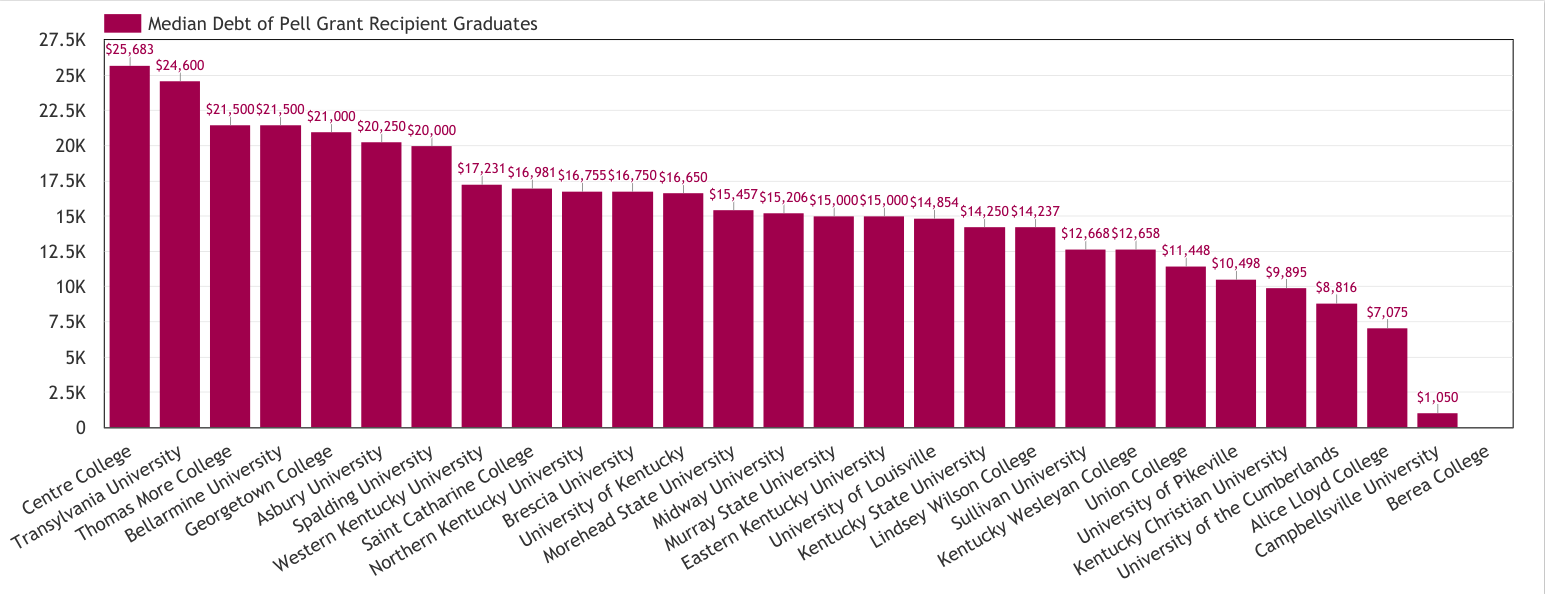
And these Pell Grant recipients leave Transy with one of the heaviest debt burdens of Kentucky schools.
Additionally, data compiled by The Education Trust indicates that Pell Grant recipients at Transy graduate at a rate nearly 13 percent lower17 12.9 percent precisely. than the graduation rate of non-Pell Grant receiving students.18 The rate within six years, or 150 percent of the four-year timeframe in which Bachelors degrees are usually completed, for non-Pell Grant receiving students is 75.2 percent, against 62.3 percent for Pell Grant receiving students. Overall, while Transy’s graduation rate for non-Pell Grant recipients is somewhat higher than those in similar institutions, the graduation rate for Pell Grant recipients at Transy is almost exactly the same as at similar institutions.19 The median graduation rates for similar institutions, as defined by The Education Trust, is 63.6 percent for Pell Grant Recipients, and 66.7 percent for non-Pell Grant recipients.
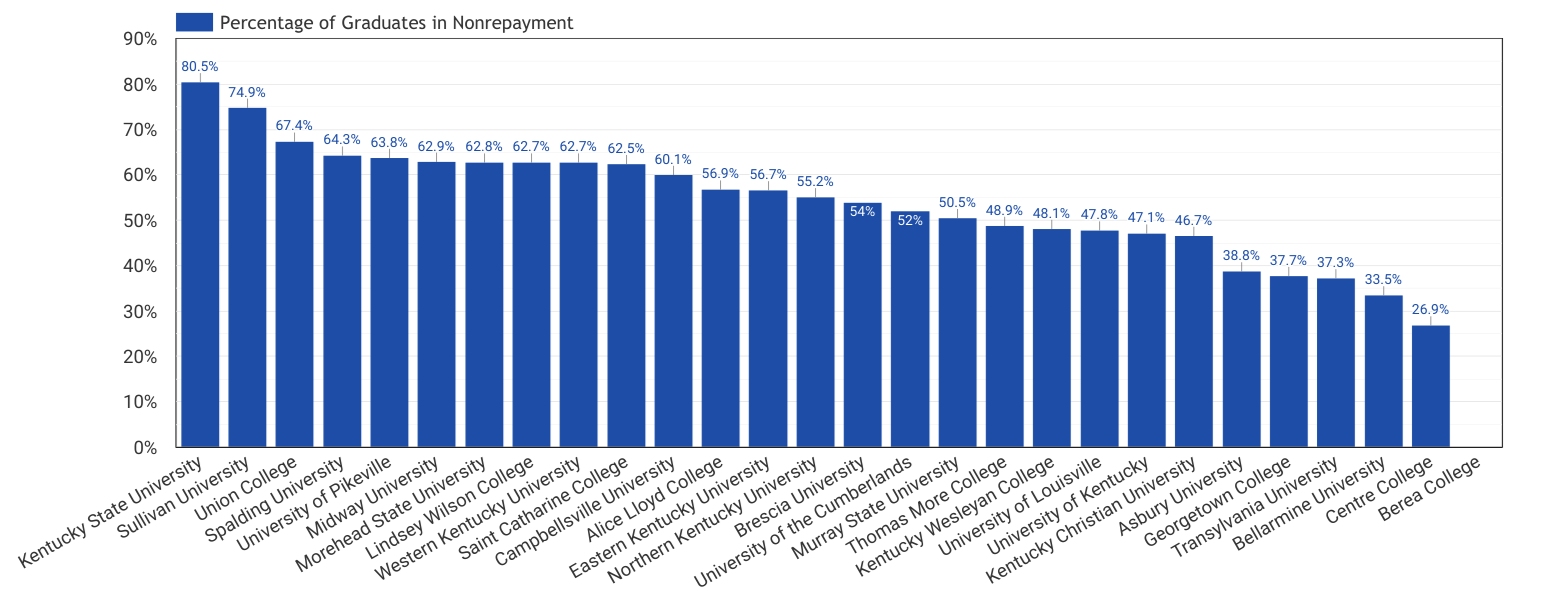
There are some bright spots for low-income students, however. Transy has one of the lowest non-repayment rates on their student loans for Pell Grant recipients from Kentucky colleges and universities. This suggests that low-income Transy students are well-positioned to pay off their educational debts after they leave college.










Column: Stress, Student Life, and Backpacks
I felt animosity growing within me every time I put the key in the ignition or hopped on my bike to begin my short commute home. My anger would simmer until I would leave my house the next morning, heading back to school. Wash, rinse, repeat.
I was being weighed down by my obsession for complete and utter independence. The closest I could get to the independence I had felt when I was abroad was every time I set foot on campus.
Subsequently, everything that related to campus was liberating, from the people to the classes, the social life, the work, and even the food. People, activities, and things I used to take interest in outside of this environment had lost their value for me. The sole thing that mattered was academic “success.” The one thing I began to carry with me at all times as an incessant subconscious reminder of this was my backpack.
As a commuter, being able to efficiently transport everything I need in a sac on my back is extremely convenient. I carry my backpack to friends’ rooms on campus-even when I do not intend on doing work-simply to present the illusion that I haven’t stopped thinking about school. My friends are very academically driven, so I feel like I need to be just as academically driven, even if it’s an illusion at times.
Spending time socializing and relaxing in my friends’ rooms, however, meant avoiding returning home, where the possibility of running into my parents and engaging in cordial, monotonous, and tedious conversation depressed me.
This is something I have been trying to grapple with for months, and even more so in counseling after having been diagnosed with moderate depression and anxiety. I know I am not alone in this, and until the beginning of last semester, I had never realized how prevalent mental health issues are, especially on college campuses, as well as in the younger generation as a whole. This is why there are many services out there, such as Honey Lake Clinic and more, that are aiming to look after young adults and teens suffering from mental health conditions, so they are able to live happy and fulfilled lives for the future. I presume that my ignorance prevented me from being perceptive to this subject the way I am now.
Throughout this, my backpack had become a symbol of my constant stress.
Cheris Kramarae, author of The Third Shift: Women Learning Online, developed the term “third shift” to build on what sociologist Arlie Russell Hochschild’s coined as the “second shift.” The “second shift” describes women who work and take care of domestic tasks. This indicates the duality of their roles and the toll, mentally; physically; and emotionally, that is taken on them. So, the “third shift” is extended to women who work, take care of domestic duties, and attend school. As this theory suggests, education and it’s time consumptive nature takes on a whole new meaning.
So the presence of my backpack permeates each environment that I transition into throughout the day. When I am at school, I am a student. When I leave school to go to work, I am an employee working on homework. When I leave work to go home, I am an overwhelmed daughter overly preoccupied with being a student. What a vicious cycle.
The constant in every environment is my backpack. At work, homework, responding to school emails, and scheduling myself for events that I don’t necessarily have room for dominates any other priorities. At home, I have gone so far as to schedule a conversation with my dad on a Sunday and a dinner party my parents were throwing in my Google Calendar, regardless of the fact that I would be home. These interactions became nothing but a carefully selected colored slot with a 10 minute notification attached.
My best friend’s 21st birthday dinner was almost tainted by my overbearing teal sac; I contemplated bringing it along, as I would be joining her after work and didn’t have a place to keep it other than at work, a totally viable and convenient option. Psychologically, I felt that if I had dared to bring my backpack to a sit-down restaurant, I would have ruined the aesthetic because my priorities would have clearly been elsewhere.
This subliminal compulsion with school work and the onset of stress when I am disconnected from it is visible even while I am at school. When I’m doing homework, I find it hard to separate myself from my phone. Consciously, I tell myself that in the event of an emergency I should be attentive to someone notifying me. But on some level, I know that I’m actually on my phone to send contorted facial snapchats of myself to friends as a means of connecting since I can’t always find time for them.
Now that I’ve unpacked the immaterial contents of my backpack, I will conclude by saying this: these realizations have only made me more capable of dealing with the stress of being a student because it can be extremely stressful at times. I remember some of my friends using color changing pipes to smoke their marijuana before finals when the stress really set in. They always found that method to be beneficial, especially before exam season. Whilst it wasn’t for me, some students might find that method works for them. However you cope with stress, it’s important to keep doing it at college. It will be stressful, but it will also be one of the best experiences of your life. Thankfully, I am now able to better understand, as I hope other students do as well, that school is just that: school. Yes, it’s been our entire lives up until now, but this time spent on this campus is unique to each of us; the positive and the negative are just symptoms of our individual experiences.
So, instead of allowing the steadily increased weight of my backpack to physically weigh me down, I am able to take it off my shoulders and more importantly off my mind and think about whatever I want.