Jenna Soderling’s senior recital ended not with music but with a standing ovation. The music technology major presented a repertoire of humorous, introspective, and social commentary pieces. After she took her last bow, I heard someone down the row whisper, “That’s our Jenna.”
She played piano for her opening piece, “Confidence Following the Decision to No Longer Give a Frick.” There were no vocals, but if music alone can give no fricks, this composition accomplished it.
Soderling made sure to thank everyone who featured on or helped to produce her songs. Megan Schandel was a reoccurring presence on that list, with a hand in “Late,” “Parade”, and “Spray Paint.”
Soderling is not only a gifted musician but a talented vocalist as well. She and Destinee Smith performed “Streetlights” by Daniel Caesar beautifully. “Late,” “Tree,” “Parade,” and “Circus” showcased her breathy, emotionally laden voice.
When I noticed “All Are Welcome” on the program, I did a double take. The last rendition of that song I witnessed was back in my uniformed, Catholic school days. It turned out that the piece was done in Kurt Gohde’s Video and Design class, and featured the song as “spoken” by Donald Trump over images of refugees. It was full of irony and a distancing patriotism.
“2 Triggerz” was another video project, but that is its only similarity to “All Are Welcome.” In it, Soderling describes her two pet peeves: Bigfoot skeptics and people who accuse her of punching her best friend. She wears a durag and raps about these small traumas.
Jenna Soderling definitely went out with a bang. “Thank you all for coming,” she said. “I’m a fan of me, too.”
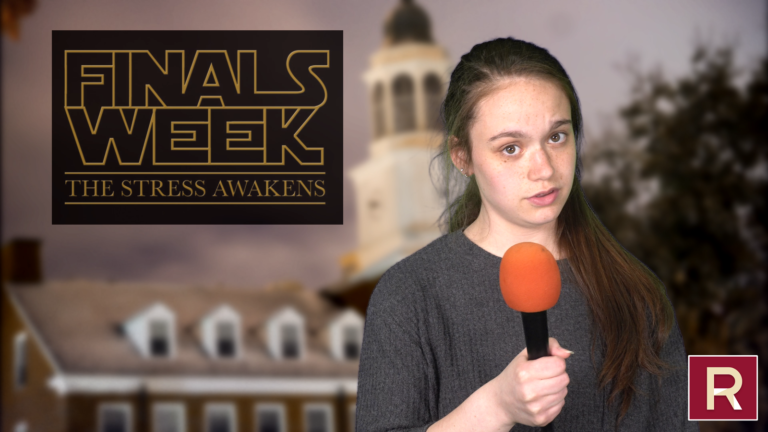
In 2016, the National College Health Assessment (NCHA) was administered on Transylvania’s campus, and its results showed that 36 percent of the campus believed that stress affected their academic performances. Last semester, I was given the chance to talk to Ashley Hill, Director of Student Wellbeing, about how Transylvania students can cope with stress.
“Stress isn’t necessarily a bad thing,” Hill emphasized at the beginning of our interview. “There is a medium level of stress, which is totally fine because it keeps you motivated.”
When these stress levels rise, Hill said that it can cause distress and anxiousness among students, especially during finals week. Hill’s first suggestion is that students plan and prioritize what needs to get done before the semester is over. This can include making to-do lists for yourself.
Staying organized is another important skill that will help during finals week. A few suggestions Hill gave were keeping all of your class notes together or purchasing a different notebook for every class. Knowing where everything is for a class makes studying a lot less stressful.
“Time management includes realizing that you can’t do everything in one night,” Hill told me. “Sometimes, you’re just going to have to take the grade hit for that.”
Hill made it clear that no student should ever have to sacrifice their grade for the sake of stress, so she suggests asking your professors for help. If you have multiple projects due on the same day, Hill suggests that you communicate with your professors about the situation.
“One thing I always encourage people to do is a mental check-in halfway through the semester,” Hill suggested if there are particular classes that are stressing you out. She also suggests that students take into account the withdrawal dates for classes if they find that one class is causing a lot of stress on them. If the date has passed, you can always apply for a late withdraw with your professor.
“Students also have the opportunity to talk to their faculty about incompletes,” Hill said, which are requests to finish assignments over a break. This can typically be used if there are intervening events going on at the same time and a student is unable to finish their assignment.
Especially during finals week, where you decide to study can be very important. Hill told me that a student should match their studying environment to their studying habits and recognize what distracts them.
Rewarding yourself is just as important, and Hill views rewards as time that a student can take to make themselves happy.
“It doesn’t mean that you’re not taking studying or finals seriously,” Hill told me. “It means that you’re giving yourself the opportunity to come back to something you really care about more refreshed than you were before.”
Lastly, Hill suggested that students use the resources offered on campus, such as the ACE and Writing centers located in the basement of the library. The math and science departments are also offering tutoring hours in room 007 of the library from 7-9 p.m. Sundays through Thursdays.
Welcome to Lit Review, where columnist Dominiq Wilson will take apart a series of chapbooks to figure out what works and what doesn’t for the modern reader of poetry.
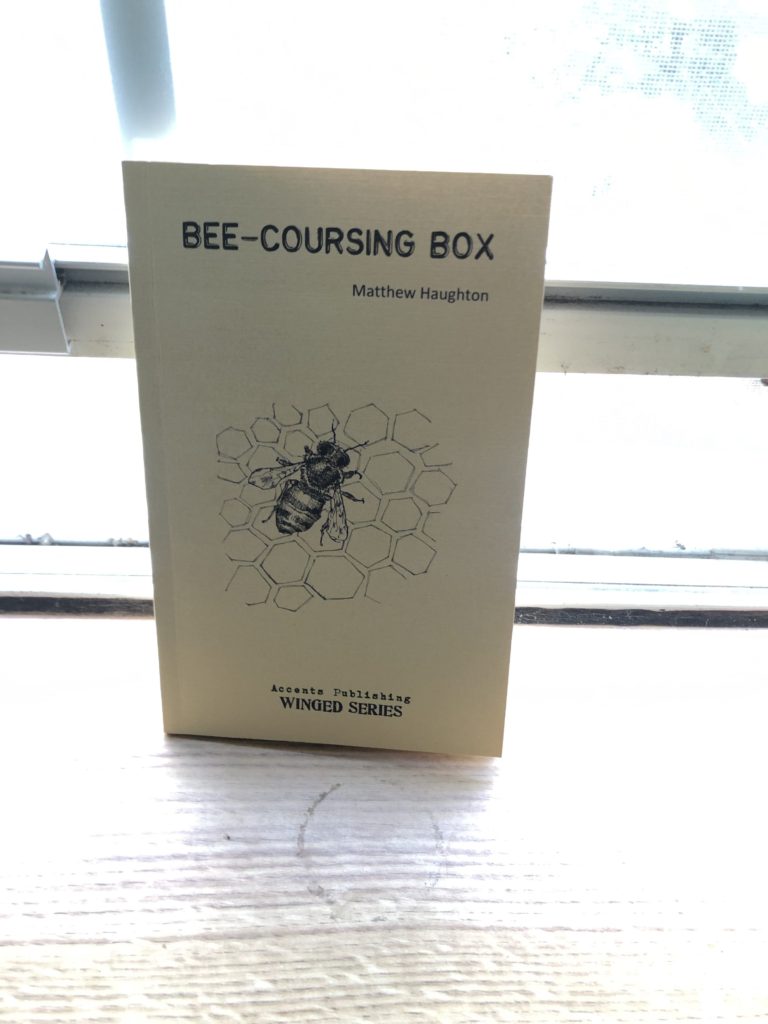
Bee-Coursing Box is Matthew Haughton’s debut poetry collection, published into Accents Publishing’s Winged Series. He currently lives in Lexington, as an artist and educator, but has lived in Colorado and eastern Kentucky, which I like to think influenced the poems in this collection.
Before the poems begin, Haughton provides instructions on how to create a bee-coursing box, which I thought was really cool! It turns out that the contraption covers bees in flour so it’s easier to see the bees while they fly, which is one of the many ways to find out where a bee’s hive is. When I first read it, it seemed a bit morbid to follow a bee to its hive and take the honey from it, but the first poem in the collection that mentions bee-coursing boxes created a different scene for me. If you would like, read the poem below:
Inside I find the shell of a honeybee,
down at the bottom of the box.
He’s thin as my fingernail,
buried in a cup’s worth of flour.
I closed my eyes and imagine
the spell lifts—
so this honeybee
can rise
like Snow White
From her apple-bitten sleep.
I follow him, coursing on the back
of his tiny wings
until he finds a hive up in a tree.
I mark the tree and return
year after year;
we grow old
together,
deep into his second life.
But there’s no magic;
his husk says
just as I found it,
the last taste of honey
becomes something
like a song
or memory
for his shapeless mouth.
The rest of the poems in the collection are obviously heavily influenced by nature, and for the most part, the life within it. The majority of the poems mention animals in some way, shape, or form, but the first few that dealt with plants included “Deer Tongue: A Conversation about Tobacco” and “Tracking Seeds,” a three-part poem in the collection.
“Deer Tongue” caught my eye in a strange way, considering I have strong negative feelings about tobacco, but I noted why it was so interesting: it describes the lighting of a cigarette in such an interesting way that I reread it a few times. I also found the mentioning of a deer tongue almost as foreshadowing to what tobacco can do to your body, but that could come from my negative bias.
“Tracking Seeds” piqued my interest in the same way that it describes a process. All three poems take a position within the cycle of a seed, from its first dismantle from a wilting plant, it’s travel through the air, and where it lands. These process perspectives are ones that I never thought about, and I find them to be very interesting.
One of the few poems that I really loved is “The Lover’s Knot,” which is a narration on a hiker finding two dead snakes that were knotted together. I relate to the narrator in the way that he seems to feel bad for these snakes and how he wishes them the best life in the afterlife. I strongly encourage you to read below.
Out walking, I found
two dead snakes
tied in a lover’s knot.
Slumped in the grass,
their skins shone
like beaded copper
while flies traveled
up their lengths.
I looked at the male,
tethered to his mate.
She lay beside him,
mouth gorged open.
I left them behind,
worried all lovers
could end this way —
in the open, without
keep or tending.
In the living wake of
things, I pray there’s
a heaven for snakes.
Their bodies coiling
round one another
in the high, cool grass.
Aside from the narrator in this poem, there isn’t much human interaction or domination with or over nature, but there is a separate series of poems at the end of the collection under the title of “Preacher Road.” This series of six poems are dedicated to the poet, minister, and activist Don West, and they tell of the road trip going down Preacher Road (or at least that’s what I assume). It starts out pretty well, and it gets increasingly eerie and strange. I won’t give away the ending, but I liked the series a lot and the ending even more.
I hope that some of you reach out to read this book! I was able to borrow the book from Professor Manning, but just like Plein Jeu, you can purchase this book on Accents Publishing’s website for $5. They are limited, so please email them to check on the book’s availability.
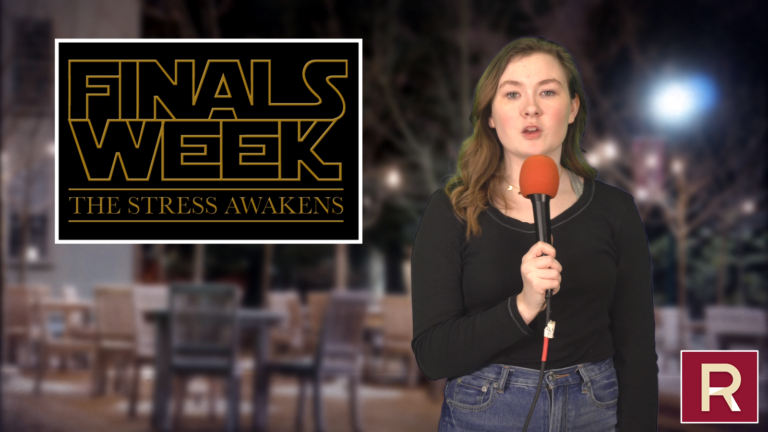
It’s officially Finals Week, which means classes are over for Winter Term!! Send me some suggestions to tmahlinger20@transy.edu for what you think the first playlist of May Term should include! We have some fun videos for this playlist, so enjoy!
The Jonas Brothers are back with ANOTHER catchy, fun song and a music video to go along with it. The music video for “Cool” is an overall entertaining video to watch with lots of people dancing around in bright colors to the beat of the band’s new tune….just be sure to watch it on 1.25 speed compared to its regular speed on YouTube, you can thank me later. There have been rumors that the brother band might change their name simply to “Jonas”, but are their fans ready to choose just one Jonas and drop the “brothers”? You tell me.
Ciara has a new single and a fun music video to go along with it. She announced her upcoming album “Beauty Marks” that’s set to be released May 10. Both the song and video are a fresh addition to the new music we’ve been hearing lately. The video follows Ciara as she gets ready for what could be a date as she sings the catchy lyrics to “Thinkin Bout You” and dances around in her underwear. This video is definitely worth the watch for some fun weekend vibes!
Ariana Grande has been on a music-making binge recently with no plans of stopping any time soon. Her newest hit called “Monopoly” ft. Victoria Monét dropped April 1 with the music video and came as a surprise to many of her fans, thinking it was some kind of April Fool’s joke. Monét is responsible for co-writing six of the tracks on Grande’s “Thank U, Next” album that debuted earlier this year. The two collaborated again for this upbeat pop single that has caused fans to speculate Grande’s sexuality because of the song’s lyrics. Grande came out with a statement on Twitter saying, “i haven’t before and still don’t feel the need to now,” and followed with, “which is OK.”
Stay chill,
Taylor
Monday, April 15th-Friday, April 19th @Campus-wide
This video features Social Media and Business Editor Alex Petrocelli, Managing Editor Taylor Mahlinger, and Host of “The After Party” podcast Collin Ruegg on their journey to Keeneland on Scholarship Day. This video features the college scholarship day set-up with tents full of free food and free merchandise.
You will follow the crew through the paddock, be able to see the horses approach the starting gate, and the home stretch, which is the final stretch of the race. Collin and Taylor also share why they love Keeneland what they love most about Keeneland!
Be sure to check out the “Here’s how to understand betting on horse races at Keeneland,” where Alex Petrocelli and senior writer William Easley give a thorough review of how to read a racing program and make informed bets!
Welcome to Lit Review, where columnist Dominiq Wilson will take apart a series of chapbooks to figure out what works and what doesn’t for the modern reader of poetry.
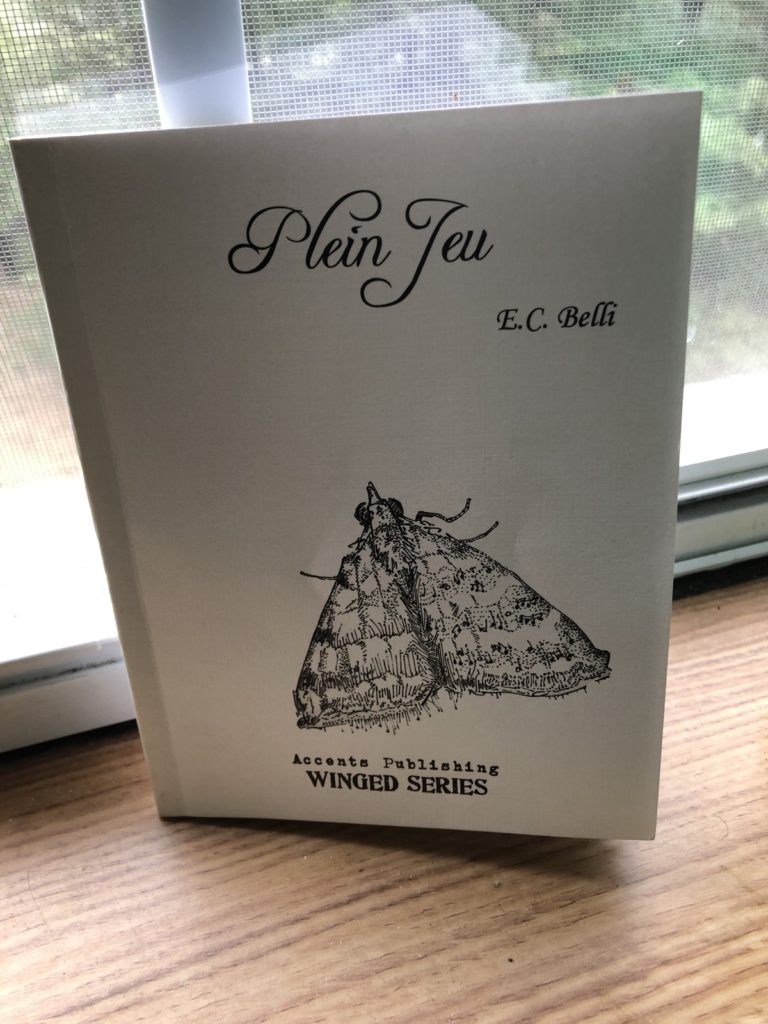
Plein Jeu by E.C. Belli is a chapbook within Accents Publishing’s Winged Series. This chapbook won a poetry chapbook contest, where authors submitted poetry manuscripts with the hopes of winning a prize of $300 dollars in addition to 30 copies of their perfectly bound chapbooks. As a result of winning the contest, the chapbook was published. The second book of this series will be reviewed in the following week.
The very first poem of this chapbook tells the story of a mother narrator. Don’t be fooled like I was: the mother isn’t a parental figure, but a person who participates in the activity of “mothing.” “Mothing” is defined as the act of watching moths. To get a better idea of “mothing,” here is “Self Portrait as Mother.”
*mother, n. [/mɑθər/] — To watch butterflies or moths is an activity known as
“butterflying” or “mothing.” A “mother” is someone who engages in this pursuit.
It is the mimicry, the cryptic eyespots that say the owl feeds on the owl
moth. It is how, in our observation, we find
someone will consume us too
and pull, by day, the dust off our backs, and swallow
by dusk the tiny scales that make up the dust. In the sink
the noctuid creature, hairy, still on ceramic,
uncurls its straw-tongue, as if to feed.
It is to be sought after. Not found.
It is to always sleep with wings open.
Poems in this collection that seem to carry these themes include “Transverse Orientation” and “Asphodel City.”
In this collection, there are quite a few poems that take up two pages, but there is only one that covers three pages: “Cantique.” The note under the title says that it’s named after French composer Gabriel Fauré’s “Cantique de Jean Racine,” which is a classically composed song that seems to mimic a hymn. Fauré wrote it when he was nineteen for a composition competition and won first place.
“Cantique,” in addition to being named after a beautiful piece of music, is also the first of a two-part story. In the story, a teenage narrator is telling about playing a piano in a church that she doesn’t attend on a regular basis. She seems to be semi-enjoying herself; however, in “Prelude VI,” which follows the same narrator later in her life, she doesn’t seem to enjoy the piano as much as she did when she was younger. The poem suggests that the pianist, now older and with many more years of performative piano playing up her sleeve, no longer finds pleasure in the instrument. She rejects the piano like she would reject a significant other. With an extended amount of emotional stress, the decision is made.
Like the last chapbook, there was a time that the poems in this book reminded me of previous poetry I’ve read this year. A poem from “Plein Jeu,” “After Our Wedding,” is arranged in couplets like many of the poems in L. A. Johnson’s Little Climates.
“After Our Wedding” follows a similar structure to Johnson’s poetry in the way that the use of couplets provides the writer with the freedom to pair the last of the good with the beginning of the bad in the same sentence. The poem isn’t structured to where the good and bad clash in the middle of the poem, but the last two stanzas seem to be the turn of events, leaving the good to be cataloged while the bad can only be imagined. I encourage you to read it below:
We woke to the sky,
to digestive sounds.
To little buds baking
Like premature births.
We woke during the hour
everything appears
so somber
even the trees,
their uneven cloaks,
radiate light.
It was a day
of blinking rain
and evanescent sun
we woke up to
and complained about
twice, the second time
as your feet sank
into the Styx.
Being a huge fan of Greek mythology, as many readers of the “Percy Jackson” series may have been at some point, I was aware that going into the River Styx makes you invulnerable except for one spot. If stabbed in this specific spot, you would die. How this applies to a married couple is beyond me, but something tells me that it isn’t a good thing.
Before I finish this review, I wanted to give “Night Bloom” an honorable mention. It doesn’t seem to connect with any other poems, nor does it remind me of any other poems I’ve read, but the theme of it seemed to capture the equally supernatural and fantastical experience of listening to music at night. I’m a night owl myself, and I often use music to help me sleep, but it also has a chance to help my imagination wander. That isn’t too great when I want to go to sleep, but it is a really fun experience to replace sleep with.
Once again, I’d like to thank Professor Manning for letting me borrow this book, among many more that are currently sitting on my desk. If you’d like to purchase this book, it’s $5 on Accents Publishing’s website and is currently limited, so please reach out to them via email before buying.
In this podcast, The Rambler Social Media and Business Editor Alex Petrocelli answers questions from Sports Editor Aaron Bell about what the overall feel towards Kentucky Basketball is on Transylvania’s Campus. With UK and Transy as next door neighbors, it seems like our school would have a favorable view of UK, but there are some conflicting factors to consider, such as school size and overall dynamic of the university. Here, Aaron and Alex get to the bottom of what UK basketball means to Transylvania University.
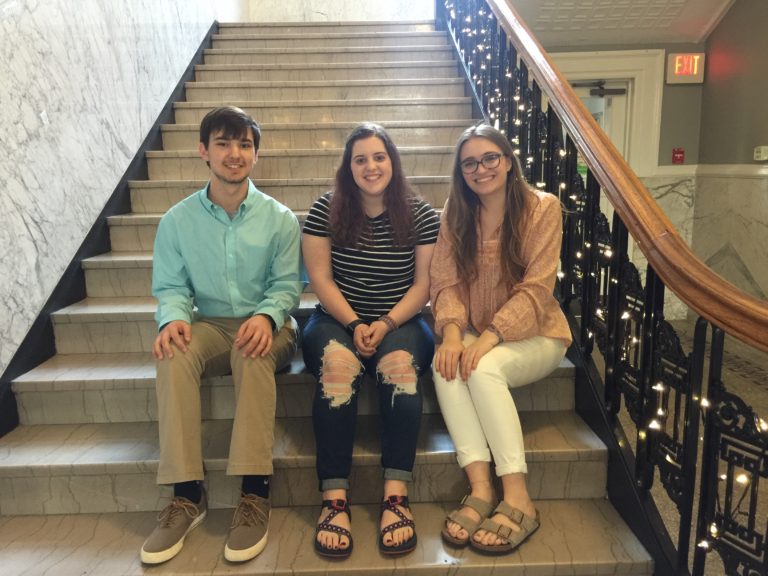
Transy students Ryan Wood, Pamela Howarah, and myself were among some of the guests invited to attend the volunteer appreciation dinner on Wednesday evening at The Carnegie Center. Mayor of Lexington, Linda Gorton was also in attendance. Both Wood, who is a first year, and Howarah, who is a sophomore, along with myself are weekly tutors at The Carnegie Center, and specialize in either math, reading, or both.
The dinner is an annual event that honors the many volunteers serving The Carnegie Center. There was also a ceremony that honored attendees who had served in specific roles with The Carnegie Center, such as ESL (English as a Second Language) outreach programs that have impacted the community in a positive way.
The volunteers were served a dinner that was provided Pasta Garage Italian Cafe here in Lexington that included salad, bread sticks, pasta, and a delicious assortment of cheesecakes.
The Carnegie Center’s Children’s Outreach & Volunteer Coordinator, Erica Cook, announced that it wouldn’t be a Carnegie event if there weren’t hidden surprises. She told everyone to check underneath their chairs for a possible surprise, as not every chair had something taped underneath. I did so, and pulled out a gift card that can be used at Zim’s Cafe or Honeywood among other Lexington restaurants, while another person sitting at my table discovered a Third Street Stuff gift card hiding under their seat. The evening was a fun way to celebrate all of the hard work that is accomplished daily by the many volunteers at The Carnegie Center and their community programs.