Tuesday, December 2, 2025
Home Blog Page 41

Gallery Review: Four Exhibitions at the Lexington Art League

The Lexington Art League’s current solo exhibitions are Return From Exile by Clay Wainscott, First World Allegory by Benjamin Salley, and The God Burden by Susan Deaton.

The Art Leage also currently has a group exhibition, Aurora, which is curated by Samantha Simpson and includes works by Natalie Baxter, Adrienne Dixon, Lori Larusso, Joe Pushel, T. Michael Martin, and John Harlan Norris.

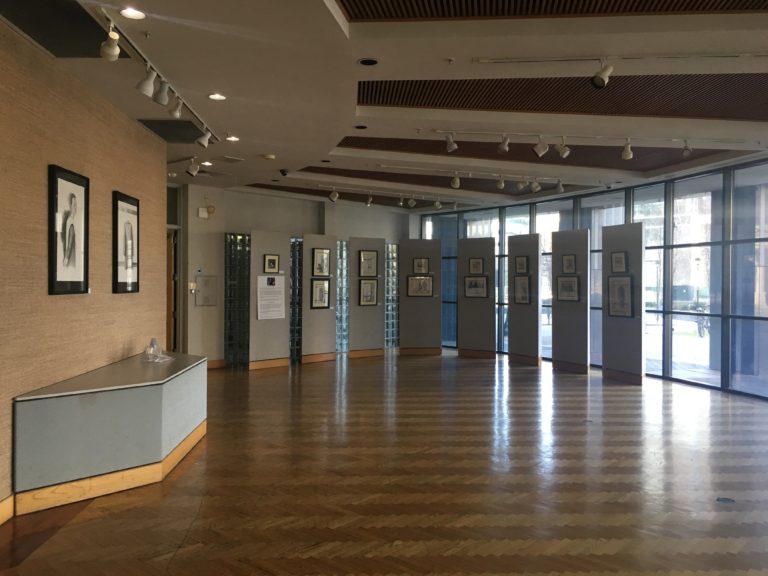
I visited Loudoun House, a Gothic revival villa, on a chilly, golden, January evening. There were no other gallery-goers, so the creak of the floorboards under my feet was especially pronounced. Inadvertent or not, this is an excellent way of tracking the movements of visitors as they appreciate the art.

My path began with Clay Wainscott. His paintings glow from within as if neon is mixed into the acrylic. His piece Wet Country Road captures the dull dreariness of a cloudy drive down a slick back road while simultaneously charging the scene with energy.

Wainscott’s stylistic evolution is clear throughout the exhibit. I started with his Self Sans Hands, an acrylic painting done in 1991. His newer pieces are brighter and glossier; they are much less textured than his self-portrait, which has a smeared effect. It seems he has returned from exile with a vengeance.


“Child Support” by Benjamin Salley. Photo by Grace Morrison

Benjamin Salley’s Volunteer depicts a mascara-smudged, fur-coat-wearing, toy-dog-clutching woman. Her shirt reads “I VOLUNTEER”, a sentiment echoed by the crown of thorns that digs into her dye job. In this painting, Salley is making a satirical jab at the sect of individuals whose mission it is to fix our woebegone and broken world as ostentatiously as possible with a self-victimizing air.

Contradiction also exists in Salley’s Child Support, an oil painting done on panel. Featured is a smiling woman with a crying girl riding piggyback behind her. Even the woman’s shirt is a smiley face, though its eyes and mouth are dripping with black ink, mirroring the child’s tears. It seems that despite appearances, the child isn’t receiving the support she needs.


Warehouse, by Susan Deaton, is a ballpoint pen piece that shows a raven gliding over a sea of mask-like faces. In her artist statement, Deaton discusses her Catholic upbringing, which she has abandoned, and the problems she now has with Christians who twist God’s words to hurt others. The raven could be death, choosing who to select next from the sea. Everyone’s eyes are closed to the suffering of the world.


Aurora invokes color to “affect one’s mood and alter perceptions.” An example of this is Lori Larusso’s Conciliatory Cake Slice, which depicts a chunk of store-bought cake in an open plastic container, left sitting out on a vast green surface. It feels forgotten.

“Conciliatory Cake Slice” by Lori Larusso. Photo by Grace Morrison

Speaking of forgetfulness, Joe Paushel’s Wearing All That We Had has certainly never misremembered anything. It is a ceramic head with a towering brain or brain-like headdress. The point seems to: In the end, we only have what’s in our minds.

Each piece in the exhibitions is steeped in allegory, color, or political commentary. There is something for everyone, so bring a friend and make your way over to Loudoun House. They are open every day but Monday and don’t close until 8 pm on Fridays. Get out there and look at some art! It’s good for you.

Rambler Weekly Blog & Playlist: February 1st

Hey Y’all!

Happy February! This week might’ve been chilly, but I found some hot beats that will be sure to warm you up. All three of the videos I chose for this week dropped within the last three days and are currently trending on YouTube. Email me some good music video suggestions at tmahlinger20@transy.edu and watch for them in next week’s blog!

Sam Smith has done it again with a beautiful single called “Dancing With A Stranger” featuring former Fifth Harmony member Normani. The single has been out for a couple of weeks with the video debuting not far behind it. The moody music video has already gained over 4 million views in just three days and is currently trending on YouTube. The video captures Smith and Normani as they dance around a light, spacious house with shadows fading in and out of the picture. To say that this song and video are a total mood is an understatement.

Billie Eilish released her new single “bury a friend” the same day the music video dropped. The song is a seriously creepy detour from what her style as an artist was last year, but I’m kinda loving it. Not only does the song have a catchy beat, but the visuals in this video gave me some serious horror movie vibes. The lyrics themselves are haunting too:

“What do you want from me/Why don’t you run from me?
What are you wondering/What do you know?
Why aren’t you scared of me/Why do you care for me?
When we all fall asleep/where do we go?”

The music video had already climbed to #19 on YouTube’s trending music list and the single has accumulated over 6 million streams on Spotify alone. This music video is definitely worth watching if you’re looking for some dark vibes for the weekend and a captivating song.

Nicki Minaj’s music video dropped 24 hours ago and is currently #4 on YouTube’s trending list with almost 2 million views. “Hard White” is one of the songs off her album Queen which was released last year. The music video has stunning visuals, but it’s almost too much. With that being said, there’s already been a lot of drama and speculation surrounding this video, with some fans saying that it is targeted at Drake specifically. What do you think?

Stay toasty,

Taylor


Arts events are slim this week, but that’s okay because we have lots coming up in the following weeks.

MFA Morlan Gallery

If you haven’t seen it yet, the fabulous Data, Mine exhibit in Mitchell Fine Art’s Morlan Gallery will run through Feb. 19th, so there’s still time! The gallery hours are weekdays from 12pm-5pm.

Thursday, February 7th @3pm, Cowgill 102

Jami Hogan-Gormley will be giving a talk about how arts is useful in her career as creative strategist at Campbell’s Soup.


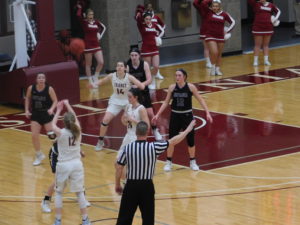
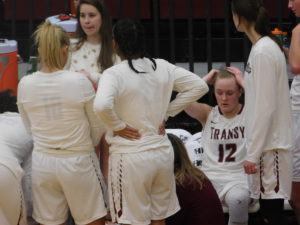
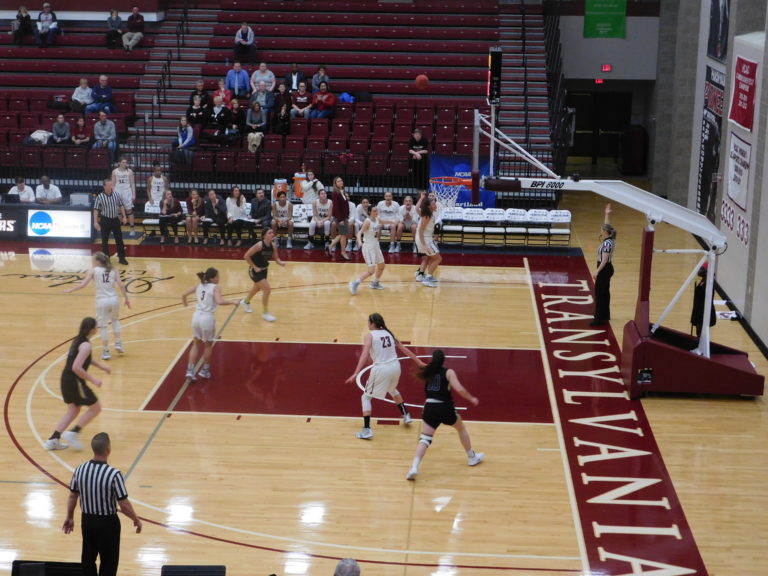
Transy Women’s Hoops cracks D3 Top 25; Fulks Secures 100th Win

Transy Women’s Hoops has been on an absolute tear as of late. The Pioneers are an impressive 17-2 with a 10-1 record against conference opponents. They are currently sitting atop the Heartland conference. In the most recent NCAA poll, they are ranked 25th. This is the first time Transy has been ranked in four years. The Jan. 19 home victory against Bluffton secured Coach Fulks’s 100th win as the head coach of the program.

In the home victory against Bluffton, it was junior forward Shelby Boyle leading the charge with a 25 point performance, her best scoring output of the season thus far. She also led the team with six assists. Her teammate, Miranda Otero, did a fantastic job controlling the paint with a game-high of 13 rebounds. Transy came out roaring in the first quarter going up by 12 points and did not back down.

The following Wednesday the Pioneers traveled to southern Indiana to face their bitter rivals, the Hanover Panthers. The Pioneers came out victorious in a tough road environment with a score of 78-70. This game became Ashton Woodard’s turn to step up with a double-double scoring 19 points and collecting 10 rebounds to lead the team in both categories. Boyle had another impressive performance coming one rebound shy of a double-double herself finishing with 16 points and nine rebounds.

On Saturday, the Pioneers took on the Rose-Hulman Engineers at home and put on a defensive stand against the Engineers. The Pioneers earned yet another victory by a score of 61-47. They held the Engineers to just 34% shooting from the field and secured the season sweep of Rose-Hulman following a win against them earlier this season. Guards Celia Kline and Zenoviah Walker both scored 13 points to propel the Pioneer offense to a win.

Our Pioneers are absolutely rolling right now and are currently on a 12-game winning streak. With some great leadership from Coach Fulks and team leaders paired with such a balanced scoring attack, the Pioneers will be a tough opponent for any team they face this season. This team has worked incredibly hard on this history-making season, and the team is just getting started. On Wednesday night at 7:00 pm, Transy Women’s Hoops are looking to extend that streak to 13 at the Beck Center as they take on Earlham.

Transy switches from Coke to Pepsi Contract

0

When students returned to campus at the start of the new semester, they were met with a new partner: PepsiCo.

As of Jan. 1, 2019, Transylvania partnered with the soda giant and began the sale of their products at dining facilities and vending machines across campus. The switch comes after seven years of partnering with Coca-Cola, the major competitor of Pepsi.

Transy partners with hundreds of vendors to provide products for the community. Contracts with vendors are rebid when a customer, Transy for example, listens to a company’s pitch for a specific product. The agreement with Coke lasted seven years, which is a longer contract than most according to University Vice President of Finance and Business, Marc Mathews. Unlike many contracts the school enters, the bidding pool for this particular contract is low: just Pepsi and Coke. Both companies bid on the contract.

According to Mathews, the items factoring into the consideration of bids include:

“1. Service – primarily accessibility, responsiveness and on-time delivery of fountain service (Jazzman’s and the Raf) and vending machines.

2. Coverage – willingness to locate beverage service in many locations to provide hospitality on campus.

3. $$$$$$$$$”

Specific details of the offers from both vendors are confidential, but Mathews affirms “that Pepsi’s offer was the best for the institution” when weighing the three factors.

The bid with Pepsi will last five years but can be canceled during the contract period for poor performance. The contract is able to be renewed for five one-year terms.

After switching to Pepsi products, Transy now offers Rockstar energy drinks, Starbucks coffee, Pepsi, Mountain Dew, Dr. Pepper, Aquafina, and others.

Megan Schandel Delivers Dazzling Performance at Senior Recital

Megan Schandel’s senior recital displayed that she is, without a doubt, a young star on the rise. Last Saturday, your correspondent had the pleasure of attending Schandel’s recital and the dexterity displayed by the blossoming artist within the single hour left me dazed and hungry for more. Out of the six pieces she presented, three were created in collaboration with other artists. The performance also included a suite that was composed solely by Schandel.

The program kicked off with Schandel performing one of the many Romantic Era Songs Without Words lyrical piano compositions originally by Felix Mendelssohn. This not only showcased the artist’s proficiency regarding the instrument but also displayed the meticulous level of thought put into the performance.

Growing up, Schandel was attracted to the drama and heightened emotion in the music of the romantic era. By starting her recital with this piece Schandel creates a parallel between the beginning of her performance and the beginning of her career in music.

Here is a performance of Mendelssohn’s piano composition:

The next three songs presented were all collaborations between Schandel and various other artists. The acoustic tracks “Pretend” performed by senior Taylor Mahlinger and “Bubbles” performed by senior Jenna Soderling were produced by Schandel. Both highlighted not only the vocal talent of Mahlinger and Soderling, but also Schandel’s ability as a producer to help translate the artist’s vision for the piece into a final product. (Disclosure: Taylor Mahlinger is also the Managing Editor for The Rambler). 

The second piece presented, “A Dream Within A Dream” let Schandel’s abilities as a producer shine the brightest. A song that displays a psychedelic rock influence, the heavily layered “A Dream Within A Dream” carries melodic harmonies that envelop you in a feeling mimicking that of a waking dream. Created in collaboration with Griffin Cobb, the two have produced a piece that truly shows a mastery of skill in music production.

The “Tarot Suite,” produced and composed solely by Schandel, also shows her proficiency in music production. Produced using the ProTools software and with MIDI instruments, Schandel draws inspiration from tarot cards—specifically, the Prisma Visions deck illustrated originally by James R. Eads.

The suite displays Schandel’s ability to draw inspiration from the world around her and translate that into music. The suite itself could be described as light and whimsical. Occasionally making use of a double harmonic major scale or Romani scales, the suite evokes intrigue and mystery much like her inspiration: tarot cards.

The recital ended with Schandel performing Beethoven’s Piano Sonata No.8 in C minor, Op.13 ii. Allegro Cantabile, which was the first piece that inspired Schandel to take up the piano. The original piece is composed of 3 movements and to this day is one of Beethoven’s most celebrated pieces.

You can see the second movement, which Schandel performed, here as performed by Daniel Barenboim:

The performance was brought full circle as Schandel begins and ends with pieces that planted the seeds of her current musical interests. It was a very poetic notion to end her performance with the song that inspired her to create music in the first place.

With the level of skill displayed in her senior recital, I would not be surprised to hear more of Schandel’s accomplishments in music production in the future.

Further Reading: Why it’s wrong to label students ‘at-risk’

This article is republished from The Conversation under a Creative Commons license. Read the original article. The original article was written by Ivory A. Toldson, Professor of Counseling Psychology, Howard University


Of all the terms used to describe students who don’t perform well in traditional educational settings, few are used as frequently– or as casually – as the term “at-risk.”

The term is regularly used in federal and state education policy discussions, as well as popular news articles and specialty trade journals. It is often applied to large groups of students with little regard for the stigmatizing effect that it can have on students.

As education researcher Gloria Ladson-Billings once said of the term “at-risk,” “We cannot saddle these babies at kindergarten with this label and expect them to proudly wear it for the next 13 years, and think, ‘Well, gee, I don’t know why they aren’t doing good.’”

My most recent encounter with the term “at-risk” came when I was tapped to review and critique a draft report for the Maryland Commission on Innovation and Excellence in Education, also known as the “Kirwan Commission.”

The Kirwan Commission, chaired by William E. Kirwan, a longtime higher education leader, was created in 2016 to make recommendations for improving education in Maryland. The initial draft of the Kirwan Commission report included a working group report called, “More Resources for At-risk Students.”

Fortunately, in this instance, commission members were aware of some common objections to using “at-risk” to categorize students and publicly discussed the limitations of using the term. Some of those objections included risk of social stigma to students and lack of a uniform definition of “at-risk.”

However, when it came to finding a better way to describe students who show lower levels of academic success because of nonacademic factors, such as poverty, trauma and lack of English proficiency, commission members were not sure what term to use.

As an outside consultant for the commission, I was asked to come up with an acceptable alternative word or phrase. As I argue in my forthcoming book, “No BS (Bad Stats): Black People Need People Who Believe in Black People Enough Not to Believe Every Bad Thing They Hear about Black People,” three things are essential to good decision making in education: good data, thoughtful analysis and compassionate understanding. What I have to say about the term “at-risk” will be based on those three things.

Practical uses exist

First, let’s acknowledge that, paired with good data, “at-risk” is practically useful and generally accepted in professional and academic settings. Used effectively, identifying risk and protective factors can help mitigate harm to students.

For example, dating back to the 1960s, research about how exposure to lead placed children at risk for cognitive impairments helped educators create safer learning environments for students by removing lead from paint, toys and drinking water.

Today, in educational research and practice, educators routinely use “at-risk” to classify students who do not perform well in traditional educational settings. However, the factors that determine “at-risk” are often either unknown or beyond the control of the student, caregiver or educational provider.

As a scholar of counseling psychology – and as one who specializes in counseling persons of black African ancestry – I believe that to designate a child “at-risk” for factors such as growing up in a single-parent household, having a history of abuse or neglect, or how much money their families make or their race or ethnicity – adds more chaos and confusion to the situation. Instead, compassion and care are what are needed.

Never use ‘at-risk’ as an adjective

Using “at-risk” as an adjective for students is problematic. It makes “at-risk” a category like honors student, student athlete or college-bound student. “Risk” should describe a condition or situation, not a person. Therefore, “More Resources for At-risk Students” might more appropriately be “More Resources to Reduce Risk Factors for Students.”

Be specific

Assessments of risk should be based on good data and thoughtful analysis – not a catch-all phrase to describe a cluster of ill-defined conditions or characteristics. If the phrase “at-risk” must be used, it should be in a sentence such as: “‘This’ places students at risk for ‘that.’” If the “this” and “that” are not clearly defined, the “at-risk” characterization is useless at best, and harmful at worst. But when these variables are clearly defined, it better enables educators and others to come up with the solutions needed to reduce specific risk factors and improve outcomes.

Skip the alternatives

Common alternatives to “at-risk” include “historically underserved,” “disenfranchised” and “placed at-risk.” These indicators acknowledge that outside forces have either not served the individual student or population well, or have assigned the at-risk label to unwitting subjects.

These phrases move the conversation in the right direction. However, using these phrases still comes up short because they obscure the problem. For example, research suggests that child abuse, poverty and racism can place students at risk. However, different strategies can lessen each risk. When the risk factors are more clearly identified, it puts educators and others in a better position to strategically confront the issues that impede student learning. It also better enables educators and others to view the individual student separately and apart from the particular risk.

Some have suggested replacing the term “at-risk” with “at-promise.” While well-intended, the problem I see with that is it could easily be seen as a condescending euphemism for the term it was meant to replace.

The best alternative for ‘at-risk’

In my book, I describe an in-service training for staff members of a public high school, in which I asked the participants to describe the neighborhoods of their students. I heard phrases like “crime-ridden,” “broken homes” and “drug-infested.” I then asked if anyone grew up in neighborhoods that had similar characteristics. After several raised their hands, I asked, “How did you grow up in such a neighborhood and still become successful?” This question spurred a more meaningful discussion about the neighborhoods where students are from. It was a discussion that considered community assets – such as hope and resilience – against a more thoughtful examination of community challenges.

Every student has a combination of risk and protective factors among their friends, in their homes, schools and neighborhoods. These factors can help or hurt their academic potential. Students who live in poverty, or have been assigned to special education, or have a history of trauma, or who are English learners, may or may not be “at risk” depending on their respective protective factors. But when students are labeled “at-risk,” it serves to treat them as a problem because of their risk factors. Instead, students’ unique experiences and perspectives should be normalized, not marginalized. This reduces a problem known as “stereotype threat,” a phenomenon in which students perform worse academically when they are worried about living up to a negative stereotype about their group.

For all these reasons and more, I believe the best alternative to describe “at-risk students” is simply “students.” For what it’s worth, the Kirwan Commission agrees. The commission recently revised its call for “More Resources for At-risk Students” to “More Resources to Ensure All Students are Successful.”

BSA & SpeakOut partner for open mic on ‘Civil Discourse’

Last Thursday the 25th, the Black Student Alliance and poetry club SpeakOut at Transylvania University co-hosted an open mic night in commemoration of Dr. Martin Luther King, Jr. Day. The event was hosted in the library basement in the Writing Center, and the subject of the night was Civil Discourse, which most of the pieces centered around.

The pieces presented by many of the students, mostly members of the BSA and SpeakOut, but with a good number of others coming out and participating. At the height of the event, around 40 people were engaged in discussion about Civil Discourse and sharing their art.

There were a variety of pieces showcased, the first of which was a series of paintings done by BSA member Jada Commodore. When asked about her contribution, Commodore said “Not many students are able to show their artwork, it was nice to be able to be a student and show my artwork.”

Art by Jada Commodore. Photo by Dylan Anderson

Beyond the visual art pieces, a number of students performed poetry and gave talks to spark dialogue among the group, such as Speak Out member and student Seth Wyatt. Wyatt began his performance with his own poetry and then opened up to the floor about the problems facing the country today which led into a discussion about what is to be done. Wyatt said “The event reflected the title brilliantly and people who actually wanted to make a difference held discourse about how to make that change.”

Overall reception to the event was positive, and when asked if there would be future collaborations between the BSA, Speak Out, and potentially other student groups in the future, Te’asia Martin from Transylvania’s Diversity and Inclusion department said “I would think so! At the leadership conference, we stressed community building with collaboration and the event was amazing,” indicating more events to come.

The next Speak Out Open Mic night will be February 15th, Valentine’s Day, and the theme will be ‘Sex Ed.’ The poetry group encourages everyone to come out and attend or share their art!


You can view other student art in The Rambler’s Student Gallery. 

Photo courtesy of Jada Commodore

Weather

Lexington
moderate rain
31.7 ° F
33.1 °
30.2 °
85 %
1.6mph
100 %
Tue
31 °
Wed
32 °
Thu
31 °
Fri
35 °
Sat
32 °