The poets…[are] the only people that know the truth about us.
—James Baldwin
When society is made of men who have no internal solitude it can no longer be held together by love: and consequently, it is held together by a violent and abusive authority.
—Thomas Merton
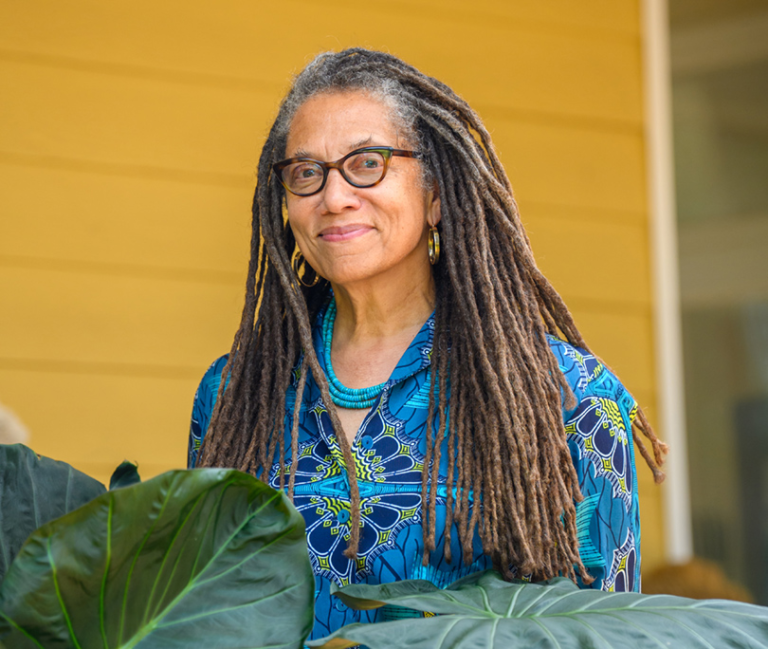
At award-winning poet Nikky Finney’s February lecture in Haggin Auditorium, she read from her 2020 piece on the late Congressman and Civil Rights leader John Lewis. Her essay, published on Literary Hub in 2020, feels even more relevant today.
It begins, “Dear John Robert Lewis, there was a colossal sweetness about you that some mistook for weakness. A sweetness, that seemed to power your actions and your life. …The love that, seems to me, fragments of which might have been found inside some of those books you always kept close in your back pack.”
Lewis was a part of the Nashville sit-ins and the Freedom Rides, and was present for Bloody Sunday in 1965. He served thirteen terms as a representative of Georgia starting in 1987. His “colossal sweetness” contrasted with the violence of those who opposed him. Finney follows his example. She needs his sweetness like a backpack which she can wear constantly.
Nikky Finney, originally from South Carolina, lived in Lexington for nearly three decades, working as a professor at the University of Kentucky. A founding member of the Affrilachian poets and 2011 winner of the National Book Award, Finney’s work explores Southern heritage and Black expression.
While John Lewis informs Finney’s activism, her writing influences include Thomas Merton and James Baldwin. Merton was a Trappist Monk living and writing in Bardstown, Kentucky, for most of his career and a proponent of pacifism; Baldwin was a Civil Rights activist and a prolific writer of both fiction and nonfiction, including Go Tell It On the Mountain.
Finney’s talk, part of the William R. Kenan Jr. lecture series, was titled “Poetry: The Influencer.”
Finney described influence as “indirect, without apparent exertion of force.” Her influences “arrived” and made “soft but intense impressions” on her. To influence, she said, is “to provide some kind of magical space to mingle, to mix, to test, to throw some idea or belief up into the air and then walk into it like a burst of brilliant powder.” We are influenced when we step into something that speaks to the part of us that was always there, but needed someone else’s words to recognize it.
Finney’s influences also make social commentary. The writers and thinkers she cites “have left us an atlas of words.” Though they wrote twenty, fifty, even close to a hundred years ago, they have given us direction that applies today. The “violent and abusive authority” that Merton contemplated—as well as the need for internal solitude—remains.
Perhaps the poets are the only ones who have this internal solitude. They are often able to discern what we might otherwise miss. In that sense, we can say that Finney arrived at Transy to share that truth with us.
Finney ended by reading the 1995 poem “Famous” by Palestinian-American poet Naomi Shihab Nye. I recommend listening to Finney read it via the livestream, beginning at 51:37. Notice where she pauses and how she enunciates each word. Or listen to your voice read the poem. In your head or aloud. Where does it pause and linger? What images does it create?
“Famous”
The river is famous to the fish.
The loud voice is famous to silence,
which knew it would inherit the earth
before anybody said so.
The cat sleeping on the fence is famous to the birds
watching him from the birdhouse.
The tear is famous, briefly, to the cheek.
The idea you carry close to your bosom
is famous to your bosom.
The boot is famous to the earth,
more famous than the dress shoe,
which is famous only to floors.
The bent photograph is famous to the one who carries it
and not at all famous to the one who is pictured.
I want to be famous to shuffling men
who smile while crossing streets,
sticky children in grocery lines,
famous as the one who smiled back.
I want to be famous in the way a pulley is famous,
or a buttonhole, not because it did anything spectacular,
but because it never forgot what it could do.
Finney’s lecture asked the audience who they want to be in the world. What is famous to you? What do you carry in your backpack? If there was a fire, what would you grab as you run out the door? What do you hold in your heart that gives you strength as you run? Either the strength to run faster–or the strength to turn around and save someone else still inside the burning building.
—
The following night was the 35th Anniversary of the Affrilachian Poets. The group was named after Frank X Walker’s poem “Affrilachia,” a term he coined because literary critics and scholars had forgotten African American Appalachians.
After the group’s preamble was read by Transy professor and poet Jeremy Paden, sixteen Affrilachian poets read their work. Poets, apparently, love to quote other poets. They also love to take off their poet hats and tell funny, personal stories about each other in their introductions. Many of the older poets, like Frank X Walker, Finney, and Crystal Wilkinson were mentors or teachers to the younger generation. They are interconnected, a close community who all influence each other. As Paden said, we “learn to read and write from and with others.”
When the poets spoke in verse, their voices became more resonant, more thoughtful. Nearly all of them said: “It’s good to be home.” Finney said it during her talk the night before.
But their poems sometimes seem to say the opposite. When a wasp attacks one honeybee, NitaJade read, all the others come buzzing in.
“Humanity,” Parneshia Jones read, “is traveling…with all our receipts.”
In his poem, Gerald L. Coleman said that right now, some people think “it’s safe to hate in the sunshine.”
Dr. Ricardo Nazario y Colón read that our American soil indicts us, it “drinks truth.”
Frank X Walker read perhaps the most famous piece of the night, his “Why I Don’t Stand.” In this poem, Walker explains that “My Old Kentucky Home” is not as peaceful as the anthem suggests. White Kentuckians were slave owners, and after abolition, the commonwealth was segregated. Even before then, Kentucky land was wrested from the indigenous people who lived here. Our soil drank the truth from which our bluegrass grows. History cannot be undone.
So how is it possible for these poets to say that it’s good to be home? How is it good? Why is it home?
There may be no clear answers to these questions. Perhaps the power of poetry is not that it provides answers, but that it asks questions and records truth. Perhaps the Affrilachian Poets ask us, the world is this way, how can we change it?
Who are we here at Transylvania? In the “26.6” years that she lived in Lexington, Nikky Finney observed a city that lives “the life of the mind.” A life we are especially equipped to live at Transy. The complexity of a liberal arts education allows us to read and respond to the reports these poets have brought us.
By living and writing here, Nikky Finney and the Affrilachian poets have had a profound influence on Lexington. They have created a home for other Affrilachian and minority poets, and pushed a place with a painful history to grapple with that pain and that history. Perhaps in doing so, it has become a place of beauty. So Lexington becomes home. Home is not always synonymous with comfort and familiarity. Home means complexity and struggle, too. Struggling to improve the places we love, and seeing our communities doing the same, is unifying and good.
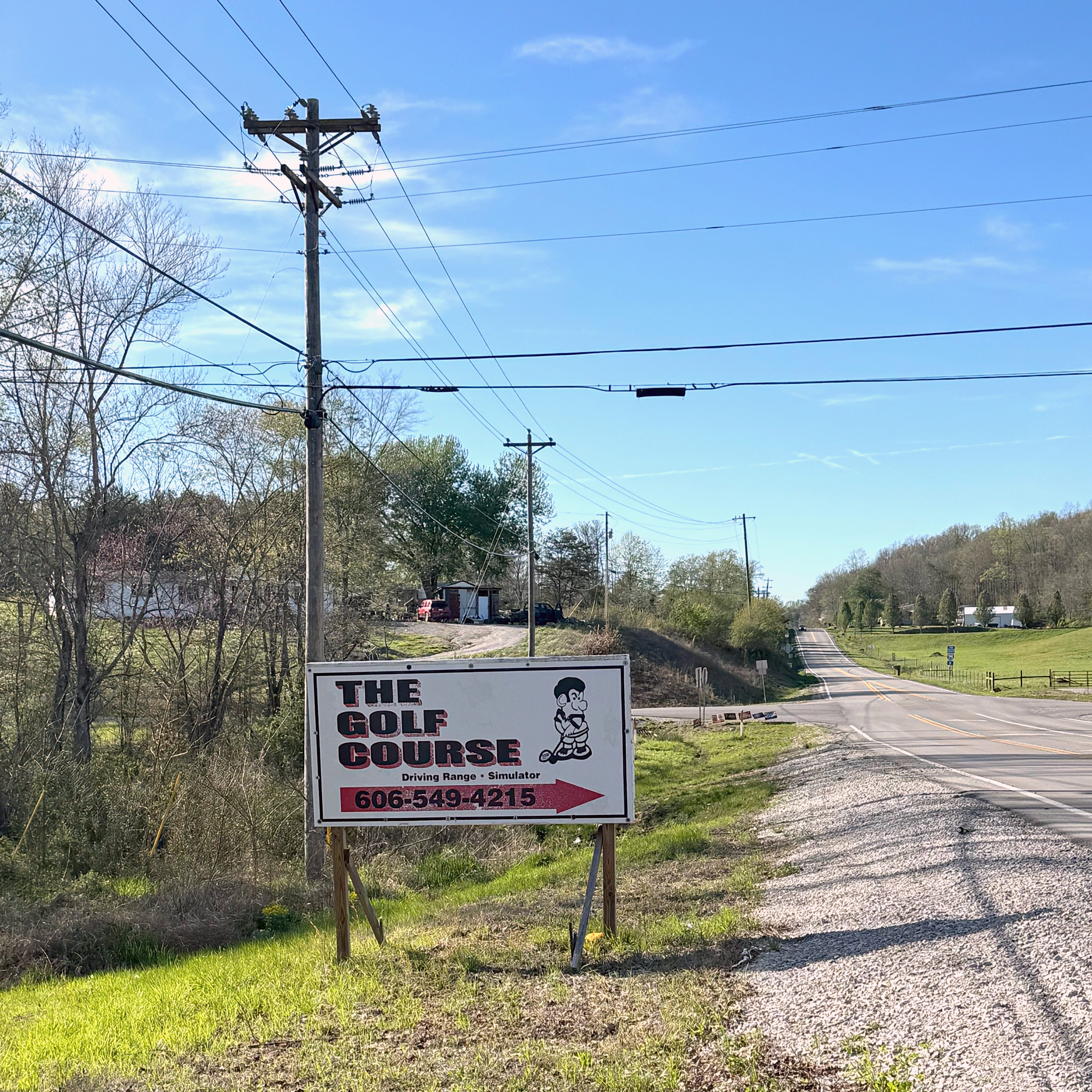
If you ever find yourself cruising down Cumberland Falls Scenic Highway between Williamsburg and Corbin and accidentally pass the turn to see the scenic waterfall, you will drive past a sign that says “THE GOLF COURSE” in big bold text.
Below the large lettering, the sign advertises a driving range and golf simulator. Both are nonexistent. Above the sign is a big red arrow pointing toward Old Airport Road, a paved, wooded path that splits off from the state highway, beckoning any unfamiliar golfer or willing drunk to spend the afternoon on the semi-green links of The Golf Course.
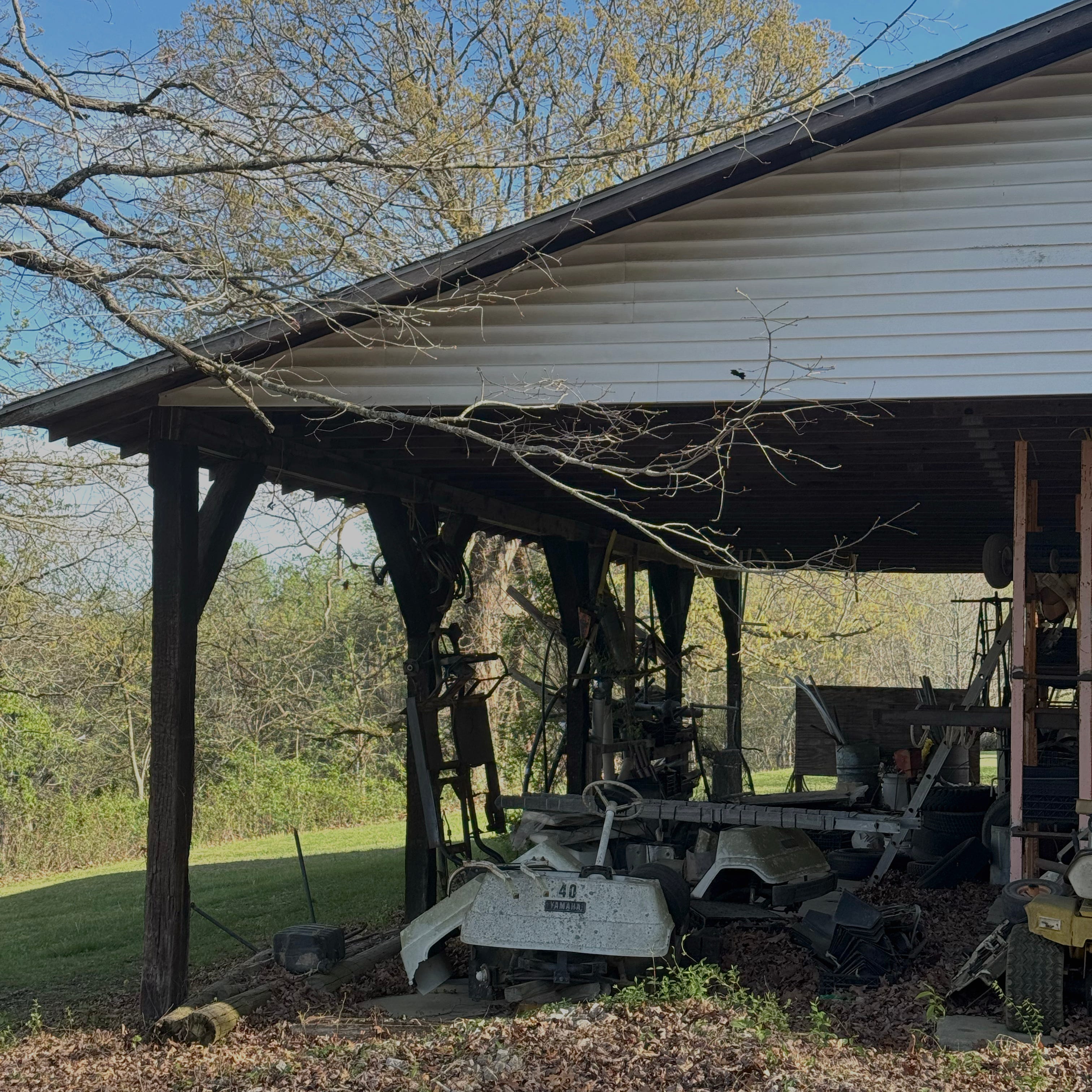
For those who turn at the big red arrow, the drive up Old Airport Road is similar to most Whitley County roads. In the summertime, prime golf weather, both sides of the road are consumed by invasive green kudzu smothering the fences and power lines that trace the road. First-time visitors have no real indication of a golf club, nothing until they pass an open-air pavilion that was converted into a golf-cart cemetery. Instead of a members-only gate, visitors drive through tires and plastic bodies of carts, haphazardly thrown about the place, giving the entrance a first impression more fitting of a backwoods demolition derby.
Pulling into the cracked parking lot, you finally reach the clubhouse. The base of operations for the county’s only golf course is an old brown building with rusty metal fixtures. The outside of the building has an overhanging carport protruding off to the side, resembling an aircraft hangar protecting its fleet of golf carts. Two things become immediately clear after seeing their club cars: 1. They’re all chained together 2. Most are topless. The backstory behind the padlocked carts was an incident that implicated two boys from Bee Creek who tried to steal a few carts for some dope money in the dead of night. The missing roofs? Purely an aesthetic choice. Aside from their convertible capabilities, the golf carts have dual-purpose seats: one part cushion, the other ashtray.
As backwards as this clubhouse sounds, it is still a country club. Next to the hangar is a bleached concrete pool deck. The pool is fitted with a diving board and high dive, one of the only in the county. By all accounts, the pool was cutting-edge summer leisure during the Reagan Administration. However, modern-day guests will find the same pool with a vacant shallow end that slants into a deep end. Accumulating at the bottom is biodiverse, stagnant, lime-green sludge. If you jump off the high dive today and the fall doesn’t kill you, the brain-eating amoebas will.
The pool.
Beneath the carport is a hand-carved wooden sign above the entrance: “Pro Shop.” Upon opening the door, you time-travel into a dimly lit room with plaid home furniture and vintage golf posters ornamenting the walls. To your immediate right is a box TV that has played the movie “Caddy Shack” on a loop for the last 40 years. Across the room is a plaque cementing all Hole-in-Oner’s in The Golf Course’s history. The most notable entry was my high school baseball assistant coach, who said the only thing better than his famous round of golf was his nude beach destination wedding. The list hasn’t been updated in a few years. To keep it relevant, new hot shots write their names on sticky notes and ceremoniously slap them on the board.
The whole operation is run by a 200-year-old woman named Butch-Anne. A tough old bird, she chain-smokes Pall Mall Lights, wears glasses three inches thick, and hates my buddy Ethan (don’t ask). Butch-Anne has owned and operated The Golf Course since 1982. She got the land from a 99-year lease with the county, and I’m willing to bet she’ll be ready to resign in 2081.
I found out Butch-Anne lived in the clubhouse during a conversation with a family friend, who happened to be a member of The Golf Course. It’s not uncommon to find Butch-Anne’s toothpaste and brush in the ladies’ locker room. Over the past five years, I have built a pretty good rapport with her through chit-chat and buying peanut butter crackers from her. Word to the wise, Butch-Anne only takes cash and doesn’t know “what the hell a Venmo is.”
It’s hard not to think back to the good ol’ days at The Golf Course. Back when the pool was full (and blue). I’ve been told by my grandpa that Butch-Anne had one of the best dinner specials in the county: Friday night prime rib and salad. In its heyday, the course was the county’s hot spot. My parents had their third date there. The date lives in Croley family infamy. After the meal, instead of a goodbye kiss, Mom ran over Dad’s foot in the parking lot. By accident, depending on who you ask.
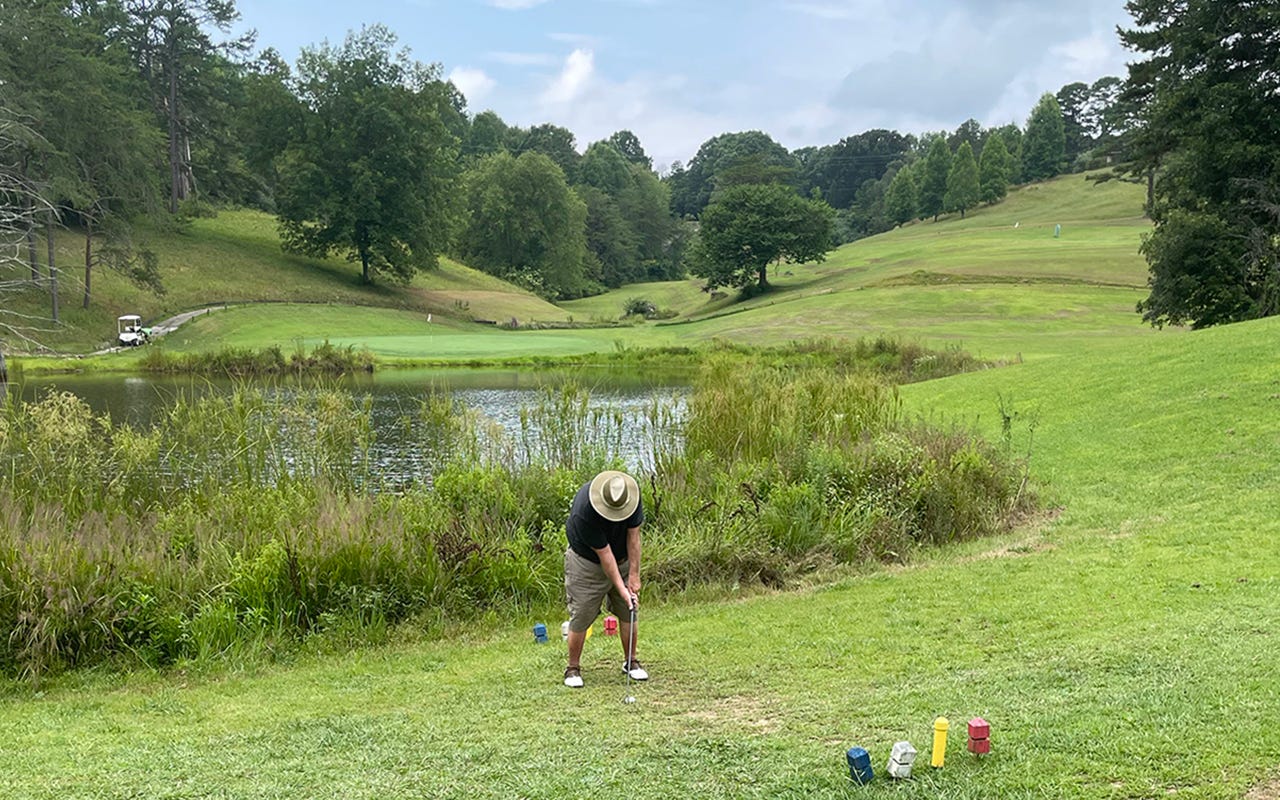
The Golf Course only has nine holes, instead of the usual eighteen. Limited by geography, most courses in Southeastern Kentucky use land that has been leveled by high-wall coal mining. Unlike its contemporaries, The Golf Course was built on top of the foothills of Appalachia, providing a scenic but difficult round of golf. Very seldom is a player on level ground with their lie. Looking onto the fairway, you can see the rolling open links, framed by green giants casting shadows over the earth below them. This attachment to the natural topography of the course offers the golfer a deep appreciation for the land. It also means a lot of balls rolling off in unintended directions.
Any time it rains, before you take a cart out, Butch Anne will say, “Now you boys be careful on the sixth hole.” The hole is a standard par four, with quick greens. The fairway has a 90-degree drop: The elevation between the tee box is greater than the distance from the hole, as the golfer launches a ball into what I can only describe as a holler. In other words, you cannot see much of the fairway in front of you, and do not know who or what might be between you and the flag. This might be a safety issue, so a rusty bell has been placed near the tee box. Any would-be drivers are asked to first ring the bell to alert any unsuspecting golfers down the slope.
The shot itself is made for gamblers. The right drive can easily net the golfer a birdie; a sliced swing and you’re left searching for your ball in a dry creekbed full of copperheads.
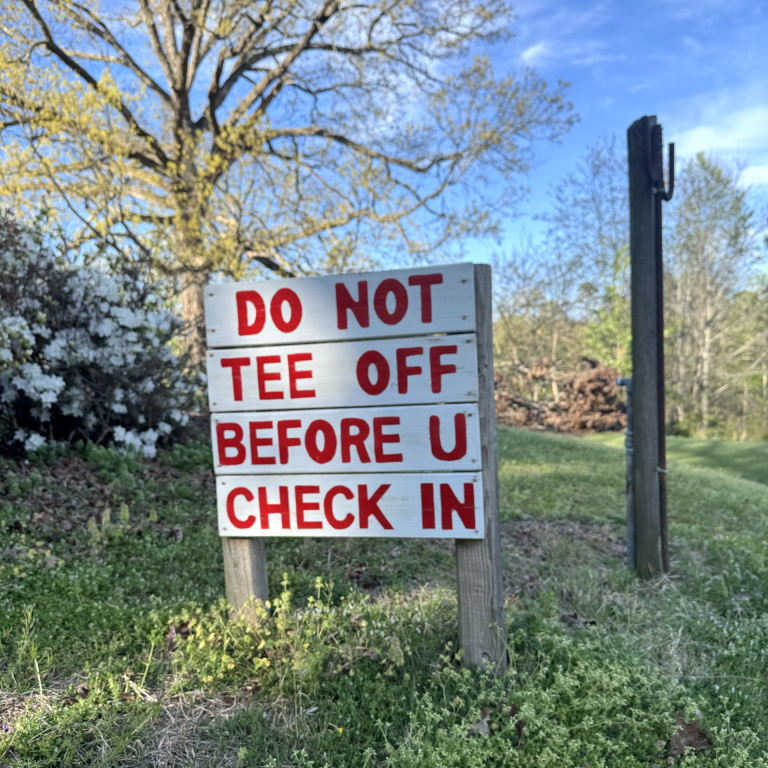
The cart paths at The Golf Course are notoriously bad. Butch-Anne once described them to the Corbin News Journal as “rough as a cob.” The worst conditions, of course, are on the sixth hole. After teeing off, the descent down the green feels more like an old wooden roller coaster than a leisurely cruise. As you creep down the hill in your cart, both sides of the path are marked with signs in bright red ink of increasing urgency: First “EASE DOWN THE HILL,” then “SLOW CART,” and finally “BRAKE.” Typically, that last sign is too late.
The first time I played at The Golf Course, in 2021, I was 16. My introduction was the same as many in my hometown—sneaking in with a few buddies and a couple beers. Sneaking in was not difficult; the Golf Course is not invested in keeping anyone out, whether they’ve paid or not.
The night before we played, I dragged my dad’s dusty golf bag from our basement. He bought them sometime in the ’90s and hadn’t played a round with them since ’05. It was a sticky summer morning when our crew rolled into The Golf Course, and for the next four hours, we wacked, chunked, sliced, and laughed. When we weren’t golfing, my buddies and I took turns racing the vintage club cars around the pond on dusty, rocky, dirt roads—a rutted-out race track surrounded by three-foot weeds. Looking back, I’m thankful Butch-Anne never had to fish one of us out.
Jerrod’s grandfather, Harold.
On the ninth hole, we gambled. The ninth hole is supposed to be the end of the course. We were done, but we didn’t want to be done. “Let’s run it back,” someone said. So we played the ninth hole again, and then another time. Butch-Anne, if she noticed, didn’t seem to mind. We played that hole until we all broke even on our bets. The course was far from perfect, but it was ours.
With my newfound interest in golf, it was time to play with a golfing legend: my grandpa. When I asked him to come to The Golf Course, he gave me a funny look. “I haven’t been there in forty years,” he said. He’s a serious golfer. But he agreed to come join me in the weeds.
On a damp Saturday morning at The Golf Course, my grandpa and I were about to tee off on the seventh hole, standing in perfect view of the hill on the previous fairway, when we saw a golf cart cresting the top of the path. It had been raining all morning, and as it began its descent down the hill, it was obvious that the driver had not heeded Butch-Anne’s warnings.
The cart began to slide, skidding its bald tires on the wet asphalt. The tires locked up, and the lack of traction caused the driver to lose complete control as the cart lifted from the ground and violently settled with a loud crash. Due to our proximity and moral obligation, it was a 17-year-old and a 75-year-old to the rescue.
By the time we made it to the cart, a river of beer, balls, and glass had begun to cascade down the mountain as the drunk driver and his elementary-aged son climbed out of the overturned golf cart. The driver introduced himself as Doug. He was wearing cargo shorts and a camo hat and did not feel a thing. The kid was on the verge of tears and probably shat himself. I don’t blame him, he had three more holes with Doug! After we helped them flip their cart back over, Doug offered his only unshattered Bud Light up, but we declined, and finished the round without hearing any other collisions.
The golf cart graveyard.
You won’t see The Golf Course on any serious golfer’s bucket list. It’s not a stop on big golf trips to places with sunshine and cart girls. It doesn’t have perfectly manicured greens or a strict dress code. There are no sand traps, only craters where the sand traps used to be.
When I told my dad I was writing a story about the course, he reminded me about how strict their policy was: “The only rule is you have to keep your shirt on for the first and last holes.”
Herein lies the beauty of the only golf course in Whitley County. To play, you don’t need a membership, you don’t need high-dollar clubs, you barely need a golf shirt. Hell, the only thing you need is tick spray. But there is something special about it. Over the last 44 years at the Golf Course, Butch-Anne and her loyal patrons have grown the game in the place I call home, Southeastern Kentucky. (It hasn’t always been easy; Butch-Anne told the Corbin News Journal, “I used to think farming was hard work, but that was before I had a golf course.”)
In a sport that has been dominated by the opulent, they created a space that is open to anyone. The Golf Course accepts all. They accept Doug and they accept me.
“Golf is something that you can do with anyone,” Butch-Anne said.
Only in Whitley County. If I could only play one course for the rest of my life, I know what I’m choosing.
It was a dark and snowy night. One of those nights where the air around you feels like freedom and suffocation at the same time. When the point of an icicle catches the light just right, when the fading streetlamps turn the concrete golden. When you’re just drunk enough on joy that even standing in the cold crisp air is exhilarating.
You shuffle through the snow and remember why you fell for this university. This utopia within a cruel city. You love the life of it, its sights and sounds and smells, the unadulterated whimsy, the scholarly necks bowed to the grindstone.
It was one of those nights when you chase small comforts.
Like building a snowman.
—
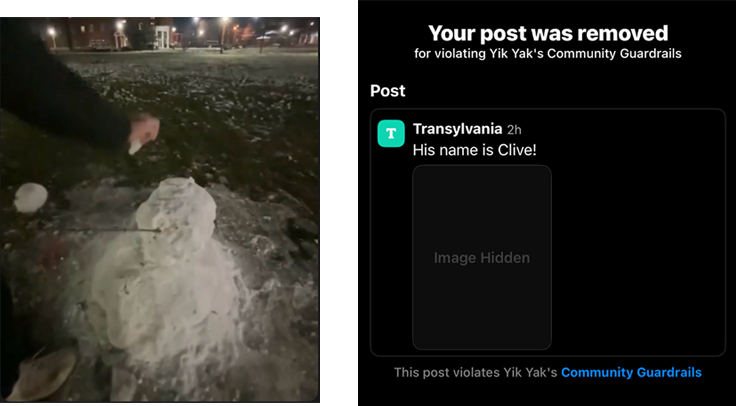
Clive. The case froze me to my core. He was built with love, and then maliciously undone.
A knock on the door. It came late in the evening. A distraught dame, a Miss Buck, with a harrowing tale.
I lit a cigarette. “What’s the trouble, doll?”
“My son,” she whispered. “They killed my son and you gotta help me.”
Her words bled together. I offered her a cigarette. She took it.
From what I gathered, he was constructed meticulously, pieced together to be a pint-sized prodigy with a dapper top hat and gloves.
“I was his mother,” she told me. “Call it what you will, but that’s the truth. Even wrote a kind of birth certificate and hung it on his neck. That night, all of us took pride in our frosted fingertips, our red noses, our dry eyes. They were testaments to our hard work.”
The words stopped suddenly. She sighed and put out her cigarette.
“Hard work,” she said, now crying as she spoke. “So easily undone.”
“What happened?”
“We went inside for warm beverages and blankets,” she told me.
Thirty minutes passed. The phone rang. He was dead.
The crime was uncovered by an unsuspecting stoolie at Dalton-Voigt Residence Hall. It was confirmed with one fateful phone call.
A snowman left headless, limbless, and helpless.
After the initial dastardly crime, the family came together and tried to revive their loved one. To scaffold his body back to its former glory before he was taken to cold storage. It worked. They built him just as before. Clive lived again. They returned once more to the warmth of Dalton-Voigt.
Thirty more minutes passed. A glance out the window.
A streak of white powder on the ground.
—
This case wore me to a frazzle. It was agonizing to unravel and damn sickening to look back on. It was the worst kind of wicked. A kind of cruelty that forces you to spin on your barstool, pie-eyed from whiskey, and think: What could make a person so malicious?
Miss Buck connected me with Julian Pies, father of the victim. I met him in the shadows of the dormitories when daylight had almost died.
“Clive was a son to all of us,” he told me. “We built him with our bare hands with love and joy in our hearts. To see his body desecrated twice…” He seethed quietly. His words saturated with sadness and anger for the bitter injustice. The man was a shell. The worst case of mean reds I’d seen this winter.
But grief ain’t a clue. There were still no stray hairs for even a wet-eared gumshoe to follow.
“Bringing Clive into the world was a nice break from hours in the library… I got to go out with my friends and bring our beautiful boy into the world.”
The man broke down. I offered him a cigarette. He took it.
“Clive was a kind soul,” Mr. Pies said, now agitated. “He would not want a witch hunt… I’m not sure I could live up to Clive’s ideal of the world, but I can’t say I have no words for monsters like that.”
This didn’t help my case.
I spoke again to Miss Buck. Her face was grave.
She offered me a cigarette. I took it.
“I put his face together,” she said. “I gave him a face and a mouth. We were on good terms. We didn’t have problems.”
I asked Miss Buck if Clive had any enemies.
“Frat boys took photos with him,” she told me. “They were so joyous and jolly, so I didn’t think they could have done it. Now, we think it was one of the rotten ones. There’s talk that someone saw a perp like that kill him and run into Bassett.”
Was this the lead I needed? Her speculation proved intriguing, but my investigation could leave no loose ends. “It appeared like they killed him by kicking,” continued Miss Buck. “We were able to reanimate his corpse… Those people are a bunch of Grinches, they kill our children, there is no soul in their eyes, and they need to drink hot chocolate to cure their ailments.”
Any human being would want justice. Justice must be served.
But it is best served ice-cold.
You try to shed a little light on things, but all light casts a shadow. To believe in a truly just world is to be at least a little unjust yourself. Real justice isn’t dirty; the people are. Dirty like footprints in snow.
There were no footprints.
—
Clive was built of snow. But not just snow. The naive joy of holiday spirit, fleeting and fragile, demanded that he be so. Held together by a family that surpassed blood relations and the temporary elation of a new life.
It’s moments like this that are all you can stand. The moment you realize that this world isn’t for you. That you’re just as tainted as everyone else, that you belong on the streets you’ve loved so long and still hate so passionately. Clive did not deserve his dual fates, yet such was the hand he was dealt.
The family wanted some kind of self-defense for their son. “We would like to rebuild Clive bigger and better, rounder, taller,” Miss Buck said “We plan to put a solid object inside of him so that they pay if they try to kill him again.” If there is a next time.
In the campus tabloids, the reaction was mixed, and some got nasty. Some students were sympathetic, telling off the old bags for bumping their gums.
It may be too cold a thought, but all that chatter may have been nothing more than a way to break the crushing monotony of impending exams.
It didn’t help my case. Nothing did. Hatchets get buried on this campus, like remains in a tomb.
Then some damn ink-slinger took the leash on the presses and ran rampant. Photos of the killing wound up in the slicks. Graphic ones.
Taunting messages that threw accusations everywhere, but led me nowhere.
—
In the weeks that followed, I caught wind of a trail I could actually follow. A new canary came forward.
Grasping for any scrap of information, I questioned them further on their recollection, but I had hit the bricks. I was walking a blind alley with this case already. The shadows of the evening and the swiftness of the heinous act made this an impossible case. I’ve hit a brick wall. My only clue was maybe the perp had a familial tie to my informant. Turns out that damn canary was crooked.
But how to prove it? That road came to a dead end, and there was no more said.
The search continues. No suspects. No leads. The case, like the night Clive was born, has gone cold. We have only the untrustworthy yaps of an anonymous stranger and a photo of the dead.
Following the original dual homicide, supporters strove to keep Clive’s memory alive. Small snowpeople began to appear on steps and benches throughout the sympathetic dormitories.
But none of it could bring him back.
You gotta admit your own defeat, and you gotta tell the dame, too. You may even stop taking the words of a damn fink on cases like this.
And so I stopped. One evening, I knew the case was cold for good. It was one of those nights when you slump on the floor of your flat, still broken and alone, knowing that all you’ve gained from this case is cold-cracked knuckles and a few more regrets.
There had been a second of possible clarity. There had been a fleeting moment in which one could be convinced of consolation. One could catch a glimpse of humanity. One could be convinced that their childhood naivety was right. Maybe some people can be good.
But those moments never last, and they never will.
You remember the world was too cruel for Clive, who was taken too soon. When you remember he’s doomed to sleep forever on the battered ground, sticks shattered, and name tag snapped, with nowhere better to call home.
But Clive’s loving parents, so world-weary and desperate for justice, are forced to wait for the next snowfall. They are resolved to pull up their bootstraps and don their gloves. To rebuild the snowman. But when they do, what then? Nowhere to go and nothing to do but wait for the next trouble to take their son once again.
But we rebuild and wait, rebuild and wait, in a never-ending cycle. Because it’s not much of a life…but at least it’s living.
I love race cars. It’s not a secret: I have racing-themed water bottles, bags, baseball caps, shirts, and jewelry. When I sleep, 21 drivers and cars watch over me.
My name is Hope Riester. I’m a junior, a physics major, and I grew up in Northern Virginia. I love racing. F1, F2, F1 Academy, WEC, IMSA, NASCAR, ARCA, Australian Supercars. Four wheels? I’m in.
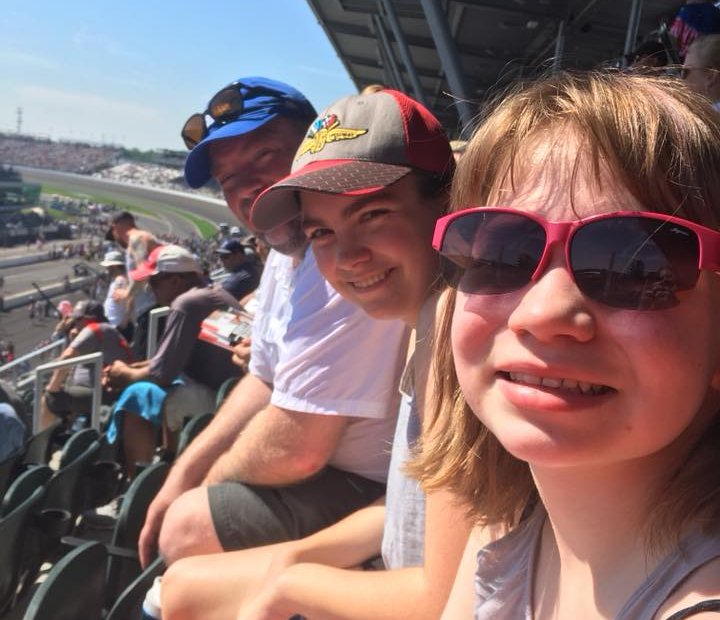
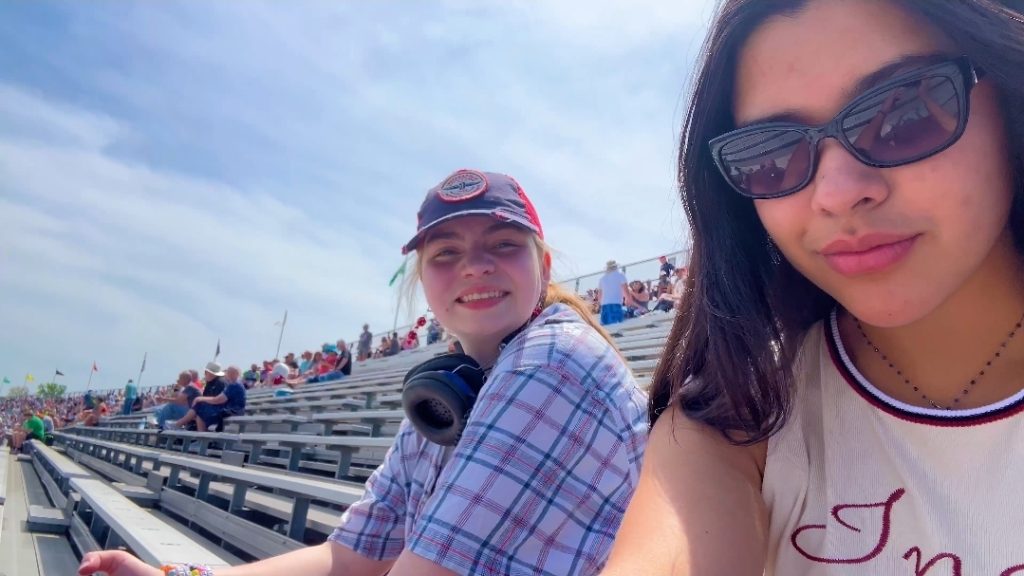
But the series I love most of all, the one I call “my wife,” is IndyCar. I grew up rolling my eyes at the races on the TV every Sunday. My dad loved them, and I thought it was boring. But sometime during my first Indy 500 in 2018, at age 12, I woke up from a 40-lap-long nap and—something happened. I was hooked.
I didn’t even acknowledge it until my senior year of high school. Now, I have a shared calendar with my dad and older sister. It has every IndyCar practice, qualifying, and warmup session, as well as every race. It has the whole F1, F2, and IndyNXT schedule, the schedule for the 24 hours of Le Mans, the 12 hours of Sebring, and the next five NASCAR races. If you quiz me, I can name the entire IndyCar grid for the year. I can give you statistics about the Indy500 in my sleep. I have a 76-slide presentation about IndyCar. Last time I gave it, it was two hours long. My best friends refuse to hear it.
But racing doesn’t always make me happy. Like many other sports, the fanbase, athletes, and teams are mostly men. Motorsports are notoriously conservative. When you think of a NASCAR fan, who do you think of? I can already picture the picture in your mind: Dixie tattoos, bandana, MAGA hat, Supercuts mullet. Never heard of sunscreen, “Let’s go Brandon” bumper stickers, sipping on a light beer from whatever company isn’t being endorsed by a transgender person.
In 2020, NASCAR banned the Confederate flag, to loud backlash from many fans. Historically, NASCAR has explicitly aligned itself with conservative politicians and causes. When the infamous segregationist George Wallace was running for president, the founder of NASCAR, Bill France Sr., served as his campaign manager. His son, and current CEO of NASCAR, Jim, has donated more than $30,000 to conservative causes in the past 12 months, according to the Federal Elections Commission.
It’s not just NASCAR, though. IndyCar, my favorite racing series, is just as conservative, if not moreso. Billionaire and owner of the series Roger Penske has donated more than $800,000 to Republican groups this past year. During the 2024 election cycle, he donated $1.1 million to Donald Trump’s SuperPAC. In 2019, Trump awarded him the Presidential Medal of Freedom.
The people who profit off my viewership are using those profits for causes that harm me, my family, my friends, and countless others. Not ideal. But I can deal. I can donate to causes I do support, including organizations interested in inviting more women, queer people, and people of color into motorsports.
I don’t know. I’m still thinking it through? But there is nothing inherently political about IndyCar. Cars don’t vote.
Even if I wince at terrible statements by the owners (and, yes, sometimes the fans), there is still so much I can’t resist: The rumble of twin-turbocharged V-6 engines; the grunt from the sweaty man standing way too close to me when a driver makes a particularly daring save; the connection between current and former drivers, fans, and sponsors. I love the deep respect IndyCar has for its history, and its passion for the future. I love going to races, the smell of burnt tire rubber, the sun beating down on me, knowing I’m going to be sunburnt to hell. I love the stories of failure and resilience, I love the incredible skill that drivers have, I love the way that the community can band together in times of sorrow and grief. I love my group of friends who react to IndyCar news with unintelligible inside jokes. I love the race. Something in me just resonates at 235 miles per hour. It’s why I major in physics. I like when things go fast, and some day I’d like to help them go faster.
Hope, age 12, at the 2018 Indy 500 with her family.
—
But two months ago, IndyCar did something that I still don’t know how to react to. You probably didn’t hear about it—it happened on the same day a new batch of Epstein files were released. Also, no one cares about IndyCar.
This year, as part of the 250th anniversary of the Declaration of Independence, an extra race has been added to the IndyCar calendar. On August 23, IndyCars will race on the National Mall, as part of the Freedom 250. The President signed an executive order to make it happen. The Department of the Interior is going to pay for it.
This should be perfect for me. I’ve been saying for years that IndyCar needs to expand its market to the East Coast, especially the Mid-Atlantic or New England. The race is going to be 12 miles from my house! Free general admission, too. And it will be promoted by Monumental Sports, who own the Washington Capitals, my favorite hockey team (yes, I’m into hockey, too). I should be elated.
But this event infuriates me. Before even getting to the political implications, it’s a logistical nightmare. IndyCar initially released its 2026 schedule in September, without a D.C. race. August was already grueling: an Aug. 9 race in Portland, Oregon, followed by a race near Toronto the next weekend, a two-race weekend in Milwaukee on Aug. 29 and 30, and then the season finale in central California on Sept. 6. Now there’s no more weekend off after Toronto; adding the new Freedom 250 race in D.C. makes six races in five weeks.
Team members will have to go back and forth across the continent and between time zones. Truck drivers will have to drag team haulers thousands of miles. Engineers will have very little time to make adjustments and improvements to the car before getting right back on track, with, at most, two days at the shop before getting right back on the road. And on a race weekend, team members are working at least nine hours outside for three days straight, usually in grueling heat. As a fan, this means teams will be sloppier and make more silly mistakes. More silly mistakes means less good racing.
Washington, D.C. could be an amazing location for an IndyCar race. But doing this on such short notice (with a federal administration that has been marked by chaos and incompetence from the moment Trump was sworn in for his second term) could be a recipe for disaster. To host an event in our nation’s capitol, a multitude of governmental and non-governmental entities have to work together to put on an event of this scale. Any miscommunication could lead to monumental issues. Everyone involved must be meticulous; it’s hard to feel confident given the current massive budget shortfalls and chronic understaffing.
There’s another danger that makes me worried given the lack of preparation time. Sounds at certain intensities and frequencies can pose a threat to the structural integrity of older buildings (at the temporary track in St. Petersburg, Florida, for example, the Dali Museum near turn 10 is rattled by the cars passing by). The section of the National Mall where the circuit will be is mostly surrounded by old buildings and sculpture gardens; the National Archives building is surrounded on three sides by the temporary track and is more than 90 years old.
Then there’s D.C.’s climate, considered “humid subtropical,” which could be trouble in a race scheduled for August. Over the past few years, D.C. summers have been getting hotter and more humid, with the number of extreme humidity days rising significantly. This kind of weather can be dangerous for anyone, but especially drivers, who get very little airflow in the cockpit of an IndyCar, and are using significant amounts of energy in their cars. But there’s more. The weather in the area can be temperamental at best, but August is the height of hurricane season. During this time of year, severe thunderstorm warnings happen multiple times a week. It’s not unlikely for practice sessions or qualifying to be rained out, or for the race to be significantly delayed.
Even if there isn’t severe enough rain to red flag and stop the race, it could be run under the cautionary yellow flag. In this case, cars aren’t allowed to pass each other on track and have to run at a specific speed, behind a pace car. If it rains hard enough, are they going to run the whole race under yellow? That’s not what fans come for.
—
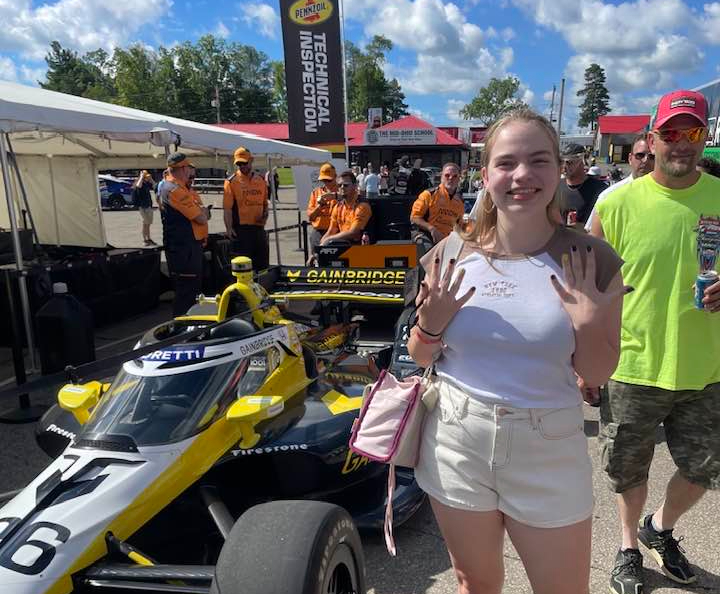
Hope, age 18, at the 2024 Mid-Ohio IndyCar race.
I’ve known for a long time that this is a conservative sport. I have gone to races and cheered for drivers anyway, because I believe that all sports can cultivate community. My experiences as a near-D.C. native have shown me that politics don’t have to limit human connection. However, pushing a race through executive order is different.
The political division in this country over the past few years has made it exceedingly difficult for me to put aside my differences with people who support the current presidential administration. My struggle comes from the past year’s deportation policies, Medicaid cuts, the dismantling of the D.O.E., invading countries for no reason and…the list goes on.
D.C. has been hit especially hard over the past 15 months of this administration, because it’s a federal district, and much of its economy and the metro area relies on the federal government. Mass budget cuts and sudden layoffs have left people struggling to make ends meet. Month-long shutdowns have left employees at home or working without pay, impacting them and every business that relies on federal workers. ICE has been kidnapping people off the streets since before protests erupted in LA and Michigan. The National Guard has been occupying the city since July and have blocked kids returning home from school from entering Union Station after getting off the Metro station.
And while all this is going on, D.C. residents still have little power in the democratic system, despite their population being larger than the state of Vermont or Wyoming. If you had an eighth grade field trip to D.C. (you probably did), you may have noticed that their license plates say “taxation without representation.” That is because D.C. has one representative in congress and she is not allowed to vote on any resolutions.
D.C. residents have been fighting. But without elected leaders with the power or media coverage, it’s incredibly hard to fight back with the same pressure as other cities. Plus, people here are tired. They’ve been living as political bargaining chips for a long time, subject to the control of individuals who do not actually live in their city or participate in their culture.
So, yes, I love racing, but I am furious about this race. It’s being held because of an edict from a leader who seems to have genuine contempt for the city I love, and as a result, the residents of that city are going to have contempt for the sport that I love. This will feel the same as the military parade to them: a busy portion of the city inaccessible for several days just so that loud machines can disrupt their streets.
The goal of a race like this is to bring in more fans and draw more interest to the sport. This will be a “street race”: instead of a permanent track, the race will be held on actual downtown streets, right in the middle of one of the most recognizable urban cores in the world. That has undeniable appeal! But making this entire spectacle yet another half-baked effort by Trump to bring glory upon himself could alienate potential new fans—especially if the fans who do show up are the sort likely to create a hostile environment for fans like me.
For years, IndyCar has been trying to figure out how to grow its fan base. After some disastrous decisions in the late ‘90s, when the league literally split in two, the sport has been slowly climbing its way back to relevance.
Interest in motorsports has been booming the past five years, and now is the time for IndyCar to capitalize. But that means finding ways to keep the interest of a new kind of fan. According to a survey conducted by F1 and Motorsport Network, women account for three quarters of new F1 fans; half of Gen Z respondents to the survey were women.
These are the same fans who can be brought to a more competitive series like IndyCar. Races often feature more daring passes or saves than FI races. IndyCar is also more economically accessible, as the average single day ticket is almost 90% cheaper than the average FI single day ticket. A recent study showed that women sports fans make 85% of their household purchasing decisions, which means that not only are they a relatively untapped demographic, they’re also a highly profitable fanbase.
But Gen Z women are also overwhelmingly progressive. According to an NBC survey conducted in September, only 26% of Gen Z women approved of Donald Trump’s job performance. Overall, 36% of Gen Z men and women approved of his performance in September. According to an Economist/YouGov poll conducted in February, that overall number has dropped to 25%. Young fans can energize this sport. What will they think when a marquee event for IndyCar is lorded over by Donald Trump (and given the nationalized politics inherent to D.C., will likely have a highly partisan atmosphere).
I wish I could say I was excited to attend this race, but it’s unlikely I’ll even tune in. I don’t think I’ll be able to get past the anger and hurt that my favorite series is doing something so antithetical to why I am a fan at all: human connection, ingenious engineering, and fun races.
Hope, age 19, and Transy student Sophia Del Val at the 2025 Sonsio Grand Prix.
I live in the “White House.” Not the one you’re thinking of, it’s what me and my three best friends call the place we live together (the house isn’t white; long story). ) My roommates and I are all very liberal, and we spend a lot of time discussing current events. I usually serve as fact-checker/historian.
I have also spent the past two years trying to get them—and everyone else I know—to watch IndyCar. Now, I’m not sure to approach that. How can I sell something to my friends that has caused so much internal conflict? How can I answer their well-founded skepticism with optimism?
My dream, as a fan, is to be able to share IndyCar with my friends without worrying about what the series might do next. I want to be able to show the thing I love off, and not feel like I have to hide a dirty little secret. I want them to feel a little bit of what I feel when I see Danny Sullivan’s ‘Spin and Win’ in the 1985 Indy 500, the whole paddock standing outside to watch the tornado at Iowa Speedway last year, Dennis Hauger driving backwards at Phoenix Raceway this year, Josef Newgarden’s pass for the win on Pato O’Ward on the last turn of the last lap of the 2024 Indy 500, Scott Dixon making fuel out of thin air. I’ll just have to hope they can see that part of racing—the part that can be for everyone—even as the sport seems more and more determined to pander to people who don’t want anything to do with people like us.
The documentary Resistance in the Redline, which played on Jan. 22 in Carrick Theater, discusses themes of racism, housing, gentrification—and the intertwined ways they contributed to redlining in Lexington.
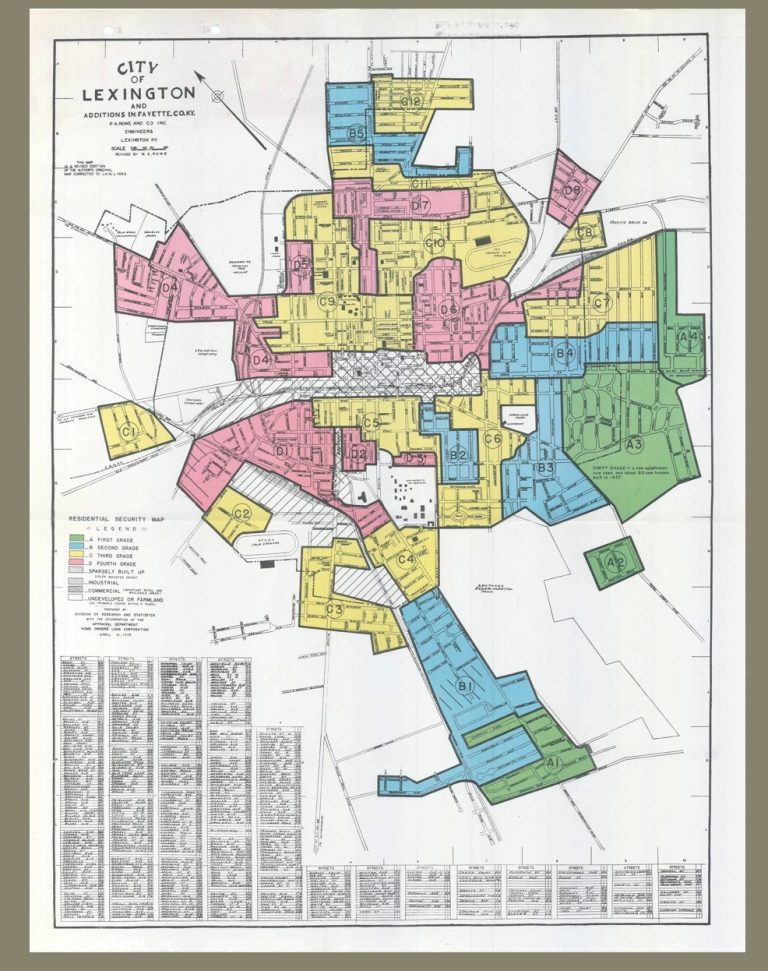
Redlining refers to the discriminatory practice of denying financial services to a particular community. The term was first coined in the 1960s, but the practice dates back to the 1930s, when a federal agency created color-coded maps for almost every major city in the U.S. They drew red lines around communities that were considered “undesirable,” predominately Black neighborhoods, and green lines around ones that they considered to be the most worthy of investment; yellow and blue fell in between these two extremes.
Black Yarn, which produced Resistance in the Redline, is a nonprofit organization based in Lexington committed to bringing light to the systematic harms that the Black community faces. In addition to film production, the group also conducts research, creates podcasts and short videos, and organizes community events.
Resistance in the Redline presents more than 30 interviews with members of the Lexington community who have either been affected by redlining, have seen the effects of it, or have researched and examined redlining.
These first-hand accounts from Lexingtonians are what bring the film to life. Bill Wilson, for example, recounts his childhood view of larger, newer houses belonging to white people, while Black people lived in smaller houses. He asked his father about seeing a brand new house in their neighborhood that he says “look[ed] like a white person’s house.” His father explained to him that “Black people normally weren’t building houses or living in houses like that; that person was very, very lucky.”
Adrienne Thakur tells a story of her mother’s parents buying their first home, which stayed in the family for over 60 years. Her mother, then in second grade, was excited, but Thakur’s grandfather told her mother: “there probably wouldn’t be any more birthdays and there wouldn’t be any more Christmas because it was going to take everything they had to own this home.”
Wilson and Thakur lived in the very same city as people in Lexington who look like most Transy students—white people. But as the film’s narrator puts it, because of inequitable and racist systems, “shared spaces don’t always equal shared experiences.”
The Home Owner’s Loan Corporation, a federal agency originating from the New Deal, gave birth to redlining through the creation of their color-coded maps. Their ratings, ostensibly designed to evaluate investment risk, affected how resources were allocated to each district. Because of the ratings, people living in green or blue (more desirable) areas were more likely to have access to lines of credit, health care, internet, and education than those living in yellow or red (less desirable) zones.
Today, well after the Fair Housing Act of 1968 made discrimination in housing illegal, the impacts persist. An average white family living in Kentucky has 30 times the wealth of a typical Black family. The average person living in Chevy Chase has a life expectancy 16 years higher than a person living on the north side of town. White people make up 61% of Lexington homeowners while only 33% are Black people.
The imbalance of wealth is due in part to the decades of Black people being denied home loans, and the continued inequity of the mortgage process, with Black people having a higher likelihood of being denied home loans than white people.
“We think of the words in the Declaration of Independence,” says Regina Lewis, a Ph.D. candidate at the University of Kentucky Martin School of Public Policy and Administration, toward the beginning of the film. “‘We hold these truths to be self-evident, that all men are created equal.’ However, all has never, in our history, included the all.”
To capture the complexities of racism in housing that still exists to this day, the film describes the “three R’s:” redlining, racially restrictive covenants, and real estate steering.
Racially restrictive covenants were written into deeds to prohibit property from being sold to people of a certain race, and real estate steering refers to realtors showing certain houses to people of certain races. Both of these practices, along with redlining, are illegal now—but the mortgage industry continues to artificially inflate the value of predominantly white neighborhoods. The median home value in Ashland Park, a predominately white Lexington neighborhood, is $504,100, while the neighborhoods along Georgetown Street, a predominately Black area, have a median home value of $74,800.
Someone living around Georgetown Street can get an education, work hard, and save up to buy a home. But the equity of their new home wouldn’t increase as much as it would if they lived in a formerly green-lined community, because local governments continuously fail to invest resources into their schools, health care, road maintenance, and other services that increase home value.
The film also traces the roots of inequity much further back than postwar redlining. After the Emancipation Proclamation, enslaved people were freed without resources, grants, land, or loans. They didn’t have the opportunity to succeed or grow wealth. They were set up for failure, and it continued for decades after emancipation.
Art Crosby, the executive director of the Kentucky Fair Housing Council, compares it to a game of Monopoly in which some players have been acquiring property through many rounds of play. “Then a new person comes in and says, ‘Okay, I want to play now,’” Crosby says. “It’s really easy to say the rules are the same [for everyone].” But the history of oppression means that some players are starting the game behind.
The film then explains how the city of Lexington executed a plan of redlining beginning in the 1920s.
Derrick White, professor of History, African and Africana Studies at the University of Kentucky, tells the story of soldiers receiving financial benefits from the federal government after they returned from World War II. Benefits included access to education and lower interest rates for home loans.
During the postwar Baby Boom, the number of suburbs in Lexington grew. Deeds either stated that these houses were only for white people or explicitly excluded Black people. While Black soldiers received benefits from the G.I. Bill, they were unable to use them in the same ways that white soldiers could.
Beginning in the 1930s, federal housing authorities funded Lexington’s first public housing project, which was segregated. Aspendale, all-black development, was separated by an eight-foot-tall, three-hundred-yard, chainlink fence from Bluegrass, an all-white development. The fence came down in 1974 and the desegregated community became known as Bluegrass-Aspendale until its demolition in the early 2000s.
In the film, Jamari Turner recounts her experience growing up in Bluegrass-Aspendale saying that there was a strong sense of community. Kids were always playing outside, she recalls; everyone knew each other, and there weren’t major conflicts among neighbors. Few of the Bluegrass-Aspendale homes that were demolished between 2002 and 2006 were replaced with genuinely affordable housing, leaving these residents with limited options once the community Turner describes was gone.
What happened to Bluegrass-Aspendale fits a pattern of displacement of Black families without giving them reasonable alternatives. The thriving, predominantly Black neighborhood Adamstown was destroyed and replaced with the University of Kentucky’s Memorial Coliseum in 1950.. Residents of Adamstown were forced to uproot from their homes for an arena and parking at a university that had zero Black students at the time.
Despite these setbacks, Black Lexingtonians built a strong middle class within their neighborhoods. After the Civil War, resilient Black communities began to form in Lexington, mainly in undesirable locations: near the railroad, flood zones, and the city jail.
Regardless of the challenges they faced, the Black population of Lexington doubled between 1860 and 1870. Black communities built their own economies, schools, and churches. Some of their developments are still visible in Lexington today, but others were erased as leaders prioritized urban development over the preservation of existing communities.
Chester Grundy, another Lexingtonian featured in the film, was one of only 60 Black students out of the University of Kentucky’s student body of 16,000 when he attended during the 1960s. To combat the feeling of unbelonging, he and other Black students frequented churches, clubs, and the Lyric Theater to find connection. In the film, he explains that they wanted to make UK more welcoming for future Black students.
In one bracing moment in the film, P.G. Peeples, president of the Urban League of Lexington-Fayette County, describes feeling blessed that his experiences growing up in Lexington benefited from the work done by prior activists in the community—even though many obstacles remained. “It still was tough times,” he says. “But we said, ‘bring it on.’”
For decades, Lexington turned a blind eye to the horrors of slavery and the various forms of legal and extralegal discrimination that followed. Resistance in the Redline highlights progress made in recent years by various activists and institutions in Lexington. Tandy Park now hosts seasonal farmers’ markets downtown; in 2018, the city finally erected a sign to explain that the park once hosted slave auctions.
The aftermath of redlining continues to harm Black Lexingtonians, but there are other signs that the city is at least beginning to reckon with its ugly past. During the Civil Rights movement the Lexington Herald avoided covering the protests, reportedly because the paper’s management believed itwould reflect poorly on the city. In 2004, the same newspaper released a series of stories about this lack of coverage.
Films like Resistance in the Redline are essential to bringing light to the challenges that Black people still face today—and to educating our community about the root causes embedded in the histories of cities like Lexington. With the work of city leaders and organizations like Black Yarn, we can take the first steps of learning our history so that we can avoid repeating problems of the past.
As Transy students we might make our own lasting roots here, or we may just be passing through for college. But at least for now, this is our home. And it’s up to all of us to work together to reckon with this history, so that we can imagine a new future: a community for all.
You’ve made it through 36 credits, dotted your i’s on your capstone. Writing intensive? Check. Upper level pairs? Check.
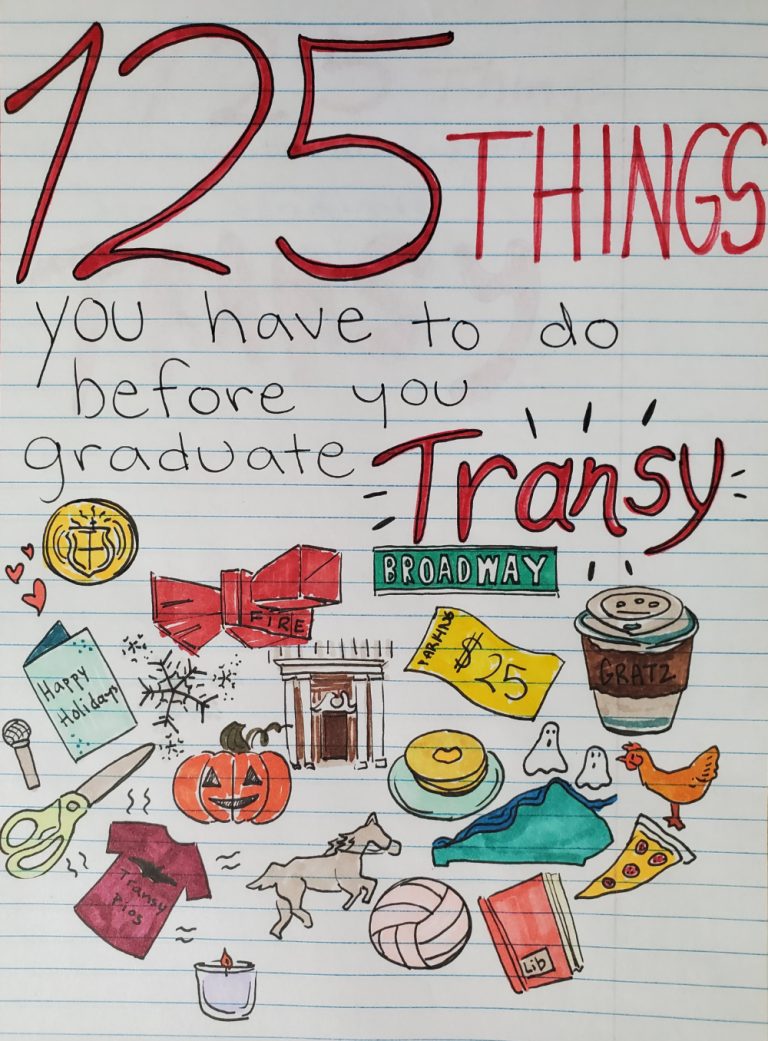
But a liberal arts education is not defined by bureaucratic details. To truly be a bat, there are certain things you just have to do in your four years at Transy. If you know, you know. But what if you don’t know? The Rambler is here to help.
Here are the 125 things you absolutely must do before you graduate. Seniors, better hurry if your checklist has holes. Freshman, get started now. Fly, Pios, fly!
▢ 1. Foolishly do a GE in May Term and ruin Play Term. ▢ 2. Get an overdue notice for a library book you forgot checking out back when you pledged to “read more.” ▢ 3. Do the “Liberal Arts 360” while gossiping at Third Street Stuff. ▢ 4. Have a conversation with Dr. Paden in Spanish even though you don’t speak Spanish. ▢ 5. Argue with your friends about whether or not a professor is hot. ▢ 6. Cry during sorority recruitment week (or witness someone crying). ▢ 7. Get your initials posted on YikYak. ▢ 8. Challenge Carole Barnsley to a game of pickleball. ▢ 9. Give a holiday card to a Caf staffer. ▢ 10. Carve a pumpkin for Pumpkinmania that leads a family member to say it’s a good thing you aren’t an art major.
▢ 11. Receive two noise complaints at once because your RA forgot to file the first one. ▢ 12. Go to a professor’s office hours unannounced; overshare. ▢ 13. Write a CARE report about your friend instead of telling them directly. ▢ 14. Write a CARE report on yourself just to skip the line and get a therapy appointment (pro tip!). ▢ 15. Come within inches of death crossing Broadway. BONUS POINTS: Get hit by a car; survive. ▢ 16. Match on Tinder with a classmate and then never address it. ▢ 17. Get your ID taken at McCarthy’s. ▢ 18. Get strep throat more than three times in one year. BONUS POINTS: You have never had strep before college. ▢ 19. Have Scott Whiddon conclude a conversation with, “Can I be honest with you right now? I loved this. This was the best part of my day.” ▢ 20. Chat with the Flat Earth activist.
▢ 21. Explain that Transylvania University is a real school. In Kentucky, not Romania. ▢ 22. Throw up at a frat party but like in a really cool nonchalant chill way. ▢ 23. Throw up at a frat party but it’s really bad and a brother has to drive you back to your dorm. ▢ 24. See your professor at a bar and play it cool. ▢ 25. Eat fresh bread baked by Kurt Gohde. ▢ 26. Gently place a DPS parking ticket in the trash and give it over to God. ▢ 27. Slip into the elevator with randoms clearly in the middle of a heated conversation because you left your key in your room. ▢ 28. Have sex in a chapter room. ▢ 29. Cut in line at SAB’s Brinner. ▢ 30. Receive an email reply from Maurice Manning. ▢ 31. Get blacklisted from a frat. BONUS POINTS: Get blacklisted from a sorority. ▢ 32. Say you’ll never date another Transy person. Date another Transy person. ▢ 33. Speak with Kerri Hauman about a problem and immediately feel a warm balm of relief. (Kerri Hauman is mother. So mother.) ▢ 34. Have a friend drive you to get tested for an STD. ▢ 35. Be serenaded with “Happy Birthday” by Ms. Beth. ▢ 36. Go to a darty instead of Zoom classes on a snow day. ▢ 37. Steal someone’s Crimmy. ▢ 38. Visit the Monroe Moosnick Medical and Science Museum in BSC (where Ozzy Osborne once filmed for his reality show), and see a 14-inch hair ball given to the university by Abraham Lincoln’s brother-in-law. ▢ 39. Regret last night. ▢ 40. Shuffle between the baseball team’s tables at Caf to put your dishes away. ▢ 41. Experience Hazelrigg.
▢ 42. Lose it all at Keeneland. ▢ 42(0). DoorDash four Jimmy John’s subs high and forget about them until the next morning. ▢ 43. Have a love affair at Transy, get fired for your misbehavior, go mad, fall into obscurity and poverty, die alone, get buried in a potter’s field, have some portion of your remains dug up a century later, mix said remains with a young girl child’s shoulder, and live out eternity as a stop on Transy’s campus tour. It’s not too late. ▢ 44. Shoot filthy looks towards your friend’s horrible ex when you have a class together. ▢ 45. Hit your head walking into the Phi Tau basement. BONUS POINTS: Fall going down their “macbook wide” stairs. ▢ 46. Twerk in the general vicinity of a professor during Pride. ▢ 47. Roll your eyes at “performative male” behavior. ▢ 48. Lowkey wish you were wearing Olivia Fleming’s outfit. ▢ 49. Grow a mustache?
▢ 50. Witness Eva Csuhai dissecting the failings of men, including her ex-husband (“the coffee cup does not walk its way to the sink and wash itself”). ▢ 51. Survive Pizzapocalypse. ▢ 52. Wait in line at Gratz only to hear, “sorry, the machine is broken.” ▢ 53. Join three or more clubs’ GroupMe chats, never attend a meeting. ▢ 54. Change your major AT LEAST once. BONUS POINTS: You change it after taking the first prerequisite. ▢ 55. Dance with the performers at the Transy Drag Show. ▢ 56. Take Kremena Todorova’s Writing for Writing’s Sake May Term class and become obsessed with going to Kenwick Table, hoping you run into her. ▢ 57. Struggle to print. ▢ 58. Attend an Orientation event hungover. ▢ 59. Make a Freshman Year Friend Group that ultimately falls apart. ▢ 60. Go see a band at The Burl, tell everyone that it’s your new spot, never go back. ▢ 61. Steal just a little bit of toothpaste from your roommate, because you ran out. ▢ 62. Suddenly notice whoever’s on aux in Caf is feeling emo today. ▢ 63. “Sniff test” a piece of clothing before running to class late. ▢ 64. Get an alert that your account balance is in the red after your Spring Break trip. BONUS POINTS: Happens during your Spring Break trip. ▢ 65. Endure a middle-of-the-night fire alarm. ▢ 66. Discover you can swap coleslaw for an extra Texas Toast on your Canes order. ▢ 67. Meet Olive, Ellen Furlong’s dog. ▢ 68. Have your car get broken into in the Bourbon lot.
▢ 69. Bang on your ceiling to tell your upstairs neighbors to quit fucking so loud. ▢ 70. Pie a Phi, Chi, Tri, or Pi, or get pied. ▢ 71. Manically refresh your email in the hopes they’ll call a Snow Day (they won’t). ▢ 72. Pay off the ref in an intramural basketball game. ▢ 73. Watch people flirt on the Transy Discord before you’ve even started Orientation. ▢ 74. Get lost in Old Morrison. As a senior. ▢ 75. Light all manner of illicit candles in your dorm. ▢ 76. Make a shot book page even though you have no idea what a shot book is. ▢ 77. Trash talk Centre.
▢ 78. Buy beer with your Transy refund check. ▢ 79. Get called “baby” by Miss Cass in Caf <3. ▢ 80. Cut or dye your hair in the dorms. BONUS POINTS: You’re a girl doing the Canon Event Big Chop. ▢ 81. Fuck up a chem lab so bad you cry. ▢ 82. Bask in the sun on Alumni Plaza on a spring day and do nothing at all. ▢ 83. Submit multiple papers at 11:59. ▢ 84. Walk out of the campus center into back circle to see children in speedos doing high knees and crabwalks. ▢ 85. Give yourself a hickey and convince your friend it’s from someone else. ▢ 86. Sit awkwardly and feel old while a campus tour walks by. ▢ 87. “Shut up, Frank!” ▢ 88. Watch someone do the walk of shame through Back Circle. BONUS POINTS: It’s you. ▢ 89. Find your laundry littered about the laundry room because they were in the dryer for five minutes. ▢ 90. Investigate the mysterious Pooletergeist glow in Poole Residence Center. ▢ 91. Take the long way to avoid eye contact with someone you’re beefing with. ▢ 92. Harbor a stray in your dorm without getting it ESA certified. ▢ 93. Cook carrots five different ways or track your food intake for a week for Health and Wellness. ▢ 94. Open the UK transfer portal ▢ 95. Find your professor’s Facebook or Instagram. ▢ 96. Attend a lacrosse game and wonder why the hell they are playing behind the goal. ▢ 97. Instead of going to therapy, write about it for your Creative Nonfiction class. ▢ 98. Get recruited for a sports team and quit, becoming a NARP by junior year. ▢ 99. Bust ass on ice. ▢ 100. Pick up a package in the mailroom and realize you requested the wrong work study. ▢ 101. Carve someone else’s initials into the wooden desks in the stacks. ▢ 102. Catch yourself singing “a pirate’s life for me” when you score a textbook on LibGen or Anna’s Archive. ▢ 103. Wear pajamas during finals to signal to everyone how stressed you are.
▢ 104. Call DPS to let you into your dorm. BONUS POINTS: Ask them to unclog your toilet. ▢ 105. Have a good cry early on in Winter Semester ▢ 106. Go back home for dinner. ▢ 107. Get invited to a professor’s book club. ▢ 108. Wake up to your roommate vomiting into a trash can while sitting on the commode. ▢ 109. Nab hella food from the student pantry. ▢ 110. Pull an all-nighter in the MFA DArt Lab. ▢ 111. Use the same water bottle for an entire year without cleaning it. ▢ 112. Play sand volleyball until it’s dark. ▢ 113. Do the macarena with President Brien Lewis. (If you can keep up.) (You can’t keep up.) ▢ 114. Grow apart, not on purpose, from your high school friends. ▢ 115. Screenshot your professor’s Zoom class and post the image on YikYak. ▢ 116. Comfort your pre-med friend, sobbing, considering no-med. ▢ 117. Do each of the following at least once: Lexington Legends game, karaoke at Night Kitty, pool at the Green Lantern, ICB at Molly Brooke’s, get a Big Blue Weiner on Main. ▢ 118. Stay in Shearer past midnight. BONUS POINTS: You have no artistic instincts but will finish that pottery or die trying. ▢ 119. Go to CRU’s midnight pancakes because you haven’t found God yet but are very hungry. ▢ 120. Hide your face so no one will see you’re tearing up at the chorus concert. ▢ 121. Make bingo cards about your professors’ sayings and habits and have your classmates fill them out live during class. ▢ 122. Fall in love by complete accident. ▢ 123. Meet one of Zoe Strecker’s chickens. ▢ 124. Write your last college paper. ▢ 125. Realize you lost the coin given during Orientation.
In seventh grade, I looked down at my legs on a chair, the way all girls do, and saw my thighs spread out and realized I had a body. There is a term for coming to an understanding that you have a mind and can think, this idea of “gaining sentience,” but I cannot come up with the word for learning that you have a body. Maybe there isn’t one. Maybe it’s just puberty, which some adults refer to as “blossoming.” I was not a blossomer. Of this I was sure. I did not blossom. But I did look at my thighs splayed out below me, and I hated them. That is how girls realize. The moment they realize their bodies they begin to hate.
My younger sister realized before me and always talked about outlining rolls of fat on her stomach with Sharpie and taking scissors to cut them right off, and so I imagined the same. I would hunch over to make and find a roll and then grab it and picture the scissors and the gushing of the blood and the strip of skin in my other hand. And then I couldn’t stop imagining, so I imagined cutting my fingers off too, and then my ears, and then my chest, even though I didn’t hate them. Maybe because I didn’t hate them.
I did like my calves, which were always strong but which grew stronger and larger when I started Irish dancing halfway through middle school. I never imagined cutting my calves off. Instead, I flexed them in social studies, noticing as they grew in size and hardness over time, and tracing the muscle with my finger. They were what I liked about my legs. It was a relief to get over the exhausting exercise of hatred. No one is born to hate.
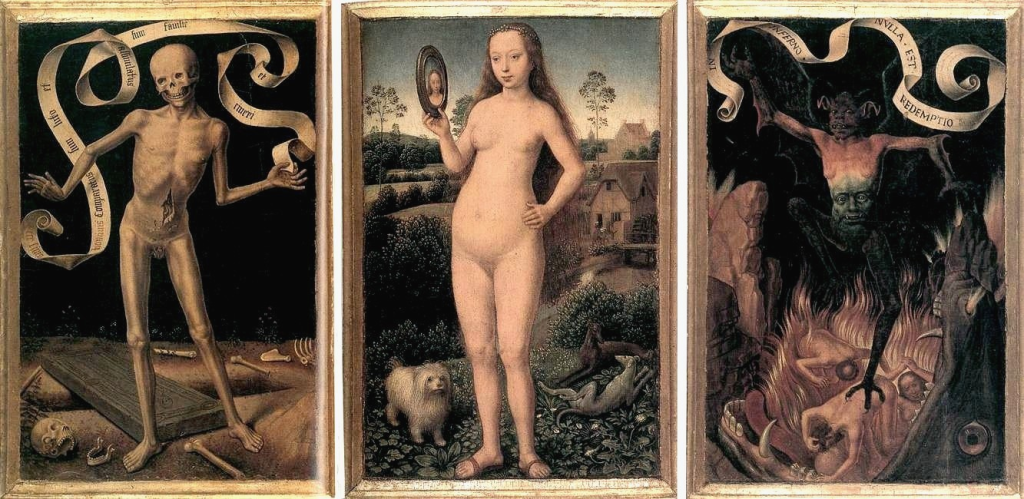
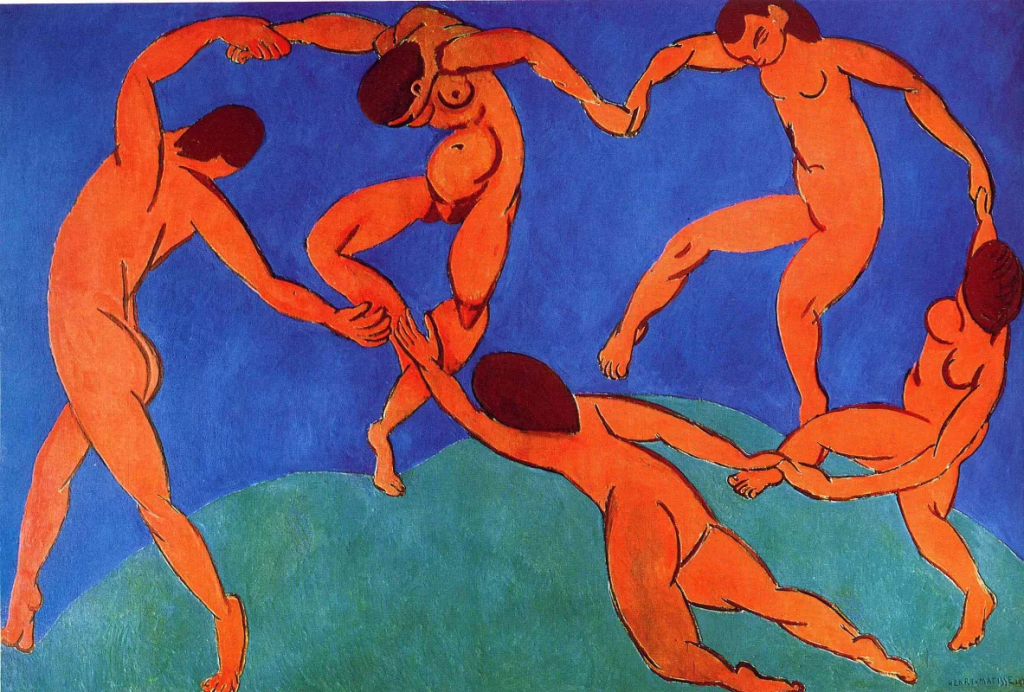
“Earthly Vanity and Divine Salvation,” Hans Memling, 1485.
My Catholic school choir friend Amelia told me the girls in my class talked about how I never shaved my legs. She told them I did. I loved Amelia, but she was a liar. I didn’t shave my legs, not then, and she knew that. She was a liar because she loved me, too.
It was Amelia who made me realize people can love you even if you’re weird and they aren’t. Not like you. Come watch Descendants on my parents’ bedroom floor. Tell me a secret. I’ll hold your hand if you hold mine.
I shaved a strip of hair up my leg in the shower with my dad’s razor and immediately told my sister. I always felt guilty for something. I was in seventh grade, and my mom got mad at me, and I still don’t know why. I am 21 years old, and I always feel guilty for something. Guilt never goes away if you were made for it, and you’re made for it when you grow up Catholic. That’s the stuff you learn in religion class, but mostly what you learn from silent in-class adoration on Fridays when you read Saint Maria Faustina Kowalska’s Divine Mercy in My Soul in the pews and she tells you and only you that Suffering is a great grace; through suffering the soul becomes like the Savior; in suffering love becomes crystallized; the greater the suffering, the purer the love. And that’s when you learn that suffering is love. And that’s when you learn you were born to suffer.
I loved a boy named Elijah more than I loved myself, though that was not hard. In one of dozens of journal entries, I wrote that his eyes were black and his freckles were constellations and his nose was “a potato but still cute.” I liked his cologne. I liked that he wore cologne. He was 4’11” in seventh grade, shorter than me by a few inches, and that made me love him more. He somersaulted behind the stage at our schools’ performance of “Madagascar the Musical Adventure Jr.” These were the most interesting things about him. I did not like how he sounded when he sang, all shrill and wobbly. The first time he sang in front of me, it made me cry. I pretended it wasn’t him I heard.
I wrote long love letters on math worksheets in tiny cursive letters that no one could read but me, and I showed them to him during language arts and snatched them away if he looked too close. Every time the clock showed all the same numbers I wished that he would love me too: 11:11 wishes, 12:12 wishes, 3:33, 5:55. There is no 6:66, but I didn’t mind because that was Satan’s number and if I wished to the devil, he would make sure Elijah would never love me. But God would make sure Elijah always did love me, even from the very beginning. I believed praying to the God of the past meant I could change it. It never changed. I considered selling my soul.
With the realization of my body came a deep feeling of strangeness, like I did not belong because there is something wrong with me. I knew it was something in the way that I walked and talked and held myself and presented the flesh and the muscles and the tendons and the bones that made up my body. I ran into things too often: shoulders into walls, forehead into doorframe, ankle onto desk leg. I dropped things: lunch trays, water bottles, mechanical pencils, all the textbooks I carried in my arms in between classes because I didn’t like the way a bag felt on my shoulders. I fell: down the stairs, up the stairs, walking to classes, running in gym, standing in line for the teacher’s desk, off the lunch table benches, standing completely still, over because I always leaned my chair too far back, into bushes, into friends, over cracks in the ground so subtle they might not have even existed in the first place. I talked: too much.
A third of the mornings before school, I promised myself I wouldn’t talk all day because there is something wrong with me. No one could (or would) tell me what it was, and they told me there wasn’t anything, but they looked at me when I talked, and they knew there was, and I knew there was, and so everyone knew it, but no one ever said it. It was middle school, and I was not normal—no middle schooler is. But it felt like I was missing some fundamental piece of soul or a guide to the universe everyone else had, the kind that would make it all finally click into place. I thought that maybe I could find it if I looked hard enough, so I was always looking, but I told myself that if I talked too much, I would scare it off, or it wouldn’t appear at all because it would see that I was unworthy. Lord, take from me the double darkness in which I have been born, an obscurity of both sin and ignorance.
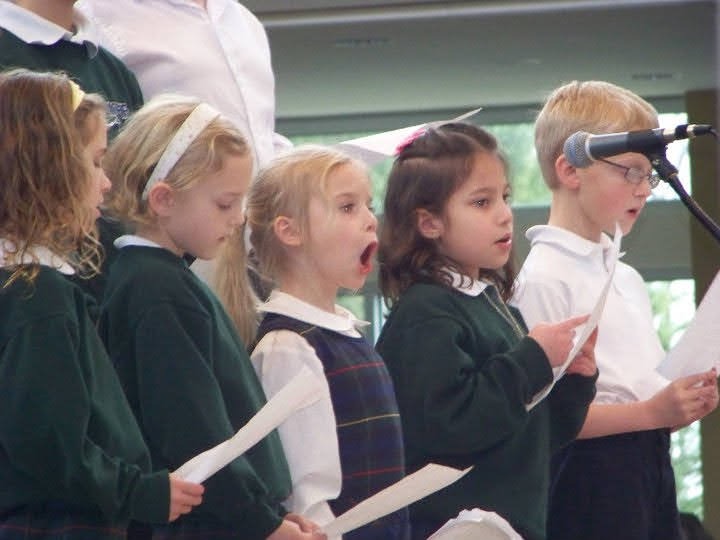
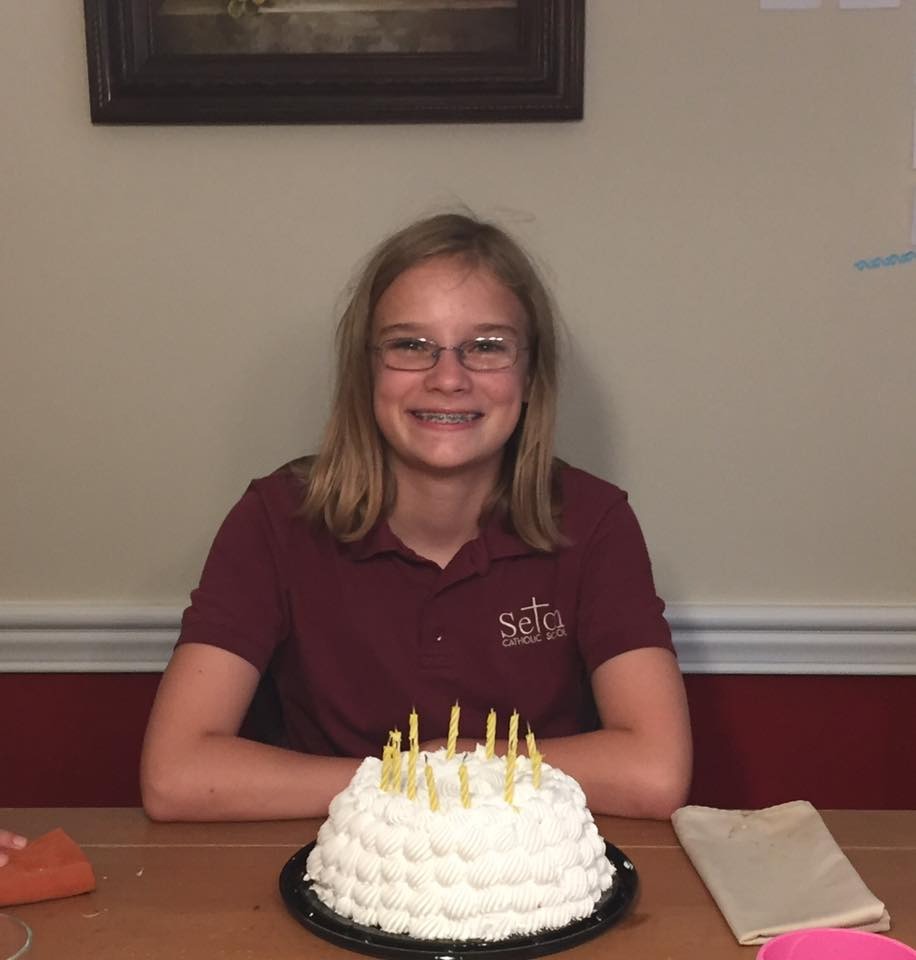
Mary Rose (center), age 7, singing in the Mary Queen of the Holy Rosary Catholic School choir.
When I was in seventh grade, I prayed to three saints and then Mary and then God every night when my mom was pregnant again (her seventh time). I prayed for the baby to live, and for it to be triplets, and for me to be normal. And the baby did live, but it was one baby, not three, and I was still strange. Mentally and physically. I had just gotten my first pair of glasses and chose ones with horrific blue rectangular librarian-wire rims and nose pads that gave me migraines. I cut my hair into a bob, but it rebelled. Maybe it was the Great Clips scissors. Maybe it was just destined to be so. It flipped up at the ends, in the inverse of the quintessential medieval pageboy cut. That haircut was one of the things I hated the most about myself, though I was the one who wanted it in the first place. I have almost always hated my hair, no matter how it has looked.
In moments of great stress, it is my hair I become the most conscious of as I begin to feel my breath move rapidly in and out and in and out. I feel my hair on my neck and on my face and on my scalp, and I feel the dirt it carries. Touch only makes it worse. In moments of great stress, I have always imagined buzzing my hair off or chopping it off with craft scissors if I have them, but I usually just put it up, covering it in whatever fabric I can grab nearby: a t-shirt, my baby blanket, a bathrobe. I do not buzz it off because I care too much about how I look, or at least how I think people perceive how I look. I have always preferred discomfort physically to discomfort mentally. But I’ve never gotten not looking weird quite right. I think now of my tenth-grade pixie cut from when I thought I was a lesbian, or the choppy bangs and rushed split dye (half blue/half black) of eleventh grade, or, yes, that seventh grade hair. It haunts me still. Not because it looked bad (it did), but because I did it trying to look good, and it didn’t work. I can’t tell if it ever does.
I was always called precocious when I was younger, which means smart but really, really annoying about it. As a child, I was precocious as a concept; in middle school, I was precocious with a body—body meaning small frame, awkward angles, big calves. I walked up to people with my stilted gait and asked them questions I knew the answers to in order to make myself look smart. When a girl from sixth grade left the school, I celebrated, because she was the smartest person in my class, and now that title would go to me.
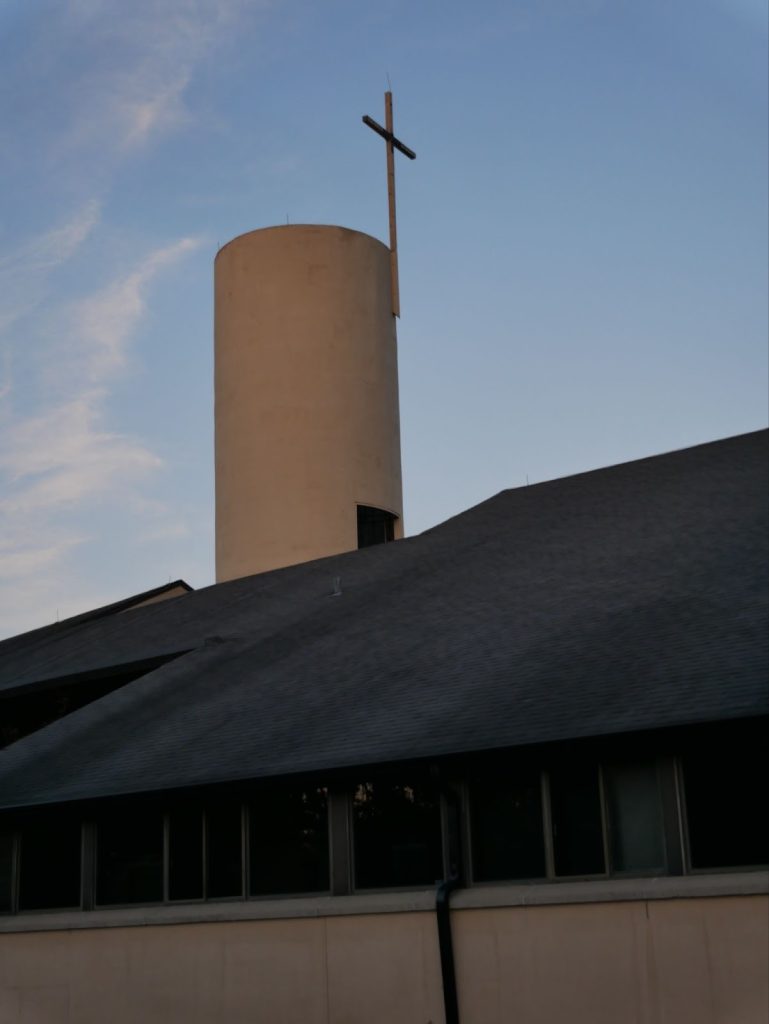
Saint Elizabeth Ann Seton Church, 2021, photography by Mary Rose Beeken.
I think almost all of the precociousness was due in part to my infatuation with books. I identified myself as a reader, as though it was a classification that set me apart in some way. In many ways it did, by my own design. When a teacher assigned the first chapter of a new book, I came to class the next day with all of it finished, rather than enjoying the community that comes from reading with a group. I was passionate but performative.
In seventh grade, I was in four choirs: my Catholic school’s Star Singers and Star Tones, my church’s Youth Ensemble (directed by my dad, the Seton Catholic Church music director), and the local Lexington Singers’ Children’s Choir. I additionally participated in audition-only honor choirs and sang in talent shows and during school masses. And I did it all with Amelia.
“Friends by circumstance” isn’t fair to the situation, but I don’t know if we would have been friends in the same way, or maybe at all, if it weren’t for singing. She had a beautiful voice, clear and sweet and high in a way that our teacher compared to the incomparable Julie Andrews. And she herself was beautiful: dark brown hair, crystal-clear blue eyes, long black eyelashes, pale with a splash of freckles across her nose, smelled like nothing in particular (a positive attribute in the context of middle school). She was the only girl I knew who wore mascara. We rode to choir together, sat together, drank out of each other’s water bottles together, and gossiped together. We told each other about our crushes and who was dating and who broke up and who kissed under the stairs at the Halloween Dance, and if they were ugly. At home, after seeing her, I always prayed for forgiveness, because no matter how fun it was, gossiping was a grave sin, and I never stopped myself. It is a sin that I imagine I will forever partake. I am not without my vices. I may be more vice than woman.
Our school choir teacher, Mrs. Steele, was evil. Ginger with a vibrato-heavy voice and a heft to her walk that came from always wearing an orthopedic boot for some unspecified ailment; she took separate special interests in Amelia and me. Amelia was her star protégé; I was her project. Where Amelia was praised publicly and privately, I was pulled from class to go to a voluntary scoliosis screening involuntarily, because Mrs. Steele thought I stood so strangely that my spine had to be curved (it was not).
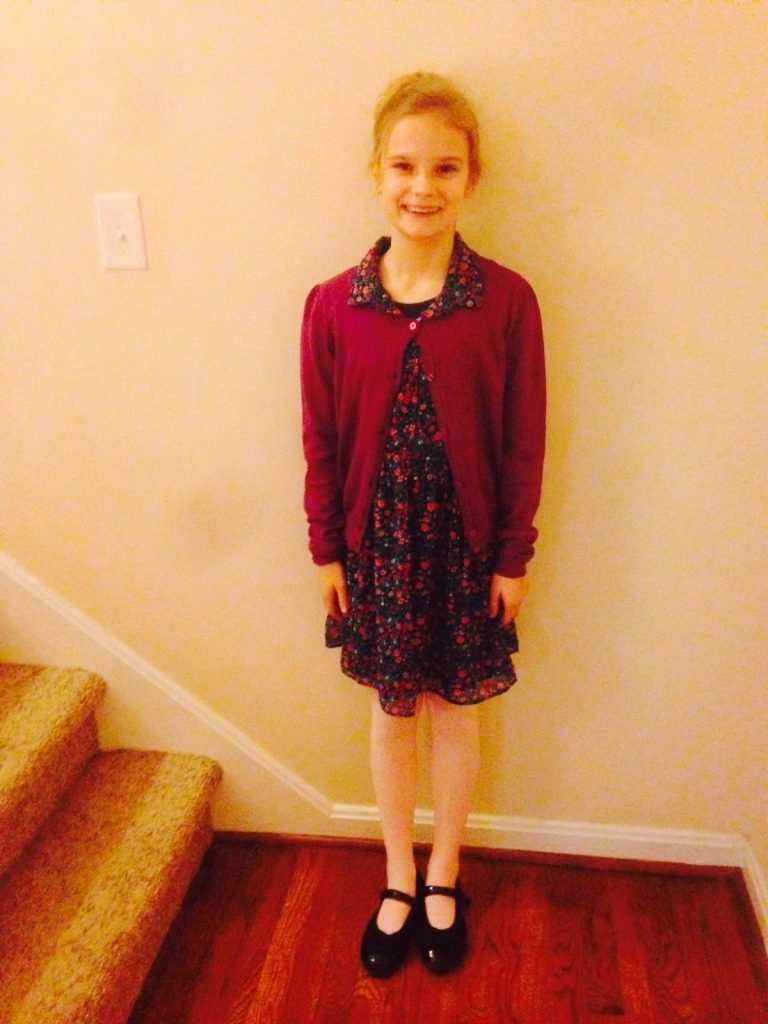
Mary Rose, age 13. Photography courtesy of the author.
I cried so frequently during choir with her that people eventually stopped noticing when tears were streaming down my face while we sang or when I rushed from classroom to bathroom. The noise from the choir was too much, and Mrs. Steele’s focus on me with feedback on my posture, my forced smile, and my vowel shapes—those oohs and ahhs—was too frequent and targeted. I never knew how to fix anything she wanted me to fix, and my attempts were never rewarded. But the crying always stopped, and I always came back, and I always continued to sing, this time with my face and eyes a little redder than before. She never pointed it out; it was easier for her to pretend she didn’t notice it, but she did point out everything I was doing wrong physically. I was already hyper-aware of my body: the way my shoulders were never far enough back, how my neck sat a little bit too far forward, how my feet always faced in, one pointing its toes at the back of the other one’s heel, a habit I still have not broken.
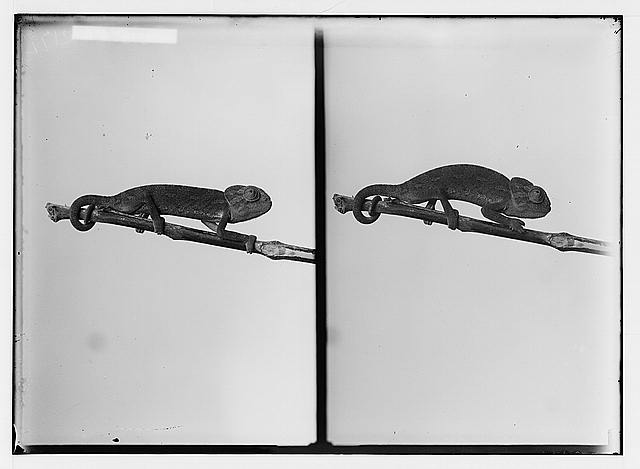
Mrs. Steele screamed at me once for something (probably talking too much) and then sat me down and told me I was a chameleon—that I changed personalities with the environment, that I was more defined by fluidity than self. She said she knew what it was like, that she was a chameleon too. I knew I should be hurt but didn’t know exactly why, and part of me thought it was a compliment, because it meant my attempts at transformation were, in some way, effective. It was true that I changed as much as I could to seem normal to people. Every person has a different type of normal, something I understood from a young age, and I wanted to be every type at once. But Mrs. Steele saying I was a chameleon meant that she saw through to the true me enough to know it was all pretend. Chameleons aren’t their colors; they are scale and casque and cone-shaped eye… a lizard, not an illusion. And I was flesh and bone and insecurity… a girl, not a chameleon.
I used to beg my dad to let me quit Star Singers, but he always told me to keep up with commitments, even if they weren’t ones I had necessarily wanted to make in the first place. There was a reason, though, that I always came back and recommitted, time and time again.
When it came to singing, I knew I was somewhat talented, but I was never good enough to be considered great. I wanted to be great more than anything, which was part of my constant return, as though being a member of multiple choirs would help me ascend to vocal heaven. I also wanted to live my life in prayer, and in Catholicism, singing about God is an act of prayer in and of itself. Shout joyfully to the Lord, all you lands; serve the Lord with gladness; come before him with joyful song.
I came before the Lord with song all the time, but it was not joyful. I was too focused on how my hands looked when I was standing in the choir area at the front of the church, or if my feet were pointed in again, or if my shoulders were too exposed in my dress, or if my voice would get caught in my throat when I went up to sing the psalm like it did every single other time. I was terrified I was going to get my first period right in front of the whole congregation, and then everyone would know I had a body, not just me. A moment of revelation for us all. Not battles or trumpets, but I thought it might signal the beginning of my end.
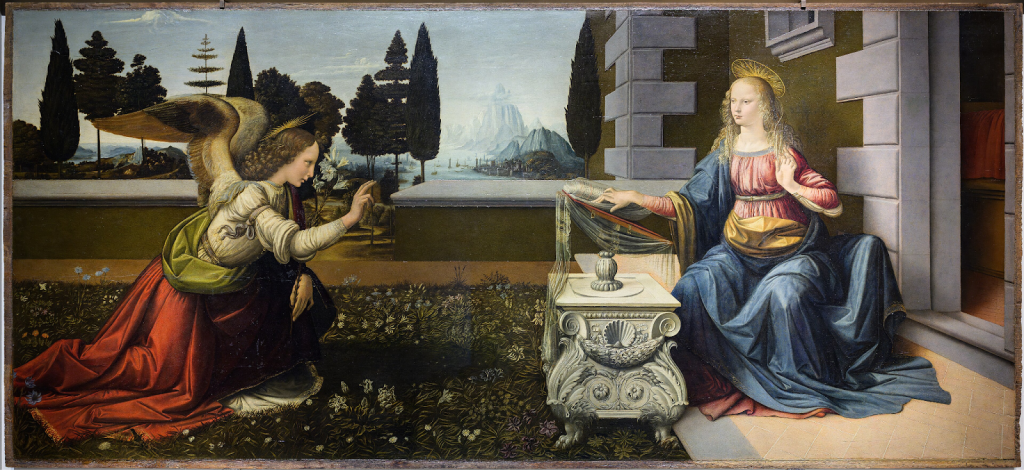
In seventh grade, I quietly thought I might be the Virgin Mary. I had the name (though with a Rose at the end of it), and I was, of course, a virgin—so who was to say God wouldn’t swoop down out of the heavens and impregnate me with the savior of the world? The only thing that held me back from truly believing this was the Catholic idea that Mary was perfect and sinless, the criteria for bearing the Christ. I knew I was a massive sinner. Each night before bed, I thought about how I used to crawl under lunch tables in kindergarten to steal snacks for a boy named Jimmy, who I loved and who did not love me (all I remember otherwise is freckles and a smile with a missing front tooth). The stealing was what I considered my gravest sin, but I thought about the love even more. It reminded me of Elijah.
Plus, there was the gossiping, and the thinking about boys and girls kissing and girls and girls kissing, and I knew there had to be something else off because I did not have the grace I imagined a perfect saint must have, what with all of my tripping and falling. I also imagined a saint was eloquent, but I figured I had time to work on that. I thought maybe times had changed, and now that the world was more imperfect, there could be no one sinless, and I would have to be the first choice. When I realized this for sure would not happen, perhaps through prayer or the development of common sense, I devoted myself to becoming a nun.
“Annunciation,” Leonardo da Vinci, dated to c. 1472-1476.
I had a convent in mind: The Dominican Sisters of Saint Cecilia in Nashville, Tennessee. I had visited once when I was ten years old, and the idea had popped up again on and off ever since then. When I wasn’t completing homework or BuzzFeedBuzzfeed quizzes on my iPad (Which Harry Potter House are You?), or doing practice ACTs so I could eventually get into Princeton, I was looking up everything I could about the sisters. I joined their newsletter. I watched their YouTube videos. I prayed their prayers and then prayed to Saint Cecilia and then to God to guide me to where they wanted me to go. I didn’t even have to hear their response to know that they wanted me to don the habit and attend the convent’s college and teach little Catholic children for the rest of my days.
The thing that ultimately turned me off from it was when I saw a video of them playing basketball on a blacktop outside the convent. Their habits flew as they dribbled up the court, sinking three pointers and dancing in celebration. The sisters of Saint Cecilia wore pure white floor-length tunics with long sleeves, along with the quintessential black nun veils, and I remember the sun hitting the sisters’ outfits and making them glow, almost as if the Lord was choosing to bless them for their skills on the court. It made me sad. I was never able to play sports; my body wouldn’t let me. I was an old action figure with barely opposable joints. Here is a girl who wants to move her body but can’t, what else is there to say?
“Dance,” Henri Matisse, 1910.
But I did learn how to move my body in seventh grade when I started Irish Dancing, albeit in a way that was still very strange and unnatural. I think what got me invested in it was that I didn’t have to use my arms; when doing solos, they were supposed to be glued to my sides with my thumbs clenched inside my fists at all times. I only had to think about one thing: my feet, and moving them as rhythmically as possible. I had rhythm, the result of choir for years, and a musical family of nine, and I loved stomping and spinning around. I spun around constantly on my own time anyway. There are two kinds of Irish Dancing shoes, each indicating a different style of dance. Soft ghillies for light, silent styles, and hard shoes, for pummeling the ground into submission; for making it listen to the sounds of the Irish old world.
I loved getting to wear hard shoes. I loved pounding the stage with my feet and making sounds that everyone around me heard. When I danced, I felt truly listened to for one of the first times in my life, and it was my use of my body that did it. I didn’t think about Irish dancing’s strangeness—I thought about rhythms and learning to control my body enough to not fall down. To instead stand up straight and proud and jig a little jig.
I have always been scared of embarrassing myself, terrified that a moment of weakness would unveil my guilt and shame. At a performance at a nursing home, during a solo in the group’s big closing number, I fell. My ankle gave in. I remember the wooden planks that made up the dance floor, and how pale they were in the nursing home lights, and how the music thrummed (Tell me ma, when I go home), and how the old ladies gasped,and how my face burned red and how, in defiance of my nature, I stood up and began to dance again. In any other moment, during any other event, I would have run off sobbing. I ran off sobbing when I sang, all the time. But there was something new there, something powerful, some part of this performance involving my hard shoes and the rhythm I loved and the clapping of all of the dancers around me that led to this bravery, this unheard of Mary Rose bravery.
Shaker Village stone wall, 2025. Photograph by George Blair.
For me, being good at Irish dancing was never the point; seventh grade is a bit too old to begin Irish Dancing, especially when everyone else began in fourth grade or earlier, and I was never going to meet the standard for my age. It wasn’t in the cards. The point was belonging, the point was being listened to and understood, the point was using my body for something instead of letting my body use itself against me. Here was a girl who was made for this. What else is there to say?
But I never felt like a girl, not then. Not in dance, in my dress, and not in class, in my khaki shorts, sitting by myself while the other girls wore their plaid maroon skorts and had each other. I always felt different and alone. What tied me to girlhood was the hatred that began with bodily realization, not any intense devotion or connection to the concept. I have always found it difficult to have female friends; it almost feels like building friendships with women requires a deep level of self-awareness that I am not capable of, and having female friends has always seemed so key to girlhood and womanhood. How does anyone figure out who they are without people like them to show them the way? How do you figure out your body?
Mary Rose, age 11. Photograph courtesy of author.
Maybe you don’t. Maybe I didn’t. Today, still in Kentucky, I stare at my face in the mirror until it changes shape into someone I do not know, and I press my nails into my hands hard, so I won’t talk more than I need to, and I imagine leaping across the floor, ghillies on, whenever there’s enough room for it. I whisper prayers into my pillow at nighttime when I feel my sins start to crawl up my throat, grasping and clutching, and I beg God not to let them find something to hold on to. Away from me, Satan! I do not sing, and I do not miss singing. I do not dance, but I do miss dancing. When I stand in line for food, I think through how I will cut my chicken with my fork and how I will lift my fork to my mouth and what I will do if the chicken drops onto my plate, and while I think about it, I nearly run into the person in front of me. My pencil falls off my desk during a silent moment in class. I feel my hair in my eyes. I imagine what it must feel like to be human.
I don’t know if I’ve ever stopped believing what I learned in seventh grade, that love is suffering. I’ve stopped believing in God now. Maybe I don’t even believe in Jesus, but my soul still clings to some notion of mortal sin I can’t seem to shake. I don’t think you can ever fully shake free from the guilt you were born into. I see my hands move in front of me and cannot grasp that they are mine. That this is my body… that this is my blood. But then I look at my thighs splayed out below me, the way all girls do. I hate them, but less now. And I remember I have a body.
Disclosure: The advisor of The Rambler, David Ramsey, is a co-founder of Human Intelligence.
This fall, students were met with a total surprise: a big red ChatGPT button was added to their MyTransy portal.
Now, a new student-led coalition is asking the questions on everybody’s mind: Who decided this, and why didn’t anyone else get a say? And they’re asking the university not to re-up its $120,000 investment in contracts with major AI companies next year, requesting that those funds instead be reinvested into “human-centered education” that more directly benefits students. The group began a petition effort this month and have collected 324 signatures thus far from students, faculty, and staff.
The petition effort grew out of Human Intelligence (Hi!), a Faculty Learning Community co-founded by creative writing professor David Ramsey and art professor Kurt Gohde. FLCs are typically faculty study groups that meet to discuss various pedagogical issues; Hi! is the first to also include students. According to an email from the group, its purpose is to “promote human-centered education, explore possibilities for embodied learning, take a critical look at AI in higher education, and create resources for students and faculty interested in AI resistance.”
“Something I’ve heard a lot from students and faculty alike is that they had no real input on the university’s decision,” Ramsey said. “Many of us believe these products are actively harmful to higher education. The petition idea came from students saying, ‘We weren’t given a voice, so let’s take the initiative and make our voices heard.’”
The petition drive is supported by Hi! Faculty, but the campaign is entirely student-led and organized.
“That’s important because it’s the students’ education that is being affected the most,” said senior Alice Beatty, the primary organizer of the petition campaign. “AI is incredibly detrimental to our ability to think for ourselves. I can confidently say that most of the student body—even those that use AI—would rather this money be spent on scholarships, more dining options, accessibility for disabled students, outdoor seating options… the list goes on.”
The petition drive began on March 3, with student organizers armed with clipboards setting up a table in the Campus Center breezeway. Despite no advertising or outreach, the students collected 226 signatures in just three hours.
“All of us in Hi! were so proud to see what these students pulled off,” Ramsey said. “I think it’s a measure both of the confidence they gained from collaborating with professors on the Hi! FLC and the genuine passion many students feel about the serious concerns with so-called generative AI in higher education.”
The group has continued to collect signatures in the Campus Center, and is planning to expand their efforts this week to academic buildings and the library. They also hope to target each fraternity, sorority, and sports team, as well as attempt to ask each faculty and staff member on campus to sign. This week, they set up a way to sign electronically.
Thus far, the group has collected signatures from 296 students (roughly a third of the total student body), 18 staff, and 10 faculty members.
The petition’s ask is simple: “We request that Transy discontinue its contracts with Google and OpenAI for ‘AI’ consumer products for the next academic year, and reinvest the $120,000 spent on those products into human-centered education.”
“We’re avoiding an extremist stance,” Schultz explained. “The sentiment at its most rudimentary is that this money would be better spent on something else. People signing fall under a pretty wide umbrella. Adopters, rejecters, and ignorers of generative AI in education can all feasibly get behind this idea.
For most students the petitioners spoke to, this effort was the very first time they had heard anything at all about the contracts. Most were shocked by the size of the university’s investment in AI products that are widely available for free.
“The most common response was just ‘What?’” Schultz said.
The lack of student awareness—and what appears to be the Transy administration’s lack of transparency—is central to the group’s argument. The petition is not solely about reversing the contracts; it’s also about advocating for student involvement on a wider scale.
The contracts themselves have been highly contentious since the university purchased three AI products—ChatGPT from OpenAI, and Gemini and NotebookLM from Google—and distributed them to everyone on campus last semester. The $120,000 price tag of these products had not been previously publicly reported when The Rambler learned these figures last semester.
In The Rambler’s January report on the AI contracts, President Brien Lewis and Amanda Sarratore, the university’s vice president for infrastructure & chief information officer, stressed the issue of privacy in explaining the purchase (Sarratore, who directed IT on campus, stepped down from her position last week). Instead of the standard AI products, the university acquired custom versions that OpenAI and Google promise will protect users’ data and privacy. As The Rambler reported in January, Transy can make a written request, no more than once per year, for OpenAI’s most recent independent audit report regarding privacy and security, as well as summary details of certain other audits or security reports, “upon reasonable request.”
Critics of the university’s purchase are skeptical. Platforms like Facebook, YouTube, and Google have paid out large settlements and fines for breaking privacy agreements with customers (none of which threatened their business models).
“Given that history, I wouldn’t trust their promises of privacy, even if they offer a third party audit,” Gohde said. “I couldn’t advise students to trust them either.”
Ramsey said he viewed these promises as a marketing ploy to infiltrate college campuses with a large potential user base. “Even if I trusted these companies,” he added, “why do AI apps get a special deal? Many of our students use TikTok or Instagram or Snapchat or any number of other apps that collect their information.”
On March 16, I joined organizers in the Campus Center as they sought signatures from students and others walking down the breezeway.
Two juniors who the petitioners flagged down, one a baseball player and one a lacrosse player, admitted that they had used ChatGPT for nearly every single writing assignment they’ve received this academic year (each asked to remain anonymous).
“Bro, if I had to do an FYRS paper again, I couldn’t without Chat,” the baseball player said.
“And that’s sad,” the lacrosse player replied. “Like, I wish I could write again, and I know that it’s bad, but I just don’t have time.”
“It’s just easier,” the baseball player said. “It sucks, but it’s easier.”
Despite their constant AI usage, their guilt led them to sign the petition.
“Even students who use ChatGPT and other generative AI products fairly regularly thought it was a poor decision to invest so much in tools that were already free to use online,” Schultz said.
First-year Annie Kunkel, another Hi! organizer, said that many students approached the table with great enthusiasm without being asked, some even running over to show their support.
“They didn’t even need to hear the details of Transy’s contract,” Kunkel said. “Just a few keywords—‘anti-AI’ and ‘petition’ were all they needed to sign’.”
Some students declined to sign, either due to indifference or disagreement (or really needing to get to class). One student who declined to sign said, “I just don’t think it’s that bad.” Another questioned whether the entire $120,000 investment should be redirected elsewhere. He suggested a smaller investment in AI products, with the rest toward other priorities.
It’s not just students signing. “The fact that many faculty and staff members are echoing a lot of the sentiments and criticisms of AI we voiced and developed through the Hi! FLC is encouraging,” Schultz said. “They want the best for students and agree that these contracts aren’t it.”
Beth Tuttle, mother of a former Transy student and an employee in the cafeteria for around 13 years, harped on the importance of funding opportunities such as scholarships or study abroad programs, rather than AI.
“My daughter went to this school. I know it’s not cheap,” she said. “There are scholarships, but not a lot. They can take that amount and give it to students to make a trip that they could never make without it. Or take an extra class here that they wouldn’t be able to afford. Sometimes just that little bump can make somebody’s world.”
Other staffers, including people who strongly agreed with the petition, said they were reluctant to sign because they feared pushback from the university. A few faculty also said they felt uncertain about whether they were “allowed” to sign and worried about professional consequences. Some had no hesitation and were excited to see students taking action on an issue they are equally concerned about.
“I had no qualms or concerns with signing,” said Spanish professor Jeremy Paden. “I think that there is no place for generative AI in elementary, secondary, or undergraduate education. I think it cheats students from acquiring and developing the hard-won skills and knowledge that will make them better thinkers and better communicators. In fact, it cheats them of developing the very skills and knowledge they need in order to be competent users of generative AI. And I think there is a fundamental confusion that proponents of it have between words and knowledge, and there is a dangerous anthropomorphism when we ascribe agency, knowledge, intellect, and will to a soulless algorithm.”
Paden acknowledged that some colleagues think otherwise, and may use or encourage the use of AI in their classrooms. Part of being in a community, he said, is learning to work with others despite deeply divergent opinions.
“Writing helps us hone our thought and helps us come into a better understanding of what we think,” Paden said. “Generative AI takes this away from us by not letting us develop the skills of deep reading, of writing, and revision. That is why I signed it.”
For some petition organizers, concerns about AI products like ChatGPT go well beyond the current contracts. They point to what they see as a broader administrative push to further integrate AI into education, a prospect that deeply unnerves many students.
“Artificial intelligence is the last thing a liberal arts school should endorse,” Schultz said. “It undermines the learning process, emphasizing an end product over actual improvement and personal development. AI is antithetical to what this institution should stand for.”
The petition organizers plan to submit their permission to President Brien Lewis in the last week before finals. The president has not replied to a request for comment as of press time; The Rambler will update this story if he responds.
Organizers say they are well aware that the university may not respond to their petition no matter how many signatures they get. But they say it’s an important signal no matter what happens next.
“Transylvania signed these contracts without our consent,” Schultz said. “We’re communicating how we feel, and if the university chooses to ignore us, then that’s that.”
Ramsey said that the potential for the university to refuse the petitioners’ request was something the group was prepared for from the beginning. “Certainly we hope that if the students collect enough signatures, the university will listen,” he said. “But ultimately, the choice is theirs. It’s also possible that there was a donor who specified this use of the funds; there’s a lot we simply don’t know. Even in that case, that’s a choice—the donor could choose to listen to the students and redirect those funds. The students are taking the only action they can, via a well-organized and peaceful expression of speech.”
For Ramsey, the conversations happening because of the petition drive are valuable in their own right. “People are talking about this issue instead of sweeping it under the rug,” he said. “When we started Hi!, opponents of AI on this campus felt like they had no voice, and that no one was listening to their concerns. Now I’m hearing the dialogue happen as part of this petition drive.”
Beatty echoed the community-building value of the petition drive, as well as the recent Hi!DIY events, which have focused on teaching and learning “do it yourself” skills in relaxed, social environments. The first event focused on crafts, such as embroidery; the second, “Hi!DIY 2: Human Words,” held last week, featured poetry readings and Chinese calligraphy.
“Organizing events for Hi! is such a joy for me,” Beatty said. “Personally, I’m really discouraged, angered even, by how much AI I see in the world around me. But when students, faculty, and staff drop what they’re doing in the middle of a day of classes to come make crafts, read poetry, and connect with other humans, I feel re-energized. I feel like we’re doing something important and worthwhile.”
On Thursday, January 12th, Zak Foster spoke about his exhibition in Morlan Gallery, “Southern White Amnesia”, as a part of the Creative Intelligence series. The exhibition seeks to explore the hidden stories of white people that are often not passed down or told to future generations due to discomfort. Foster works with textiles, comparing them to our second skin, and embraces these relatable materials as a part of his storytelling journey.
Foster’s story begins with an interest in his ancestry, which led him to complete a DNA test and find he was related to both white people and black people. This was a perplexing truth, and he set the goal to seek more of how and why his ancestry looks like this.
Foster discussed how he had no idea he was related to black people, and this uncertainty felt like something he should know. He then began this investigation into how some stories get told, and others do not. He brings in famous quilter Jessie Telfair and her Freedom quilt.
Jessie was a black woman in Georgia who was fired from her job for attempting to exercise her right to vote. After her job loss, she was encouraged to make a quilt out of her frustration– it is bright red with the words “Freedom” quilted seven times in blue. Foster recreated this freedom quilt titled “Jessie Telfair and the white man who fired her”. He describes how the words “freedom, freedom, freedom” were not said in a celebratory way. The quilts are very similar to Foster’s, including a patterned edge of humans holding hands with red and black diamonds above. Foster described how these cries of “freedom” were an act to hold America accountable for its alleged statement that all are free in America. Foster goes on to explain the back of the quilt, which is referred to as “the white man who fired her.” The back is simply the loose ends and stitching which make up the front of the quilt. He describes the back of the quilt as depicting the unfair reality of Telfair’s ancestors knowing her story, while the children of the white man who fired her live in ignorance of his actions.
Jessie Telfair and the White Man Who Fired Her
“We don’t often have a lot of info on our family lineage- where they come from and who those people were.”
Next, Foster goes on to describe this silk chiffon piece titled “Appraisement.” This was a real document from after one of his ancestors had passed away, and the appraiser documented his remaining possessions. The list describes furniture, animals, and people who he enslaved. Foster describes how his third great-grandfather had this amazing obituary, which described him as a devout christian who was content to work out life’s problems. Yet, he participated in the enslavement of human individuals. His obituary was one sided— showing his amazing traits as a person, but leaving out the horrible things he did throughout this time on earth. Connecting back to Jessie Telfair and the white man who fired her, it is clear that the ancestors of white people oftentimes have to do real digging to find out who they truly are.
Foster continues his journey to better understand his ancestors and finds himself in Lawrence, South Carolina, to explore some family land and burial sites. He describes his experience at this burial site, where his family’s graves were fenced in. He illustrates their graves being innately carved with little cherubs and nice expressions. As he looked further, he found concave spots on the ground outside of the fenced in cemetery. He asked the tour guide, and she explained that this was where they buried the black people who worked for the family. Foster was then inspired to memorialize these individuals by creating a floor quilt called “Like Family”, which is known as a common expression to use for black workers. This quilt has a special sense of topography, which is used to really see how the whiteness was used as a gatekeeper— even in the afterlife. As Foster continues to explore his family history and dig into the harsh realities, he finds time and time again how the stories of black individuals are hidden and buried. Without a headstone to commemorate their death, the stories of these individuals are left to fade away.
Like Family
Foster explains how you can’t cancel your own family. What he means by this phrase is that it can be difficult to hold your ancestors accountable, but it is necessary for us to do the work now. He then elaborates on the uncomfortable awkwardness of the research he was doing. These feelings were further channeled into creating a small, handmade doll for each slave-owning ancestor. He piled all of these ancestors together in an antique bed and made one doll for himself to represent the uncomfortable feelings that he had to work through. These dolls have an uneasy look to them, and the choice of dolls creates this action of humanizing his ancestors to further hold them accountable for their choices.
“My ancestors are now very clear on the harm they have caused in their life and working through open-hearted descendants to undo the injustices and harm that were perpetrated.”
The quilt titled “The Snake Handler” describes more than ever that this work must be completed by the living. Foster came about this piece in a dream, in which he was handing off his poisonous snake back and forth with one of his ancestors. He described that when he woke up from the dream, he was the one holding the snake. Family history doesn’t fully disappear with its members. The passing of the snake exemplifies how it must be addressed by the living to not prolong its racist venom.
Foster’s incredible and meaningful work is all done through the medium of textiles. He further explains how we typically associate this type of work with a granny-like nature. Foster elaborates on why he chooses to work through the medium of textiles— describing that when we have this sense of softness and connection, it is here where we can open from a more vulnerable place and understand these difficult questions.
As the Valentine’s Day posts started to roll in this year—bouquets, chocolates, candlelit dinners, and corny photoshoots—I began to notice how many of my classmates have officially coupled up.
During my campus tour around five years ago (I’m old, I know), I remember being told that, historically, something like 40 percent of Transy graduates married another alum. I can’t find any hard data to support that claim, but there are plenty of anecdotes. We all know the classic “ring by spring” phenomenon: As the winter semester slows down and May term approaches, engagement rings begin appearing on seniors’ fingers. Off the top of my head, I can count more than a dozen Transy seniors or recent graduates who have gotten engaged or married in the past year. More than two-thirds of them chose fellow Transy students.
When I think about all the newlyweds on my feed, alum love stories no longer seem like distant legends, but rather evidence of a longstanding tradition. I found one Transy graduate who posted on Facebook a while back to say he met his wife “on Day One, graduated in 1963, and married three weeks later.”
Maybe they first locked eyes during the super romantic handshake line and spent their next four years under the kissing tree.
The story is undeniably romantic. But for my generation, romance alone no longer seems like enough justification to plan your entire future around another person. Today, many women enter college prioritizing independence, education, and career stability, goals that don’t always align neatly with early marriage.
Meanwhile, some Transy students are reluctant even to date another student on campus. This is partly driven by fear that things will go awry within the Transy social bubble, but it may also reflect broader cultural trends.
It turns out that simply having a boyfriend is embarrassing for many straight young women today, at least according to a recent viral article in Vogue. I was mindlessly scrolling on TikTok one night when I came across a video by Chanté Joseph, the article’s author, explaining her theory.
Joseph suggests that, in the context of social media, it has become increasingly distasteful to center one’s entire personality and online presence on a boyfriend. In another online video I saw, a woman says she “won’t post another man until there’s a ring on [her] finger.”
The moment you post a boyfriend, you risk public humiliation. He could very easily break up with you next week, leaving you to take down all of the photos shamefully. According to Joseph, having a boyfriend is “no longer considered an achievement, and, if anything, it’s become more of a flex to pronounce yourself single.”
Is that stopping students from coupling up at Transy? That doesn’t seem to be the case, based on a recent YikYak poll I conducted. Of the 356 respondents, 244 reported that they are either currently dating another Transy student or would be open to dating one.
A YikYak survey is not a scientific poll, but given the number of responses, the results are notable—and honestly surprised me. The campus seems to follow a much less cynical narrative about dating than the chronically online communities I’ve found on TikTok. Many Transy students reported feeling optimistic about future relationships on campus. Here, a significant other isn’t necessarily embarrassing. We haven’t lost all hope.
At least historically, it makes sense that college students would meet their lifelong partners on campus. Before dating apps and algorithmic matching, your romantic prospects were limited to people you knew (classmates, friends of friends, the guy who sat two rows behind you in Econ).
Now, we have the apps. While the idea of expanding your dating pool beyond your immediate circle sounds promising, the swipe-based system often feels transactional and can lead to awkward dates.
I’ve tested it myself a couple of times, mostly out of curiosity. Freshman year, I grabbed coffee with a UK student I met on Tinder. On paper, it checked out: he looked like his pictures, held a normal conversation, and, most importantly, was not secretly trying to kidnap me. However, the spark just wasn’t there. For one thing, he smelled weird (unwashed vintage clothes), which doesn’t show up as a red flag on a Tinder profile. But mostly, I was missing the butterflies of meeting someone in person and instantly clicking. You just can’t replicate that kind of chemistry online.
Maybe that’s why Gen Z has started to romanticize meeting someone “organically.” Whether it’s locking eyes in a coffee shop, talking at a bar, or even bonding over a group project for class, it feels more special than swiping right. There’s an endearing appeal to the old-fashioned campus meet-cute.
However, our nostalgia is clouded by rose-colored glasses. Dating in the past was constrained: the pool of available prospects was much smaller, and social pressure to marry was stronger. If you met someone you somewhat clicked with at college, there weren’t endless alternatives in your pocket. With fewer options available, people didn’t necessarily hold out for the perfect match. Finding a life partner was more of a necessary inevitability and not just about compatibility.
At highly religious schools, that dynamic hasn’t entirely disappeared. In TikTok interviews at Brigham Young University, a Mormon institution, students describe marrying their partners just months after meeting. According to a USA Today article, about 60% of women and 62% of men were attending college with their spouse while at BYU in 2013.Such cases are presumably the result of a conservative Mormon culture, an outlier versus national trends.
Despite the centrality of college relationships in pop culture, there’s been surprisingly little robust research on whether people still marry their college sweethearts. One nationwide survey conducted by Facebook in 2013 found that 28% of married graduates attended the same college as their spouse.
Analysts at the Brookings Institution, meanwhile, describe a pattern known as “assortative mating,” in which people with a bachelor’s degree overwhelmingly marry other college graduates, based on 2016 population data. In other words, education not only shapes our identities and values, but also frames our romantic expectations.
People often pair up with others from similar income brackets and social standing. Education is one of the strongest predictors of both, especially at a pricey liberal arts institution like Transy. We look for partners who understand our experiences: the anxiety before exams, the weight of student loans, and long-term career ambitions. We’re simply more likely to meet people who reflect our own trajectories through certain jobs, friend groups, networking events, and shared social circles.
Maybe meeting your future partner in class isn’t as outlandish as it seems. When your daily life unfolds within a particular environment, your dating market is bound to mirror it. If education and environment shape who we’re drawn to, the bigger question is whether college relationships still lead to lifelong commitments. Or whether it only feels that way while we’re here, immersed in a confined world where it can almost seem like everyone is getting engaged at once.
On a small campus, even a handful of proposals can take over group chats, making a few engagements resemble a community-wide movement. But overall, college students today are waiting longer to get married. Researchers at Iowa State University found that higher education doesn’t make marriage more or less likely; rather, it simply delays it, pushing commitment further into adulthood. College graduates are waiting until they feel financially and professionally stable before walking down the aisle.
There’s no way to predict whether current Transy students will get hitched down the line, but what about who students are choosing right now? We can get a hint by examining the current state of the Pio dating scene.
To learn about dating at Transy, I turned to YikYak, an app where students can anonymously discuss campus life. I published three surveys asking students about their experiences dating other Transy students, including whether they would choose to date another student and if they could see themselves marrying a classmate. The polls remain live and continue to collect responses.
Before getting into the results, a few caveats. There’s no way to conduct a truly scientific poll on YikYak. Not every student uses the app, and its audience may well skew toward a particular type of student. While YikYak requires a .edu email and uses geographic restrictions, making it overwhelmingly likely that respondents are indeed Transy students, it’s at least theoretically possible that faculty or staff with a .edu address could access the platform and choose to participate in a poll for students.
The app also raises some ethical concerns. It has been criticized for racist and sexist posts, cyberbullying, and misinformation, and some students avoid it altogether (which could mean particular voices are underrepresented). Anonymity may also shape how users respond, and the app’s format limited how precisely I could word the questions.
Still, the sample size is hard to ignore. “It’s notable that the poll has a very large sample, with nearly 350 respondents [for one of the surveys] from a college with around 900 students,” said Transy political science professor Steve Hess. But he cautioned that “without demographic data, such as race, gender, or sexual orientation, there’s a strong possibility of sampling bias,” making it difficult to generalize to the entire student body.
Here are the results of the first survey, which has the largest number of respondents because it was posted earlier, back on Dec. 16, 2025.
Would you date another Transy student?
Total Responses: 356
Yes! But I haven’t: 108 Yes, and I am right now: 107 Yes. I have before and will again: 29 Absolutely not. Too much drama: 72 I tried, but never again: 40
These responses complicate the narrative that I sometimes hear about Transy’s dating scene being hopeless.
When asked, “Would you date another Transy student?” 244 (68.5%) respondents said yes, while 112 (31.5%) said no.
Breaking that down further, 108 (30.3%) said they haven’t dated another Transy student but would consider it; 107 (30%) said they are currently; and 29 (8%) said they have before and would again. Only 72 (19.7%) selected “Absolutely not. Too much drama,” and 40 (11.2%) said they had tried and would never do it again.
Those numbers suggest that most students are at least open to dating within the Transy bubble. The same sentiment seems to carry over into the proposal of marriage, which I asked about in the next survey, which was first posted on February 14, 2026:
Would you CONSIDER marrying another Transy student? (even if you’re not currently dating one or think it’s likely)
Total Responses: 239
Yes: 153 No: 86
Asked whether they would consider marrying another Transy student, 153 (64%) said yes, while 86 (36%) said no. These numbers closely correspond with the 68.5% of students who are open to dating.
But when the question shifts from possibility to plausibility, enthusiasm fades, as shown in the third survey, also posted on February 14, 2026:
Do you think you will marry another Transy student?
Total Responses: 292
Yes: 77 No: 215
When asked more directly, “Do you think you will marry another Transy student?” only 77 (26.4%) said yes, while a whopping 215 (73.6%) said no. The drop is striking. While nearly two-thirds of respondents are open to the idea of marrying another student, only about one-quarter actually expect it to happen. But even so, 77 students who confidently believe they will marry another Pio: that’s a significant number!
Experience also shapes attitudes. When asked whether Transy students have dated another student before, responses were nearly split: 176 said yes and 180 said no. That divide demonstrates how seriously common campus relationships are, while also revealing that a significant portion of students avoid them entirely.
The comments on my posts help explain why. Many concerns appear less rooted in incompatibility and more in social consequences. One respondent warned that dating another student would be “the [worst] experience of your life if you break up,” while another simply pleaded, “Please don’t do it. It’s terrible.” On a campus this small, breakups rarely stay private; your business is everybody’s business.
For some, the risk feels so high that they avoid campus dating altogether. Twenty percent said they have never and would never date another Transy student. Several mentioned preferring to date outside the university instead. One respondent said they prefer “blue-collar” workers, while another noted that “UK is down the street,” implying that a larger campus offers both anonymity and emotional safety.
The YikYak responses reveal a campus caught between desires and self-preservation. Students are not opposed to dating each other; many are actively doing so. But in a social world where circles overlap, and stories travel quickly, commitment requires not just affection but confidence that the risk is survivable.
One comment stood out for its misogynistic tone: “Just don’t date the women here and you’re fine.” The remark sounded familiar to me. I suspect it reflects a deeper undercurrent of gendered tension that may be intensified by campus demographics.
During my first year, 2022-23, undergraduate enrollment at Transy was 59% female and 41% male. This dynamic reflects broader national trends in higher education. According to Forbes, women now make up the majority of college students nationally, and in Kentucky, women graduate at significantly higher rates than men. On a female-majority campus, that imbalance shapes the social economy of dating.
In the context of straight dating, sociologists describe this dynamic through sex ratio theory; when one gender is in shorter supply, members of that group tend to gain disproportionate dating power. Research shows that on female-dominated campuses, straight women report going on fewer traditional dates, are less likely to have boyfriends, and engage in more casual sexual relationships. Even if such women want commitment, there may be fewer men willing or incentivized to offer it. In that context, because hookup culture has become more like a prerequisite for participation in the dating scene, women are not necessarily given an active choice. (Obviously, the sex ratio theory described above only describes one portion of the dating scene, leaving out LGBTQ+ couples who face very different questions of supply and demand.)
As for all those friends of mine with engagement rings, there’s one factor that feels impossible to ignore: every single one of them was a member of a sorority. That makes sense: Sororities and Greek life in general shrink an already small campus into an even tighter social circle. Formals, living in Bassett, philanthropy events, parties, Snapchat group chats, and overlapping friend groups all create constant proximity. There’s a selection effect here, too: A lot of my close friends are in Greek life! But it’s not just me—on a campus where 40 percent of students participate in Greek organizations, that could be a factor in Transy alums tying the knot.
My own experience doesn’t necessarily fit neatly into one narrative. I have dated another Transy student before, and I genuinely enjoyed it. There’s something uniquely comforting about being with someone whose life already overlaps with yours—the same class schedules, the same professors, and the same stress over midterms. Our social lives blended easily. Our friends knew each other. We understood each other’s routines, priorities, and campus quirks without much explanation. It felt natural.
Even though the aftermath of a breakup at Transy can feel like your entire social circle is collapsing—with friends of friends asking what happened and nasty stares from your ex’s buddies—it eventually fades out. Things go back to normal. The effort to find a genuine, long-lasting connection couldn’t be a waste of time when the goal is to find companionship during such a tumultuous chapter of our lives. I wouldn’t be opposed to doing it again, even if the window for campus romance is slowly closing.
At the same time, I’m hesitant to imagine my entire future mapped out before graduation. I want to move to a new city, pursue opportunities wherever they take me, and travel while I’m young. That doesn’t mean I’m entirely opposed to relationships right now. But “ring by spring” feels like an unnecessary ticking clock. Who knows? Maybe in a few years, I’ll run into a Transy alum while visiting Lexington and…the rest will be history.