
As the Valentine’s Day posts started to roll in this year—bouquets, chocolates, candlelit dinners, and corny photoshoots—I began to notice how many of my classmates have officially coupled up.
During my campus tour around five years ago (I’m old, I know), I remember being told that, historically, something like 40 percent of Transy graduates married another alum. I can’t find any hard data to support that claim, but there are plenty of anecdotes. We all know the classic “ring by spring” phenomenon: As the winter semester slows down and May term approaches, engagement rings begin appearing on seniors’ fingers. Off the top of my head, I can count more than a dozen Transy seniors or recent graduates who have gotten engaged or married in the past year. More than two-thirds of them chose fellow Transy students.
When I think about all the newlyweds on my feed, alum love stories no longer seem like distant legends, but rather evidence of a longstanding tradition. I found one Transy graduate who posted on Facebook a while back to say he met his wife “on Day One, graduated in 1963, and married three weeks later.”
Maybe they first locked eyes during the super romantic handshake line and spent their next four years under the kissing tree.
The story is undeniably romantic. But for my generation, romance alone no longer seems like enough justification to plan your entire future around another person. Today, many women enter college prioritizing independence, education, and career stability, goals that don’t always align neatly with early marriage.
Meanwhile, some Transy students are reluctant even to date another student on campus. This is partly driven by fear that things will go awry within the Transy social bubble, but it may also reflect broader cultural trends.
It turns out that simply having a boyfriend is embarrassing for many straight young women today, at least according to a recent viral article in Vogue. I was mindlessly scrolling on TikTok one night when I came across a video by Chanté Joseph, the article’s author, explaining her theory.
Joseph suggests that, in the context of social media, it has become increasingly distasteful to center one’s entire personality and online presence on a boyfriend. In another online video I saw, a woman says she “won’t post another man until there’s a ring on [her] finger.”
The moment you post a boyfriend, you risk public humiliation. He could very easily break up with you next week, leaving you to take down all of the photos shamefully. According to Joseph, having a boyfriend is “no longer considered an achievement, and, if anything, it’s become more of a flex to pronounce yourself single.”
Is that stopping students from coupling up at Transy? That doesn’t seem to be the case, based on a recent YikYak poll I conducted. Of the 356 respondents, 244 reported that they are either currently dating another Transy student or would be open to dating one.
A YikYak survey is not a scientific poll, but given the number of responses, the results are notable—and honestly surprised me. The campus seems to follow a much less cynical narrative about dating than the chronically online communities I’ve found on TikTok. Many Transy students reported feeling optimistic about future relationships on campus. Here, a significant other isn’t necessarily embarrassing. We haven’t lost all hope.
At least historically, it makes sense that college students would meet their lifelong partners on campus. Before dating apps and algorithmic matching, your romantic prospects were limited to people you knew (classmates, friends of friends, the guy who sat two rows behind you in Econ).
Now, we have the apps. While the idea of expanding your dating pool beyond your immediate circle sounds promising, the swipe-based system often feels transactional and can lead to awkward dates.
I’ve tested it myself a couple of times, mostly out of curiosity. Freshman year, I grabbed coffee with a UK student I met on Tinder. On paper, it checked out: he looked like his pictures, held a normal conversation, and, most importantly, was not secretly trying to kidnap me. However, the spark just wasn’t there. For one thing, he smelled weird (unwashed vintage clothes), which doesn’t show up as a red flag on a Tinder profile. But mostly, I was missing the butterflies of meeting someone in person and instantly clicking. You just can’t replicate that kind of chemistry online.
Maybe that’s why Gen Z has started to romanticize meeting someone “organically.” Whether it’s locking eyes in a coffee shop, talking at a bar, or even bonding over a group project for class, it feels more special than swiping right. There’s an endearing appeal to the old-fashioned campus meet-cute.
However, our nostalgia is clouded by rose-colored glasses. Dating in the past was constrained: the pool of available prospects was much smaller, and social pressure to marry was stronger. If you met someone you somewhat clicked with at college, there weren’t endless alternatives in your pocket. With fewer options available, people didn’t necessarily hold out for the perfect match. Finding a life partner was more of a necessary inevitability and not just about compatibility.
At highly religious schools, that dynamic hasn’t entirely disappeared. In TikTok interviews at Brigham Young University, a Mormon institution, students describe marrying their partners just months after meeting. According to a USA Today article, about 60% of women and 62% of men were attending college with their spouse while at BYU in 2013. Such cases are presumably the result of a conservative Mormon culture, an outlier versus national trends.
Despite the centrality of college relationships in pop culture, there’s been surprisingly little robust research on whether people still marry their college sweethearts. One nationwide survey conducted by Facebook in 2013 found that 28% of married graduates attended the same college as their spouse.
Analysts at the Brookings Institution, meanwhile, describe a pattern known as “assortative mating,” in which people with a bachelor’s degree overwhelmingly marry other college graduates, based on 2016 population data. In other words, education not only shapes our identities and values, but also frames our romantic expectations.
People often pair up with others from similar income brackets and social standing. Education is one of the strongest predictors of both, especially at a pricey liberal arts institution like Transy. We look for partners who understand our experiences: the anxiety before exams, the weight of student loans, and long-term career ambitions. We’re simply more likely to meet people who reflect our own trajectories through certain jobs, friend groups, networking events, and shared social circles.
Maybe meeting your future partner in class isn’t as outlandish as it seems. When your daily life unfolds within a particular environment, your dating market is bound to mirror it. If education and environment shape who we’re drawn to, the bigger question is whether college relationships still lead to lifelong commitments. Or whether it only feels that way while we’re here, immersed in a confined world where it can almost seem like everyone is getting engaged at once.
On a small campus, even a handful of proposals can take over group chats, making a few engagements resemble a community-wide movement. But overall, college students today are waiting longer to get married. Researchers at Iowa State University found that higher education doesn’t make marriage more or less likely; rather, it simply delays it, pushing commitment further into adulthood. College graduates are waiting until they feel financially and professionally stable before walking down the aisle.
There’s no way to predict whether current Transy students will get hitched down the line, but what about who students are choosing right now? We can get a hint by examining the current state of the Pio dating scene.
To learn about dating at Transy, I turned to YikYak, an app where students can anonymously discuss campus life. I published three surveys asking students about their experiences dating other Transy students, including whether they would choose to date another student and if they could see themselves marrying a classmate. The polls remain live and continue to collect responses.
Before getting into the results, a few caveats. There’s no way to conduct a truly scientific poll on YikYak. Not every student uses the app, and its audience may well skew toward a particular type of student. While YikYak requires a .edu email and uses geographic restrictions, making it overwhelmingly likely that respondents are indeed Transy students, it’s at least theoretically possible that faculty or staff with a .edu address could access the platform and choose to participate in a poll for students.
The app also raises some ethical concerns. It has been criticized for racist and sexist posts, cyberbullying, and misinformation, and some students avoid it altogether (which could mean particular voices are underrepresented). Anonymity may also shape how users respond, and the app’s format limited how precisely I could word the questions.
Still, the sample size is hard to ignore. “It’s notable that the poll has a very large sample, with nearly 350 respondents [for one of the surveys] from a college with around 900 students,” said Transy political science professor Steve Hess. But he cautioned that “without demographic data, such as race, gender, or sexual orientation, there’s a strong possibility of sampling bias,” making it difficult to generalize to the entire student body.
Here are the results of the first survey, which has the largest number of respondents because it was posted earlier, back on Dec. 16, 2025.
Would you date another Transy student?
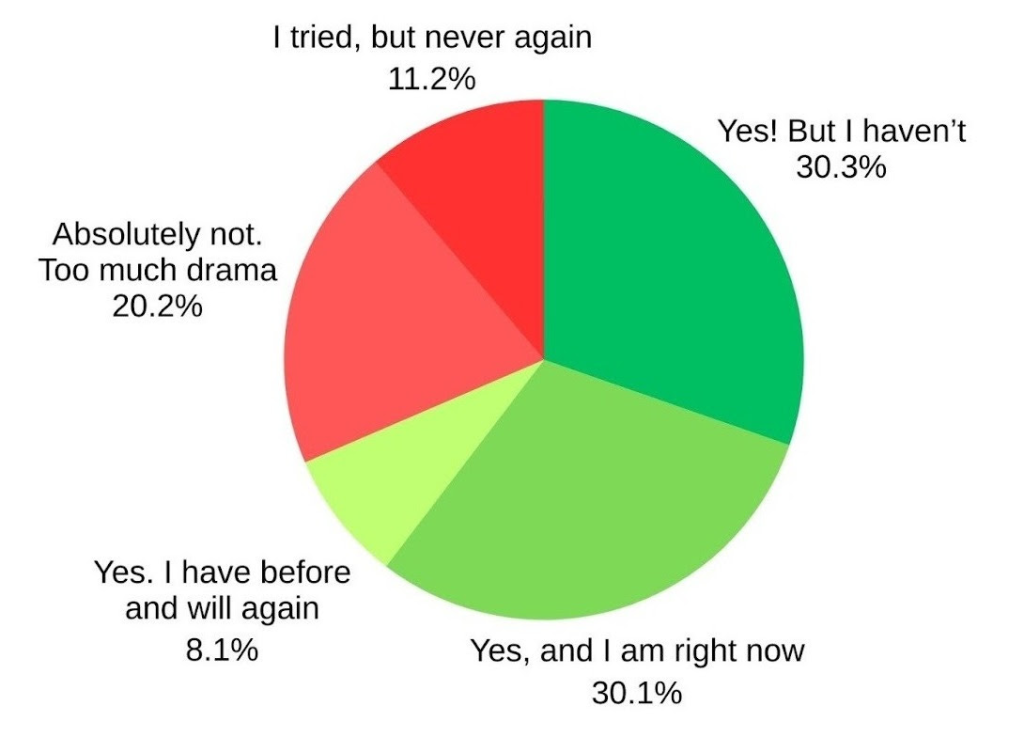
Total Responses: 356
Yes! But I haven’t: 108
Yes, and I am right now: 107
Yes. I have before and will again: 29
Absolutely not. Too much drama: 72
I tried, but never again: 40
These responses complicate the narrative that I sometimes hear about Transy’s dating scene being hopeless.
When asked, “Would you date another Transy student?” 244 (68.5%) respondents said yes, while 112 (31.5%) said no.
Breaking that down further, 108 (30.3%) said they haven’t dated another Transy student but would consider it; 107 (30%) said they are currently; and 29 (8%) said they have before and would again. Only 72 (19.7%) selected “Absolutely not. Too much drama,” and 40 (11.2%) said they had tried and would never do it again.
Those numbers suggest that most students are at least open to dating within the Transy bubble. The same sentiment seems to carry over into the proposal of marriage, which I asked about in the next survey, which was first posted on February 14, 2026:
Would you CONSIDER marrying another Transy student? (even if you’re not currently dating one or think it’s likely)
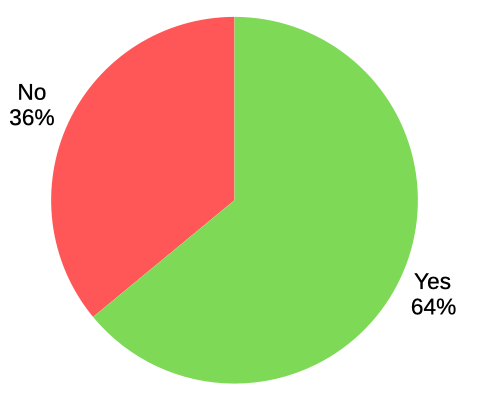
Total Responses: 239
Yes: 153
No: 86
Asked whether they would consider marrying another Transy student, 153 (64%) said yes, while 86 (36%) said no. These numbers closely correspond with the 68.5% of students who are open to dating.
But when the question shifts from possibility to plausibility, enthusiasm fades, as shown in the third survey, also posted on February 14, 2026:
Do you think you will marry another Transy student?
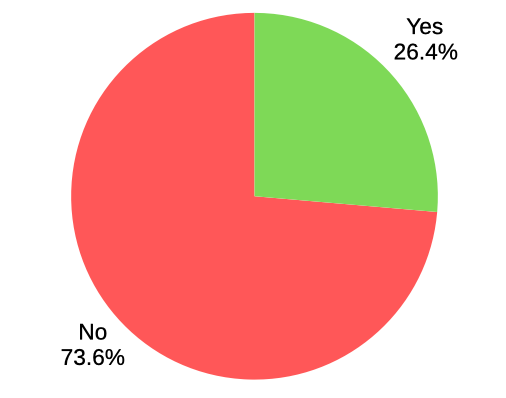
Total Responses: 292
Yes: 77
No: 215
When asked more directly, “Do you think you will marry another Transy student?” only 77 (26.4%) said yes, while a whopping 215 (73.6%) said no. The drop is striking. While nearly two-thirds of respondents are open to the idea of marrying another student, only about one-quarter actually expect it to happen. But even so, 77 students who confidently believe they will marry another Pio: that’s a significant number!
Experience also shapes attitudes. When asked whether Transy students have dated another student before, responses were nearly split: 176 said yes and 180 said no. That divide demonstrates how seriously common campus relationships are, while also revealing that a significant portion of students avoid them entirely.
The comments on my posts help explain why. Many concerns appear less rooted in incompatibility and more in social consequences. One respondent warned that dating another student would be “the [worst] experience of your life if you break up,” while another simply pleaded, “Please don’t do it. It’s terrible.” On a campus this small, breakups rarely stay private; your business is everybody’s business.
For some, the risk feels so high that they avoid campus dating altogether. Twenty percent said they have never and would never date another Transy student. Several mentioned preferring to date outside the university instead. One respondent said they prefer “blue-collar” workers, while another noted that “UK is down the street,” implying that a larger campus offers both anonymity and emotional safety.
The YikYak responses reveal a campus caught between desires and self-preservation. Students are not opposed to dating each other; many are actively doing so. But in a social world where circles overlap, and stories travel quickly, commitment requires not just affection but confidence that the risk is survivable.
One comment stood out for its misogynistic tone: “Just don’t date the women here and you’re fine.” The remark sounded familiar to me. I suspect it reflects a deeper undercurrent of gendered tension that may be intensified by campus demographics.
During my first year, 2022-23, undergraduate enrollment at Transy was 59% female and 41% male. This dynamic reflects broader national trends in higher education. According to Forbes, women now make up the majority of college students nationally, and in Kentucky, women graduate at significantly higher rates than men. On a female-majority campus, that imbalance shapes the social economy of dating.
In the context of straight dating, sociologists describe this dynamic through sex ratio theory; when one gender is in shorter supply, members of that group tend to gain disproportionate dating power. Research shows that on female-dominated campuses, straight women report going on fewer traditional dates, are less likely to have boyfriends, and engage in more casual sexual relationships. Even if such women want commitment, there may be fewer men willing or incentivized to offer it. In that context, because hookup culture has become more like a prerequisite for participation in the dating scene, women are not necessarily given an active choice. (Obviously, the sex ratio theory described above only describes one portion of the dating scene, leaving out LGBTQ+ couples who face very different questions of supply and demand.)
As for all those friends of mine with engagement rings, there’s one factor that feels impossible to ignore: every single one of them was a member of a sorority. That makes sense: Sororities and Greek life in general shrink an already small campus into an even tighter social circle. Formals, living in Bassett, philanthropy events, parties, Snapchat group chats, and overlapping friend groups all create constant proximity. There’s a selection effect here, too: A lot of my close friends are in Greek life! But it’s not just me—on a campus where 40 percent of students participate in Greek organizations, that could be a factor in Transy alums tying the knot.
My own experience doesn’t necessarily fit neatly into one narrative. I have dated another Transy student before, and I genuinely enjoyed it. There’s something uniquely comforting about being with someone whose life already overlaps with yours—the same class schedules, the same professors, and the same stress over midterms. Our social lives blended easily. Our friends knew each other. We understood each other’s routines, priorities, and campus quirks without much explanation. It felt natural.
Even though the aftermath of a breakup at Transy can feel like your entire social circle is collapsing—with friends of friends asking what happened and nasty stares from your ex’s buddies—it eventually fades out. Things go back to normal. The effort to find a genuine, long-lasting connection couldn’t be a waste of time when the goal is to find companionship during such a tumultuous chapter of our lives. I wouldn’t be opposed to doing it again, even if the window for campus romance is slowly closing.
At the same time, I’m hesitant to imagine my entire future mapped out before graduation. I want to move to a new city, pursue opportunities wherever they take me, and travel while I’m young. That doesn’t mean I’m entirely opposed to relationships right now. But “ring by spring” feels like an unnecessary ticking clock. Who knows? Maybe in a few years, I’ll run into a Transy alum while visiting Lexington and…the rest will be history.