

The documentary Resistance in the Redline, which played on Jan. 22 in Carrick Theater, discusses themes of racism, housing, gentrification—and the intertwined ways they contributed to redlining in Lexington.
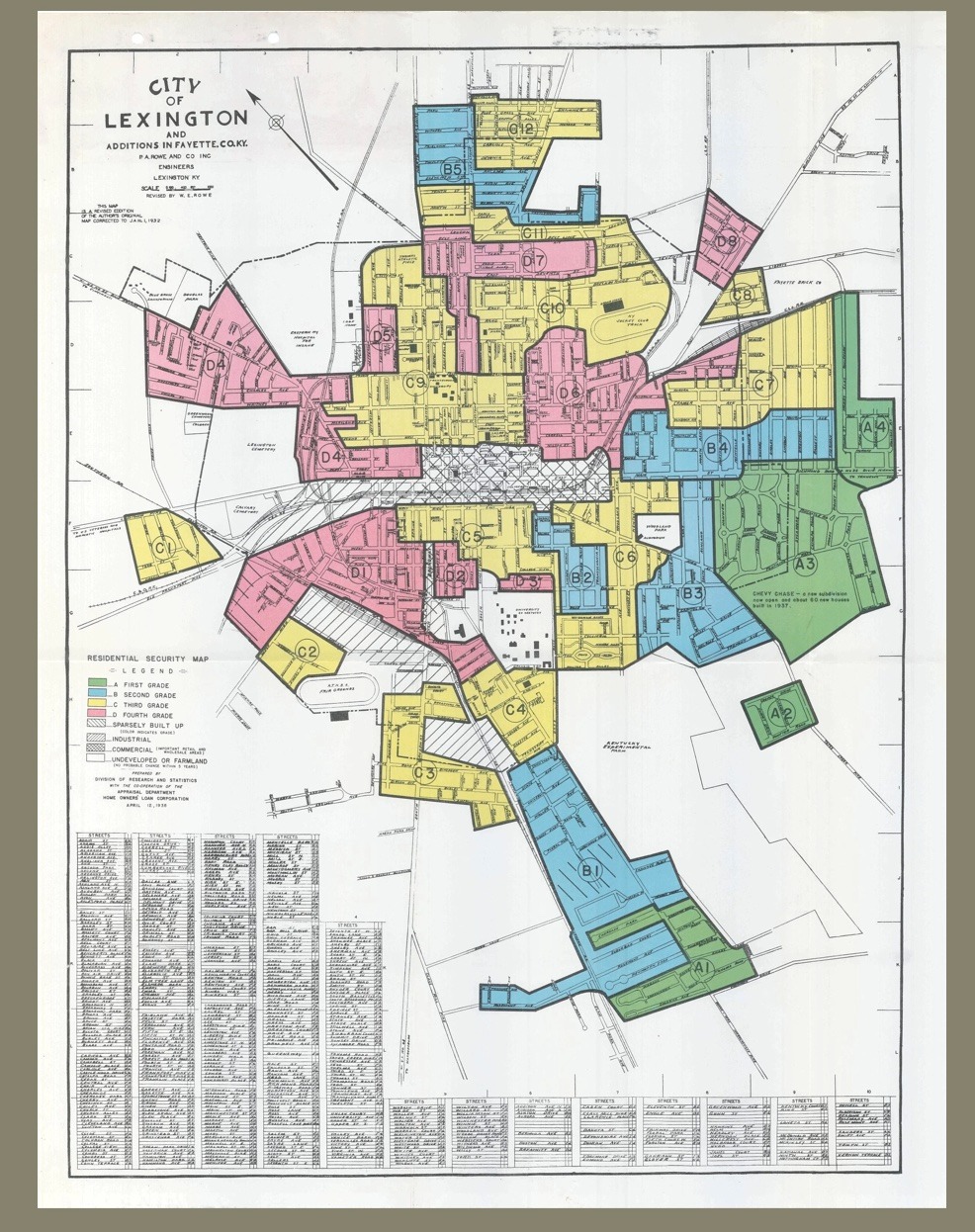
Redlining refers to the discriminatory practice of denying financial services to a particular community. The term was first coined in the 1960s, but the practice dates back to the 1930s, when a federal agency created color-coded maps for almost every major city in the U.S. They drew red lines around communities that were considered “undesirable,” predominately Black neighborhoods, and green lines around ones that they considered to be the most worthy of investment; yellow and blue fell in between these two extremes.
Black Yarn, which produced Resistance in the Redline, is a nonprofit organization based in Lexington committed to bringing light to the systematic harms that the Black community faces. In addition to film production, the group also conducts research, creates podcasts and short videos, and organizes community events.
Resistance in the Redline presents more than 30 interviews with members of the Lexington community who have either been affected by redlining, have seen the effects of it, or have researched and examined redlining.
These first-hand accounts from Lexingtonians are what bring the film to life. Bill Wilson, for example, recounts his childhood view of larger, newer houses belonging to white people, while Black people lived in smaller houses. He asked his father about seeing a brand new house in their neighborhood that he says “look[ed] like a white person’s house.” His father explained to him that “Black people normally weren’t building houses or living in houses like that; that person was very, very lucky.”
Adrienne Thakur tells a story of her mother’s parents buying their first home, which stayed in the family for over 60 years. Her mother, then in second grade, was excited, but Thakur’s grandfather told her mother: “there probably wouldn’t be any more birthdays and there wouldn’t be any more Christmas because it was going to take everything they had to own this home.”
Wilson and Thakur lived in the very same city as people in Lexington who look like most Transy students—white people. But as the film’s narrator puts it, because of inequitable and racist systems, “shared spaces don’t always equal shared experiences.”
The Home Owner’s Loan Corporation, a federal agency originating from the New Deal, gave birth to redlining through the creation of their color-coded maps. Their ratings, ostensibly designed to evaluate investment risk, affected how resources were allocated to each district. Because of the ratings, people living in green or blue (more desirable) areas were more likely to have access to lines of credit, health care, internet, and education than those living in yellow or red (less desirable) zones.
Today, well after the Fair Housing Act of 1968 made discrimination in housing illegal, the impacts persist. An average white family living in Kentucky has 30 times the wealth of a typical Black family. The average person living in Chevy Chase has a life expectancy 16 years higher than a person living on the north side of town. White people make up 61% of Lexington homeowners while only 33% are Black people.
The imbalance of wealth is due in part to the decades of Black people being denied home loans, and the continued inequity of the mortgage process, with Black people having a higher likelihood of being denied home loans than white people.
“We think of the words in the Declaration of Independence,” says Regina Lewis, a Ph.D. candidate at the University of Kentucky Martin School of Public Policy and Administration, toward the beginning of the film. “‘We hold these truths to be self-evident, that all men are created equal.’ However, all has never, in our history, included the all.”
To capture the complexities of racism in housing that still exists to this day, the film describes the “three R’s:” redlining, racially restrictive covenants, and real estate steering.
Racially restrictive covenants were written into deeds to prohibit property from being sold to people of a certain race, and real estate steering refers to realtors showing certain houses to people of certain races. Both of these practices, along with redlining, are illegal now—but the mortgage industry continues to artificially inflate the value of predominantly white neighborhoods. The median home value in Ashland Park, a predominately white Lexington neighborhood, is $504,100, while the neighborhoods along Georgetown Street, a predominately Black area, have a median home value of $74,800.
Someone living around Georgetown Street can get an education, work hard, and save up to buy a home. But the equity of their new home wouldn’t increase as much as it would if they lived in a formerly green-lined community, because local governments continuously fail to invest resources into their schools, health care, road maintenance, and other services that increase home value.
The film also traces the roots of inequity much further back than postwar redlining. After the Emancipation Proclamation, enslaved people were freed without resources, grants, land, or loans. They didn’t have the opportunity to succeed or grow wealth. They were set up for failure, and it continued for decades after emancipation.
Art Crosby, the executive director of the Kentucky Fair Housing Council, compares it to a game of Monopoly in which some players have been acquiring property through many rounds of play. “Then a new person comes in and says, ‘Okay, I want to play now,’” Crosby says. “It’s really easy to say the rules are the same [for everyone].” But the history of oppression means that some players are starting the game behind.
The film then explains how the city of Lexington executed a plan of redlining beginning in the 1920s.
Derrick White, professor of History, African and Africana Studies at the University of Kentucky, tells the story of soldiers receiving financial benefits from the federal government after they returned from World War II. Benefits included access to education and lower interest rates for home loans.
During the postwar Baby Boom, the number of suburbs in Lexington grew. Deeds either stated that these houses were only for white people or explicitly excluded Black people. While Black soldiers received benefits from the G.I. Bill, they were unable to use them in the same ways that white soldiers could.
Beginning in the 1930s, federal housing authorities funded Lexington’s first public housing project, which was segregated. Aspendale, all-black development, was separated by an eight-foot-tall, three-hundred-yard, chainlink fence from Bluegrass, an all-white development. The fence came down in 1974 and the desegregated community became known as Bluegrass-Aspendale until its demolition in the early 2000s.
In the film, Jamari Turner recounts her experience growing up in Bluegrass-Aspendale saying that there was a strong sense of community. Kids were always playing outside, she recalls; everyone knew each other, and there weren’t major conflicts among neighbors. Few of the Bluegrass-Aspendale homes that were demolished between 2002 and 2006 were replaced with genuinely affordable housing, leaving these residents with limited options once the community Turner describes was gone.
What happened to Bluegrass-Aspendale fits a pattern of displacement of Black families without giving them reasonable alternatives. The thriving, predominantly Black neighborhood Adamstown was destroyed and replaced with the University of Kentucky’s Memorial Coliseum in 1950.. Residents of Adamstown were forced to uproot from their homes for an arena and parking at a university that had zero Black students at the time.
Despite these setbacks, Black Lexingtonians built a strong middle class within their neighborhoods. After the Civil War, resilient Black communities began to form in Lexington, mainly in undesirable locations: near the railroad, flood zones, and the city jail.
Regardless of the challenges they faced, the Black population of Lexington doubled between 1860 and 1870. Black communities built their own economies, schools, and churches. Some of their developments are still visible in Lexington today, but others were erased as leaders prioritized urban development over the preservation of existing communities.
Chester Grundy, another Lexingtonian featured in the film, was one of only 60 Black students out of the University of Kentucky’s student body of 16,000 when he attended during the 1960s. To combat the feeling of unbelonging, he and other Black students frequented churches, clubs, and the Lyric Theater to find connection. In the film, he explains that they wanted to make UK more welcoming for future Black students.
In one bracing moment in the film, P.G. Peeples, president of the Urban League of Lexington-Fayette County, describes feeling blessed that his experiences growing up in Lexington benefited from the work done by prior activists in the community—even though many obstacles remained. “It still was tough times,” he says. “But we said, ‘bring it on.’”
For decades, Lexington turned a blind eye to the horrors of slavery and the various forms of legal and extralegal discrimination that followed. Resistance in the Redline highlights progress made in recent years by various activists and institutions in Lexington. Tandy Park now hosts seasonal farmers’ markets downtown; in 2018, the city finally erected a sign to explain that the park once hosted slave auctions.
The aftermath of redlining continues to harm Black Lexingtonians, but there are other signs that the city is at least beginning to reckon with its ugly past. During the Civil Rights movement the Lexington Herald avoided covering the protests, reportedly because the paper’s management believed it would reflect poorly on the city. In 2004, the same newspaper released a series of stories about this lack of coverage.
Films like Resistance in the Redline are essential to bringing light to the challenges that Black people still face today—and to educating our community about the root causes embedded in the histories of cities like Lexington. With the work of city leaders and organizations like Black Yarn, we can take the first steps of learning our history so that we can avoid repeating problems of the past.
As Transy students we might make our own lasting roots here, or we may just be passing through for college. But at least for now, this is our home. And it’s up to all of us to work together to reckon with this history, so that we can imagine a new future: a community for all.