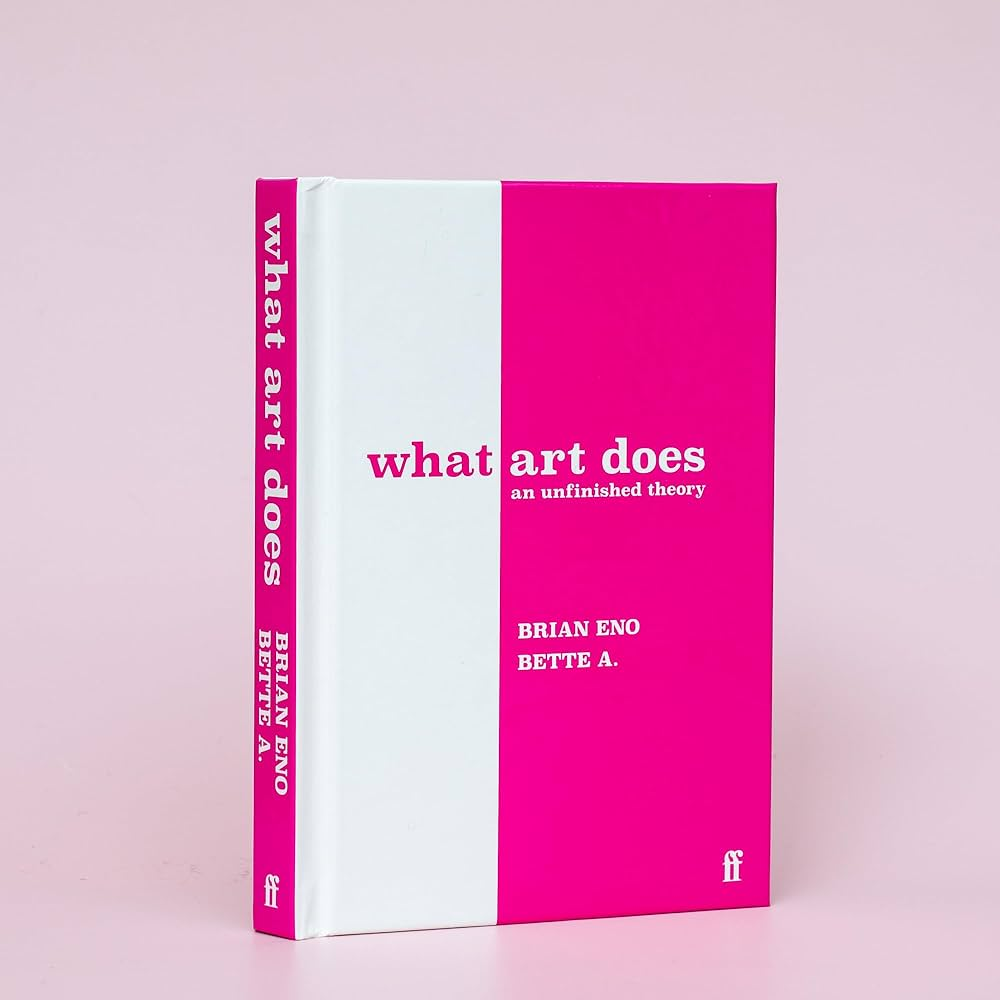
Green Room Exchange operates less like a traditional concert series or talent agency, and more like a cross-cultural laboratory. It’s designed to reframe how Lexington experiences other places and communities, not as distant, unheard foreign things, but as relationships worth maintaining and conversations worth having. That sense of closeness to art and art making is one of the things that make Green Room Exchange (GRE) so special (and so similar to Brian Eno, but more on that later). I had a wonderful conversation with the founder Lee Carroll about GRE’s challenges, successes, and the many unique aspects that make the organization unlike any other in Lexington. Our conversation, as well as the research I conducted on GRE, led me to see the organization in conversation with Brian Eno’s claims in What Art Does, such as art as a simulator, a social technology, play, and collective creativity.
GRE’s goal, as listed on their website, is to offer the opportunity “to see other cultures through the eyes of those who live there, using the universal language of music and art.” They achieve this by bringing international musicians to Lexington to perform, sometimes teach, and collaborate with local artists. It sounds simple, but the process of finding musicians is extensive. Lee travels to different music festivals around the world to scout for talent to bring to Lexington. Recent performances include Hermanos Villalobos, a folk fusion group from Veracruz, Mexico, in September of this year, and a fusion festival of Indian classical and world music in June. Lee visited Ghana, Cuba, Mexico, and various countries in Europe, and every time, what struck him over and over again was how relationships with artists felt so welcoming, humbling, and human, and that’s precisely what he wanted to bring to Lexington.
Getting the first series of events started was a difficult task, filled with challenges along the way. Navigating through travel barriers, visa requirements, funding, and venues presented obstacles that GRE deals with to this day. Because world music can be niche in a place like Lexington, there was a learning curve in marketing and building trusting relationships. Additionally, when the organization started working on creating workshops as well as shows, the already present challenges demanded more time, relational energy, and resources.
Now, Lee and the rest of the crew (made up of various artists who take part in administrative duties) have a more robust operations process. Artists’ identification and relationship building remain the first steps, often via travel, social networks, and pre-existing connections. Then the invitation and logistical arrangements take place, which consist of visas, scheduling, travel, securing venues, and rehearsals. While these first two steps take place, funding and budgeting are occurring around the clock. Lee serves as treasurer as well as founder, so during this time, he is also focusing on looking for grants, sponsors, ticket revenues, managing the costs of travel, lodging, artist fees, technical setups, and fundraising via events or local support.
According to Lee, aside from overcoming audience bias and cultural prejudice, the most difficult and time-consuming portion of the whole process is funding and budgeting. The final two steps, local engagement and performance, take care of themselves by the end of the process, although they are also arduous in their own way. Arranging workshops, educational components, and marketing all fall into place around halfway through the process.
The final performance/concert step often has multiple components: main show, smaller show or collab, sometimes talk or lecture to provide cultural context. Once all of those components have taken place, that means there are still two more things left to do. Documentation is extremely important to the mission of the organization, as it allows continued and accessible access to music and art that stands the test of time. Documentation is so critical to GRE that there is a dedicated section on the website with a video and photo archive going back years. Videos, photos, and audio recordings are all uploaded either to the website or to their Facebook page, which is their most active social media. Staying in touch with artists, perhaps with return visits, and evaluating what went well and could improve is the true last step of the process, and it is continuous.
Beyond what’s already been touched on, Lee mentioned some recurring challenges that the organization has had to learn to overcome. Financial constraints, although not huge since the organization is primarily privately funded, present significant obstacles when it comes to technical costs and the fees associated with all the logistics required to move artists around the globe. What seems to be the most difficult is audience development and bridging demographic gaps. Building awareness in Lexington for music forms that may be unfamiliar to the majority is difficult.
Most people are closed off to what they don’t know, so not only does people’s initial apprehension due to lack of familiarity present an issue, but so does prejudice, which makes it even more difficult for events like this to take place. Lee and I discussed politics and the current attitudes of Americans towards those of other cultures. It is extremely difficult to get people to come to a show when they have already dismissed both the artist and the music as weird and strange. Attracting audiences for this organization is therefore less about marketing/advertising and more about getting people to trust that such events are worthwhile.
This is the part where Brian Eno comes in. According to Eno, art is a simulator that allows an audience to inhabit alternative realities. When a Kora drum master performs in Lexington, the performance area becomes a short-term simulation of a musical lineage rooted in West African social life. People aren’t just listening to music; via music, they are rearranging their attention. In Eno’s language, they are becoming part of mini-worlds that people can step into and experiment with that expand the range of what the local community can imagine and practice.
Eno stresses that art’s value often accrues through social effects: it binds people into shared practices and generates new forms of attention, as well as uniting communities. By bringing artists to audiences, documenting these exchanges, and creating collaborative environments, GRE creates a social technology that fulfills its mission. Especially when they host workshops, more than entertaining, these events facilitate an environment where listening, learning, and co-creation can create community bonds. Over time, these bonds can translate into broader civic benefits such as deeper intercultural understandings that can sustain further exchange. By creating repeated, structured encounters with world music traditions, the organization expands Lexington’s cultural reach and offers tools for empathy and connection in a region that is sometimes stereotyped as being culturally homogenous. To Eno’s joy (hopefully), GRE makes new ways of feeling, living, and playing happen. Those worlds in which people can play and learn influence how the city thinks about its identity, its relationships to migration and globalization, and its capacity for cultural hospitality. Because Lee Carroll and GRE treat hospitality as a cultural bridge, it demonstrates how a small, focused arts organization can enact many of the things that Eno says art “does”. In the current political environment, where anything different or new is discarded as dangerous or inferior, GRE’s mission is vital to maintaining a sense of unity and connection across geographical boundaries. Reshaping feelings, attention, and cultural understanding is something that music has always been able to do, and that magic has been furthered in Lexington in a unique and powerful way.



Has the Well of SNAP Run Dry?
Americans across the country have had their social media feeds flooded with SNAP-related posts, videos, and calls for action. Users have reposted headings and articles centered around the decline of the federal program, spreading awareness of the potential elimination. What exactly is SNAP? How did it originate, and why is it crucial for millions living in the United States?
The Supplemental Nutrition Assistance Program, widely referred to as SNAP, is a federally funded program that distributes money for food to underprivileged Americans. Previously known as the Food Stamp Program, SNAP has paved its way to becoming the largest federal nutrition program in the country, feeding 1 in 8 impoverished persons per month. Amidst the federal government shutdown, nearly 42 million Americans are at risk of losing food and nutrition benefits. SNAP is not a new program by any means, though, hence the national pushback over the loss. How did it come to be?
The origins of SNAP date back to the Great Depression, as a way to distribute excess farm commodities such as wheat and livestock. With the passing of President Franklin D. Roosevelt’s New Deal, the Agricultural Adjustment Act of 1933 was established, providing more income for farmers and distributing food for the impoverished. Carrying out the mission in 1935, the Federal Surplus Commodities Corporation began to purchase, transport, and distribute food to relief agencies across the country. With the system seemingly replicating the services provided by the grocery industry, there was national defiance; in hopes of ending the discourse, Secretary of Agriculture Henry Wallace created the first Food Stamp Program.
Through years of research and experimentation, the Food Stamp Program was made permanent by the Food Stamp Act of 1964. Decades of implementation, expansion, and milestones led to the Farm Bill of 2008, changing the name of the Food Stamp Program to SNAP with the switch from paper to digital stamps.
As of today, SNAP helps Americans who are eligible to receive benefits towards food. Requirements to acquire monthly stamps include having a gross household monthly income at or below 130% of the poverty line. Recipients must also have proof of employment to maintain the average, individual amount of $187 per month. Upon achieving eligibility for SNAP benefits, individuals will be issued an Electronic Benefit Transfer (EBT) card, allowing for the purchase of food groceries.
So, why is SNAP so important, anyway? And, how will the delay of payments affect Kentuckians? Well, the access to food provided by SNAP helps families in poverty, veterans, and disabled people. With federal help with allocating money for groceries, people in need can properly budget their personal money for rent, bills, and non-food essential items without the worry of putting food on their plates. By delaying and minimizing SNAP benefits from being issued to Americans during the government shutdown, only 50% of eligible households will be covered by emergency funds, leaving millions across the country on their own to find money for crucial nutrition needs.
Zooming into home, approximately 600,000 Kentuckians, 225,000 of whom are children, utilize SNAP. Such vulnerable citizens will be left with empty cupboards, despite Governor Andy Beshear’s efforts to combat the disruption by suing the U.S. Department of Agriculture (USDA).
I reached a grim realization when researching the USDA’s extensive history of the Food Stamps Program. Despite their official and accurate information, the message headlining the website holds an unfortunate series of words: “Senate Democrats have now voted 13 times to not fund the food stamp program, also known as the Supplemental Nutrition Assistance Program (SNAP). Bottom line, the well has run dry. At this time, there will be no benefits issued November 01. We are approaching an inflection point for Senate Democrats. They can continue to hold out for healthcare for illegal aliens and gender mutilation procedures or reopen the government so mothers, babies, and the most vulnerable among us can receive critical nutrition assistance” (usda.gov).
With the clear bias referring to the Democratic party, along with the negative connotation regarding immigrants and gender-affirming care, the issue of accuracy in governmental sources has become relevant. If we can’t go to the federal archives for information, where can we go? If we can’t rely on our government for properly budgeting money and resources during a shutdown, who can we rely on?
All in all, the instability of SNAP benefits makes for a scary time in our country. If you or your family is struggling amidst the change, though, do not give up hope. The City of Lexington has partnered with God’s Pantry Food Bank and various community organizations to launch “Lexington’s Big Give”, a city-wide food drive. Collecting food for families across the Commonwealth, both God’s Pantry and The Family Care Center are available resources for Kentuckians in need.
You are not alone in this time of uncertainty. The well of SNAP will not run dry without a fight or support from our community.