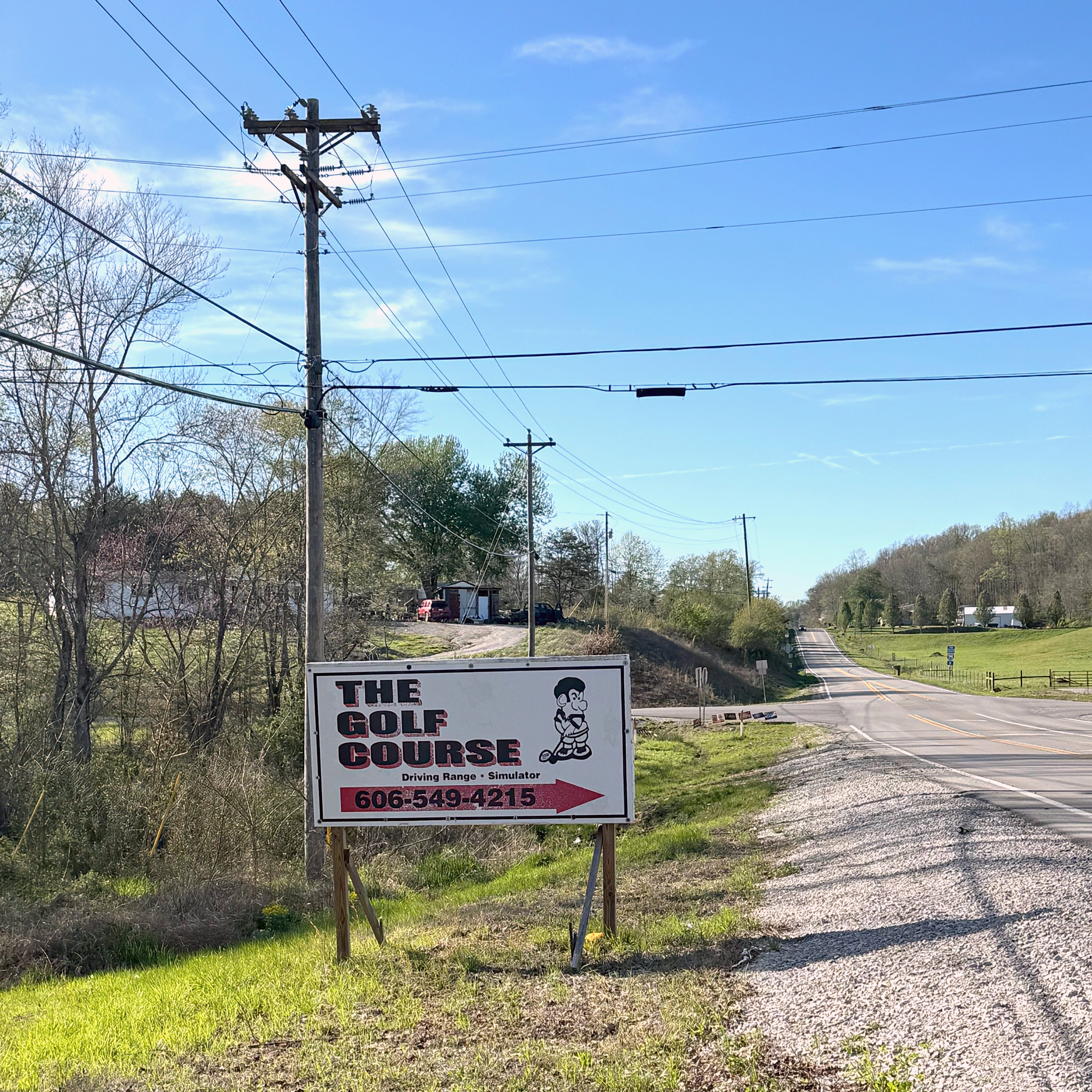
If you ever find yourself cruising down Cumberland Falls Scenic Highway between Williamsburg and Corbin and accidentally pass the turn to see the scenic waterfall, you will drive past a sign that says “THE GOLF COURSE” in big bold text.
Below the large lettering, the sign advertises a driving range and golf simulator. Both are nonexistent. Above the sign is a big red arrow pointing toward Old Airport Road, a paved, wooded path that splits off from the state highway, beckoning any unfamiliar golfer or willing drunk to spend the afternoon on the semi-green links of The Golf Course.
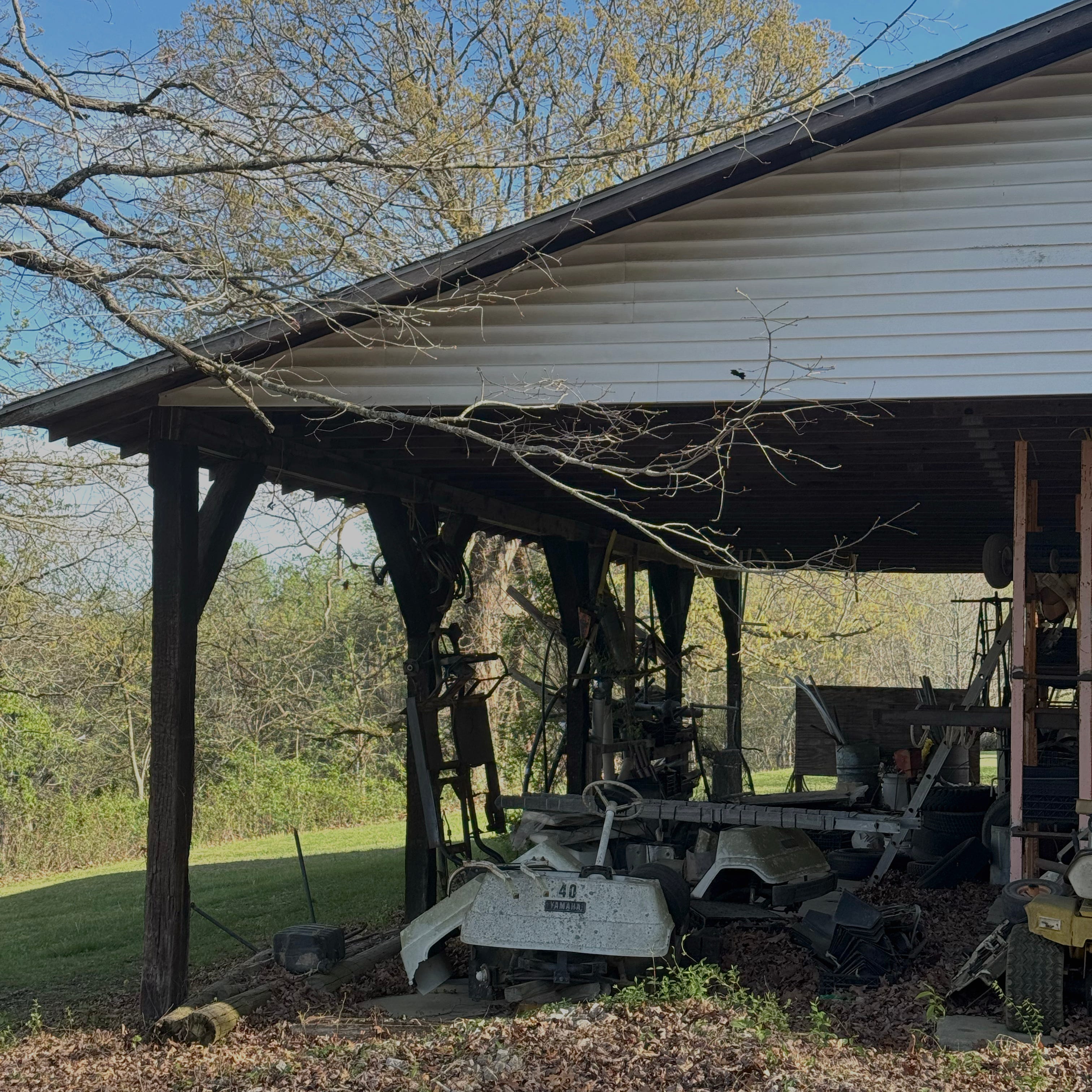
For those who turn at the big red arrow, the drive up Old Airport Road is similar to most Whitley County roads. In the summertime, prime golf weather, both sides of the road are consumed by invasive green kudzu smothering the fences and power lines that trace the road. First-time visitors have no real indication of a golf club, nothing until they pass an open-air pavilion that was converted into a golf-cart cemetery. Instead of a members-only gate, visitors drive through tires and plastic bodies of carts, haphazardly thrown about the place, giving the entrance a first impression more fitting of a backwoods demolition derby.
Pulling into the cracked parking lot, you finally reach the clubhouse. The base of operations for the county’s only golf course is an old brown building with rusty metal fixtures. The outside of the building has an overhanging carport protruding off to the side, resembling an aircraft hangar protecting its fleet of golf carts. Two things become immediately clear after seeing their club cars: 1. They’re all chained together 2. Most are topless. The backstory behind the padlocked carts was an incident that implicated two boys from Bee Creek who tried to steal a few carts for some dope money in the dead of night. The missing roofs? Purely an aesthetic choice. Aside from their convertible capabilities, the golf carts have dual-purpose seats: one part cushion, the other ashtray.
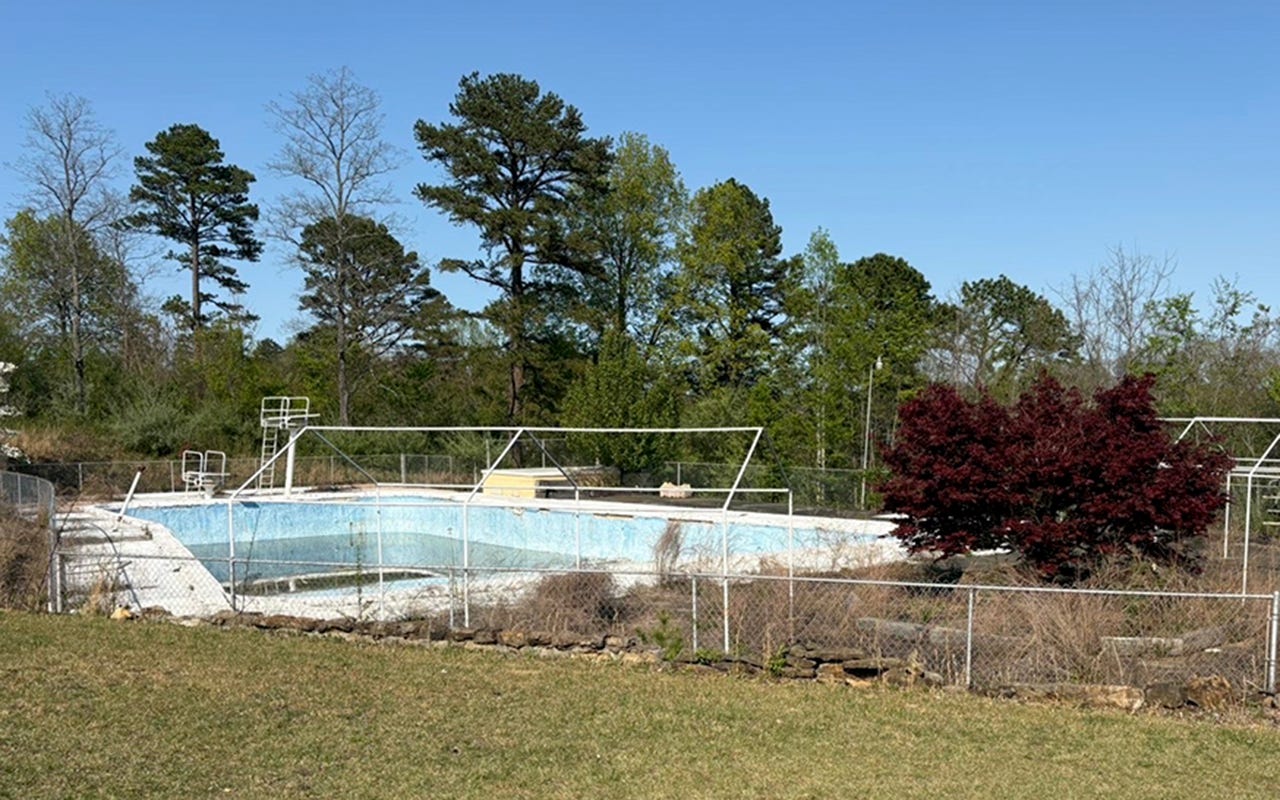
As backwards as this clubhouse sounds, it is still a country club. Next to the hangar is a bleached concrete pool deck. The pool is fitted with a diving board and high dive, one of the only in the county. By all accounts, the pool was cutting-edge summer leisure during the Reagan Administration. However, modern-day guests will find the same pool with a vacant shallow end that slants into a deep end. Accumulating at the bottom is biodiverse, stagnant, lime-green sludge. If you jump off the high dive today and the fall doesn’t kill you, the brain-eating amoebas will.
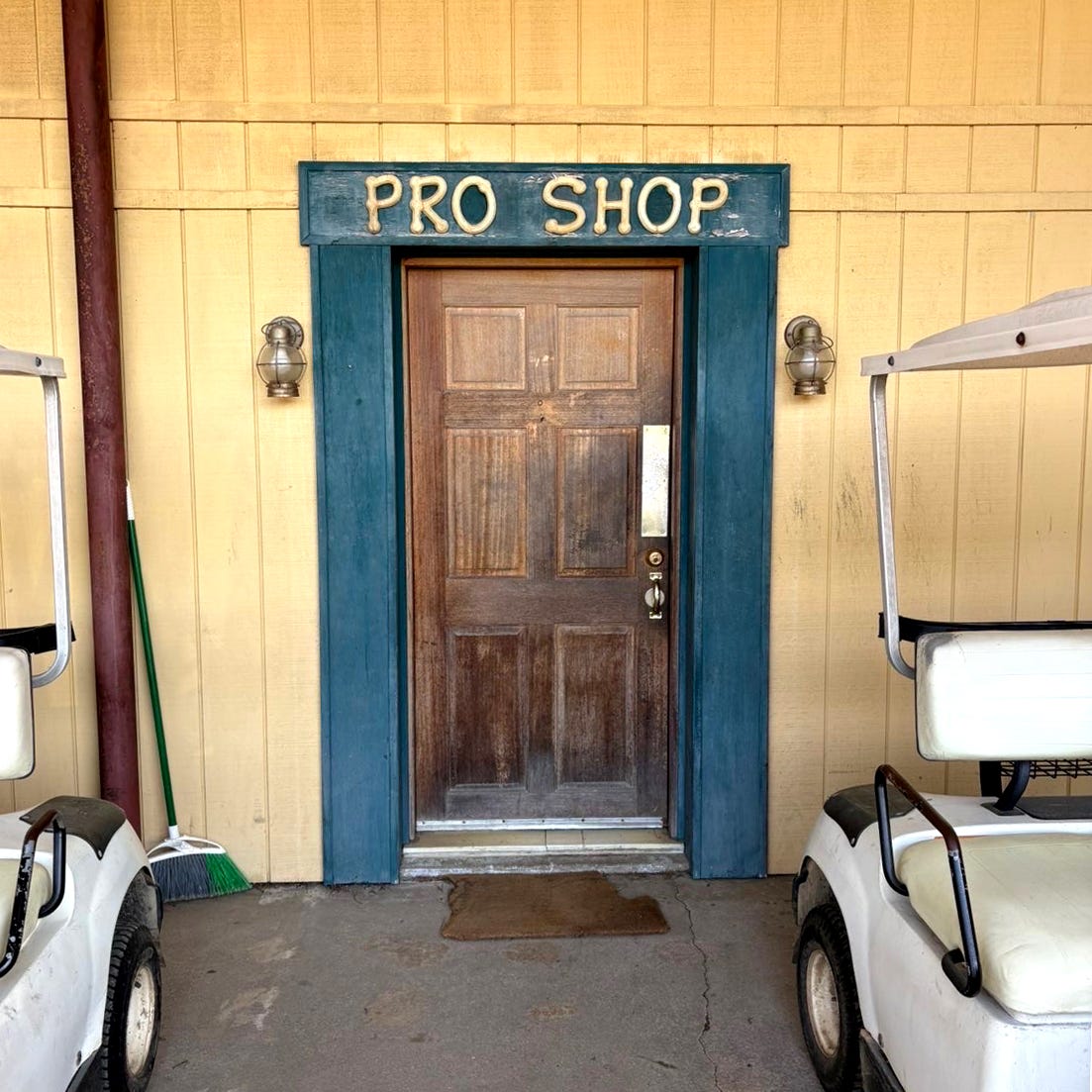
Beneath the carport is a hand-carved wooden sign above the entrance: “Pro Shop.” Upon opening the door, you time-travel into a dimly lit room with plaid home furniture and vintage golf posters ornamenting the walls. To your immediate right is a box TV that has played the movie “Caddy Shack” on a loop for the last 40 years. Across the room is a plaque cementing all Hole-in-Oner’s in The Golf Course’s history. The most notable entry was my high school baseball assistant coach, who said the only thing better than his famous round of golf was his nude beach destination wedding. The list hasn’t been updated in a few years. To keep it relevant, new hot shots write their names on sticky notes and ceremoniously slap them on the board.
The whole operation is run by a 200-year-old woman named Butch-Anne. A tough old bird, she chain-smokes Pall Mall Lights, wears glasses three inches thick, and hates my buddy Ethan (don’t ask). Butch-Anne has owned and operated The Golf Course since 1982. She got the land from a 99-year lease with the county, and I’m willing to bet she’ll be ready to resign in 2081.
I found out Butch-Anne lived in the clubhouse during a conversation with a family friend, who happened to be a member of The Golf Course. It’s not uncommon to find Butch-Anne’s toothpaste and brush in the ladies’ locker room. Over the past five years, I have built a pretty good rapport with her through chit-chat and buying peanut butter crackers from her. Word to the wise, Butch-Anne only takes cash and doesn’t know “what the hell a Venmo is.”
It’s hard not to think back to the good ol’ days at The Golf Course. Back when the pool was full (and blue). I’ve been told by my grandpa that Butch-Anne had one of the best dinner specials in the county: Friday night prime rib and salad. In its heyday, the course was the county’s hot spot. My parents had their third date there. The date lives in Croley family infamy. After the meal, instead of a goodbye kiss, Mom ran over Dad’s foot in the parking lot. By accident, depending on who you ask.
The Golf Course only has nine holes, instead of the usual eighteen. Limited by geography, most courses in Southeastern Kentucky use land that has been leveled by high-wall coal mining. Unlike its contemporaries, The Golf Course was built on top of the foothills of Appalachia, providing a scenic but difficult round of golf. Very seldom is a player on level ground with their lie. Looking onto the fairway, you can see the rolling open links, framed by green giants casting shadows over the earth below them. This attachment to the natural topography of the course offers the golfer a deep appreciation for the land. It also means a lot of balls rolling off in unintended directions.
Any time it rains, before you take a cart out, Butch Anne will say, “Now you boys be careful on the sixth hole.” The hole is a standard par four, with quick greens. The fairway has a 90-degree drop: The elevation between the tee box is greater than the distance from the hole, as the golfer launches a ball into what I can only describe as a holler. In other words, you cannot see much of the fairway in front of you, and do not know who or what might be between you and the flag. This might be a safety issue, so a rusty bell has been placed near the tee box. Any would-be drivers are asked to first ring the bell to alert any unsuspecting golfers down the slope.
The shot itself is made for gamblers. The right drive can easily net the golfer a birdie; a sliced swing and you’re left searching for your ball in a dry creekbed full of copperheads.
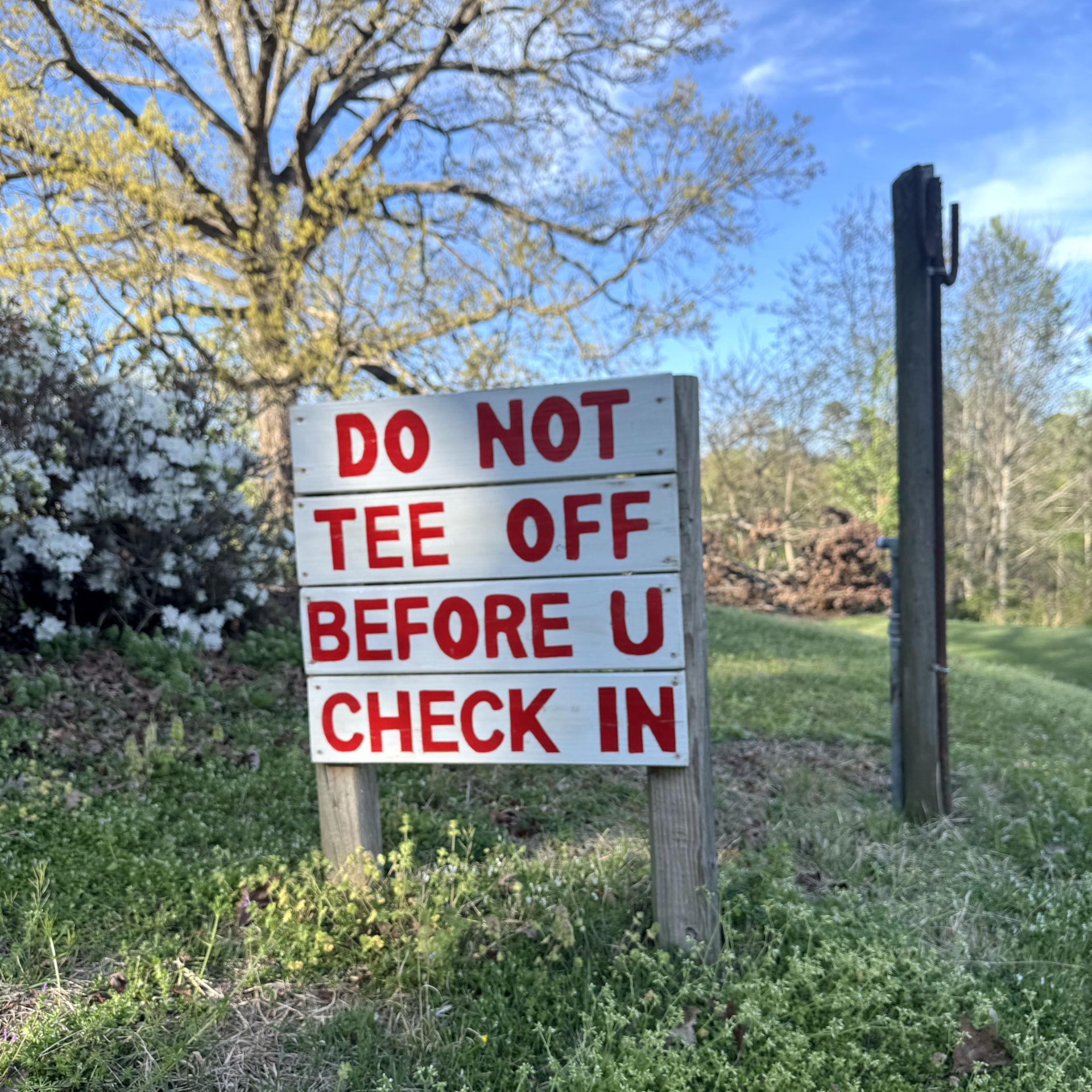
The cart paths at The Golf Course are notoriously bad. Butch-Anne once described them to the Corbin News Journal as “rough as a cob.” The worst conditions, of course, are on the sixth hole. After teeing off, the descent down the green feels more like an old wooden roller coaster than a leisurely cruise. As you creep down the hill in your cart, both sides of the path are marked with signs in bright red ink of increasing urgency: First “EASE DOWN THE HILL,” then “SLOW CART,” and finally “BRAKE.” Typically, that last sign is too late.
The first time I played at The Golf Course, in 2021, I was 16. My introduction was the same as many in my hometown—sneaking in with a few buddies and a couple beers. Sneaking in was not difficult; the Golf Course is not invested in keeping anyone out, whether they’ve paid or not.
The night before we played, I dragged my dad’s dusty golf bag from our basement. He bought them sometime in the ’90s and hadn’t played a round with them since ’05. It was a sticky summer morning when our crew rolled into The Golf Course, and for the next four hours, we wacked, chunked, sliced, and laughed. When we weren’t golfing, my buddies and I took turns racing the vintage club cars around the pond on dusty, rocky, dirt roads—a rutted-out race track surrounded by three-foot weeds. Looking back, I’m thankful Butch-Anne never had to fish one of us out.
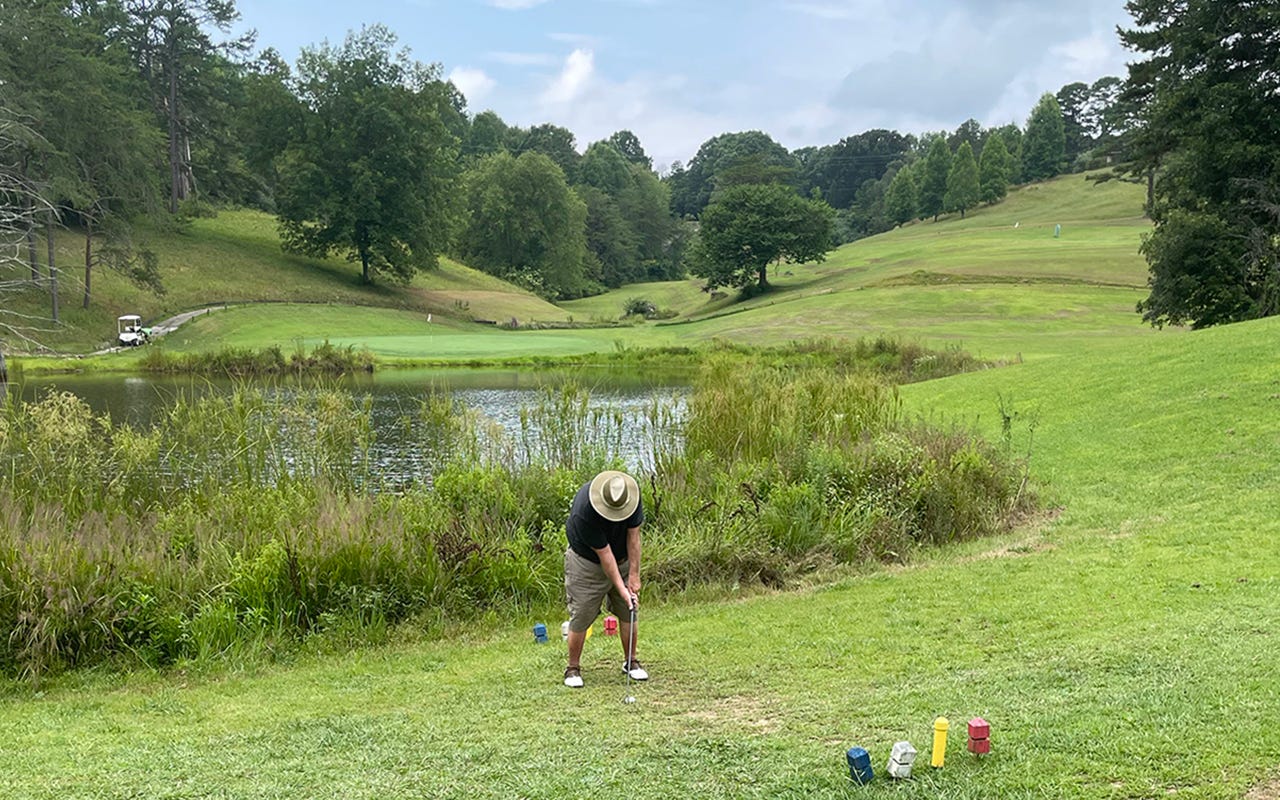
On the ninth hole, we gambled. The ninth hole is supposed to be the end of the course. We were done, but we didn’t want to be done. “Let’s run it back,” someone said. So we played the ninth hole again, and then another time. Butch-Anne, if she noticed, didn’t seem to mind. We played that hole until we all broke even on our bets. The course was far from perfect, but it was ours.
With my newfound interest in golf, it was time to play with a golfing legend: my grandpa. When I asked him to come to The Golf Course, he gave me a funny look. “I haven’t been there in forty years,” he said. He’s a serious golfer. But he agreed to come join me in the weeds.
On a damp Saturday morning at The Golf Course, my grandpa and I were about to tee off on the seventh hole, standing in perfect view of the hill on the previous fairway, when we saw a golf cart cresting the top of the path. It had been raining all morning, and as it began its descent down the hill, it was obvious that the driver had not heeded Butch-Anne’s warnings.
The cart began to slide, skidding its bald tires on the wet asphalt. The tires locked up, and the lack of traction caused the driver to lose complete control as the cart lifted from the ground and violently settled with a loud crash. Due to our proximity and moral obligation, it was a 17-year-old and a 75-year-old to the rescue.
By the time we made it to the cart, a river of beer, balls, and glass had begun to cascade down the mountain as the drunk driver and his elementary-aged son climbed out of the overturned golf cart. The driver introduced himself as Doug. He was wearing cargo shorts and a camo hat and did not feel a thing. The kid was on the verge of tears and probably shat himself. I don’t blame him, he had three more holes with Doug! After we helped them flip their cart back over, Doug offered his only unshattered Bud Light up, but we declined, and finished the round without hearing any other collisions.
You won’t see The Golf Course on any serious golfer’s bucket list. It’s not a stop on big golf trips to places with sunshine and cart girls. It doesn’t have perfectly manicured greens or a strict dress code. There are no sand traps, only craters where the sand traps used to be.
When I told my dad I was writing a story about the course, he reminded me about how strict their policy was: “The only rule is you have to keep your shirt on for the first and last holes.”
Herein lies the beauty of the only golf course in Whitley County. To play, you don’t need a membership, you don’t need high-dollar clubs, you barely need a golf shirt. Hell, the only thing you need is tick spray. But there is something special about it. Over the last 44 years at the Golf Course, Butch-Anne and her loyal patrons have grown the game in the place I call home, Southeastern Kentucky. (It hasn’t always been easy; Butch-Anne told the Corbin News Journal, “I used to think farming was hard work, but that was before I had a golf course.”)
In a sport that has been dominated by the opulent, they created a space that is open to anyone. The Golf Course accepts all. They accept Doug and they accept me.
“Golf is something that you can do with anyone,” Butch-Anne said.
Only in Whitley County. If I could only play one course for the rest of my life, I know what I’m choosing.