It was a dark and snowy night. One of those nights where the air around you feels like freedom and suffocation at the same time. When the point of an icicle catches the light just right, when the fading streetlamps turn the concrete golden. When you’re just drunk enough on joy that even standing in the cold crisp air is exhilarating.
You shuffle through the snow and remember why you fell for this university. This utopia within a cruel city. You love the life of it, its sights and sounds and smells, the unadulterated whimsy, the scholarly necks bowed to the grindstone.
It was one of those nights when you chase small comforts.
Like building a snowman.
—
Clive. The case froze me to my core. He was built with love, and then maliciously undone.
A knock on the door. It came late in the evening. A distraught dame, a Miss Buck, with a harrowing tale.
I lit a cigarette. “What’s the trouble, doll?”
“My son,” she whispered. “They killed my son and you gotta help me.”
Her words bled together. I offered her a cigarette. She took it.
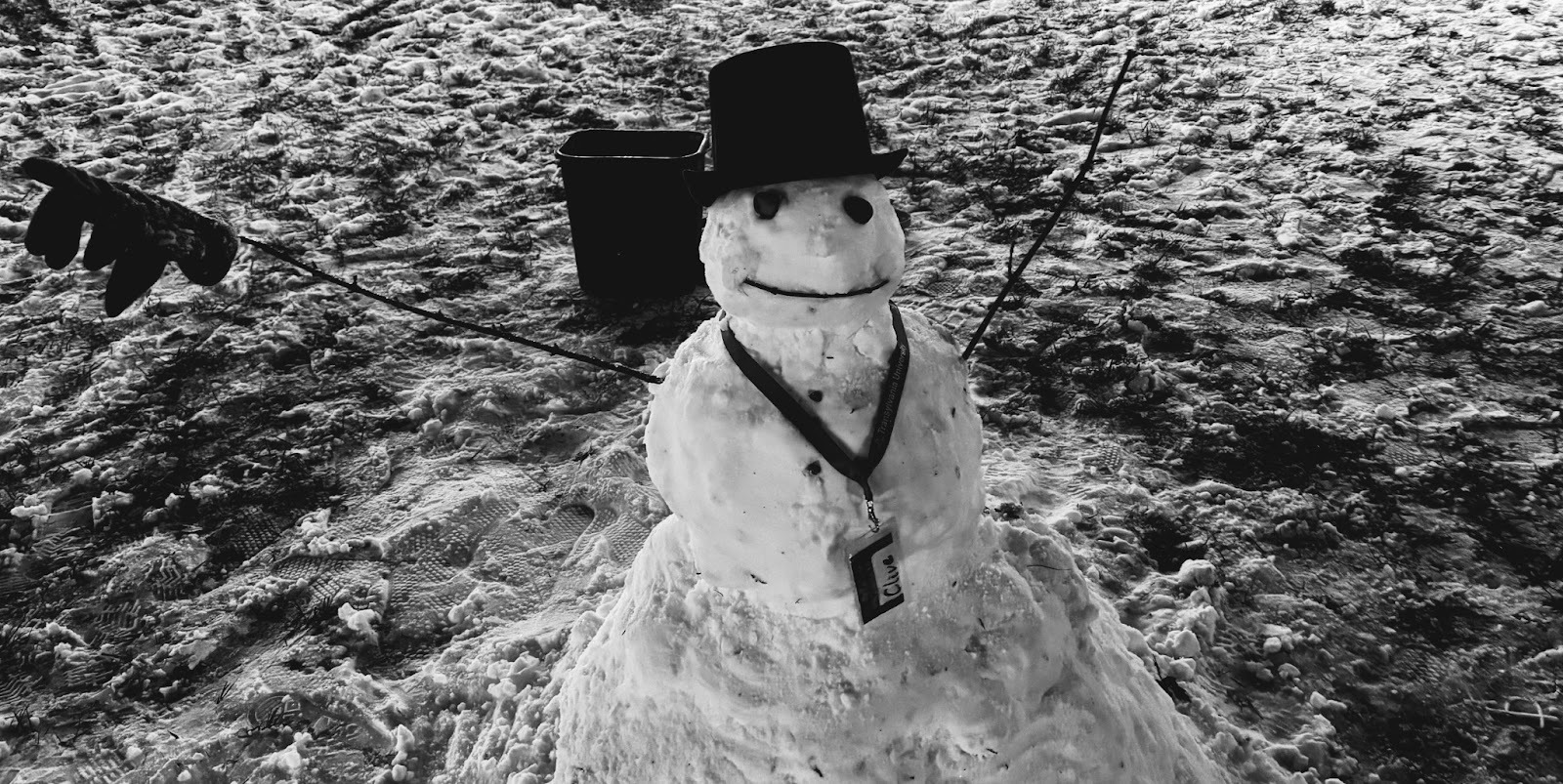
From what I gathered, he was constructed meticulously, pieced together to be a pint-sized prodigy with a dapper top hat and gloves.
“I was his mother,” she told me. “Call it what you will, but that’s the truth. Even wrote a kind of birth certificate and hung it on his neck. That night, all of us took pride in our frosted fingertips, our red noses, our dry eyes. They were testaments to our hard work.”
The words stopped suddenly. She sighed and put out her cigarette.
“Hard work,” she said, now crying as she spoke. “So easily undone.”
“What happened?”
“We went inside for warm beverages and blankets,” she told me.
Thirty minutes passed. The phone rang. He was dead.
The crime was uncovered by an unsuspecting stoolie at Dalton-Voigt Residence Hall. It was confirmed with one fateful phone call.
A snowman left headless, limbless, and helpless.
After the initial dastardly crime, the family came together and tried to revive their loved one. To scaffold his body back to its former glory before he was taken to cold storage. It worked. They built him just as before. Clive lived again. They returned once more to the warmth of Dalton-Voigt.
Thirty more minutes passed. A glance out the window.
A streak of white powder on the ground.
—
This case wore me to a frazzle. It was agonizing to unravel and damn sickening to look back on. It was the worst kind of wicked. A kind of cruelty that forces you to spin on your barstool, pie-eyed from whiskey, and think: What could make a person so malicious?
Miss Buck connected me with Julian Pies, father of the victim. I met him in the shadows of the dormitories when daylight had almost died.
“Clive was a son to all of us,” he told me. “We built him with our bare hands with love and joy in our hearts. To see his body desecrated twice…” He seethed quietly. His words saturated with sadness and anger for the bitter injustice. The man was a shell. The worst case of mean reds I’d seen this winter.
But grief ain’t a clue. There were still no stray hairs for even a wet-eared gumshoe to follow.
“Bringing Clive into the world was a nice break from hours in the library… I got to go out with my friends and bring our beautiful boy into the world.”
The man broke down. I offered him a cigarette. He took it.
“Clive was a kind soul,” Mr. Pies said, now agitated. “He would not want a witch hunt… I’m not sure I could live up to Clive’s ideal of the world, but I can’t say I have no words for monsters like that.”
This didn’t help my case.
I spoke again to Miss Buck. Her face was grave.
She offered me a cigarette. I took it.
“I put his face together,” she said. “I gave him a face and a mouth. We were on good terms. We didn’t have problems.”
I asked Miss Buck if Clive had any enemies.
“Frat boys took photos with him,” she told me. “They were so joyous and jolly, so I didn’t think they could have done it. Now, we think it was one of the rotten ones. There’s talk that someone saw a perp like that kill him and run into Bassett.”
Was this the lead I needed? Her speculation proved intriguing, but my investigation could leave no loose ends. “It appeared like they killed him by kicking,” continued Miss Buck. “We were able to reanimate his corpse… Those people are a bunch of Grinches, they kill our children, there is no soul in their eyes, and they need to drink hot chocolate to cure their ailments.”
Any human being would want justice. Justice must be served.
But it is best served ice-cold.
You try to shed a little light on things, but all light casts a shadow. To believe in a truly just world is to be at least a little unjust yourself. Real justice isn’t dirty; the people are. Dirty like footprints in snow.
There were no footprints.
—
Clive was built of snow. But not just snow. The naive joy of holiday spirit, fleeting and fragile, demanded that he be so. Held together by a family that surpassed blood relations and the temporary elation of a new life.
It’s moments like this that are all you can stand. The moment you realize that this world isn’t for you. That you’re just as tainted as everyone else, that you belong on the streets you’ve loved so long and still hate so passionately. Clive did not deserve his dual fates, yet such was the hand he was dealt.
The family wanted some kind of self-defense for their son. “We would like to rebuild Clive bigger and better, rounder, taller,” Miss Buck said “We plan to put a solid object inside of him so that they pay if they try to kill him again.” If there is a next time.
In the campus tabloids, the reaction was mixed, and some got nasty. Some students were sympathetic, telling off the old bags for bumping their gums.
It may be too cold a thought, but all that chatter may have been nothing more than a way to break the crushing monotony of impending exams.
It didn’t help my case. Nothing did. Hatchets get buried on this campus, like remains in a tomb.
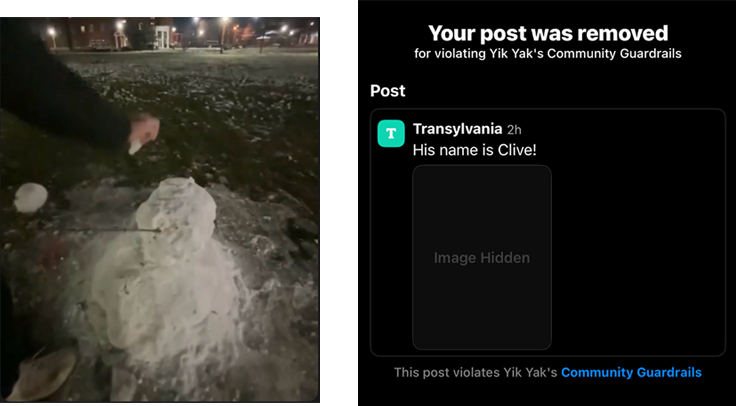
Then some damn ink-slinger took the leash on the presses and ran rampant. Photos of the killing wound up in the slicks. Graphic ones.
Taunting messages that threw accusations everywhere, but led me nowhere.
—
In the weeks that followed, I caught wind of a trail I could actually follow. A new canary came forward.
Grasping for any scrap of information, I questioned them further on their recollection, but I had hit the bricks. I was walking a blind alley with this case already. The shadows of the evening and the swiftness of the heinous act made this an impossible case. I’ve hit a brick wall. My only clue was maybe the perp had a familial tie to my informant. Turns out that damn canary was crooked.
But how to prove it? That road came to a dead end, and there was no more said.
The search continues. No suspects. No leads. The case, like the night Clive was born, has gone cold. We have only the untrustworthy yaps of an anonymous stranger and a photo of the dead.
Following the original dual homicide, supporters strove to keep Clive’s memory alive. Small snowpeople began to appear on steps and benches throughout the sympathetic dormitories.
But none of it could bring him back.
You gotta admit your own defeat, and you gotta tell the dame, too. You may even stop taking the words of a damn fink on cases like this.
And so I stopped. One evening, I knew the case was cold for good. It was one of those nights when you slump on the floor of your flat, still broken and alone, knowing that all you’ve gained from this case is cold-cracked knuckles and a few more regrets.
There had been a second of possible clarity. There had been a fleeting moment in which one could be convinced of consolation. One could catch a glimpse of humanity. One could be convinced that their childhood naivety was right. Maybe some people can be good.
But those moments never last, and they never will.
You remember the world was too cruel for Clive, who was taken too soon. When you remember he’s doomed to sleep forever on the battered ground, sticks shattered, and name tag snapped, with nowhere better to call home.
But Clive’s loving parents, so world-weary and desperate for justice, are forced to wait for the next snowfall. They are resolved to pull up their bootstraps and don their gloves. To rebuild the snowman. But when they do, what then? Nowhere to go and nothing to do but wait for the next trouble to take their son once again.
But we rebuild and wait, rebuild and wait, in a never-ending cycle. Because it’s not much of a life…but at least it’s living.