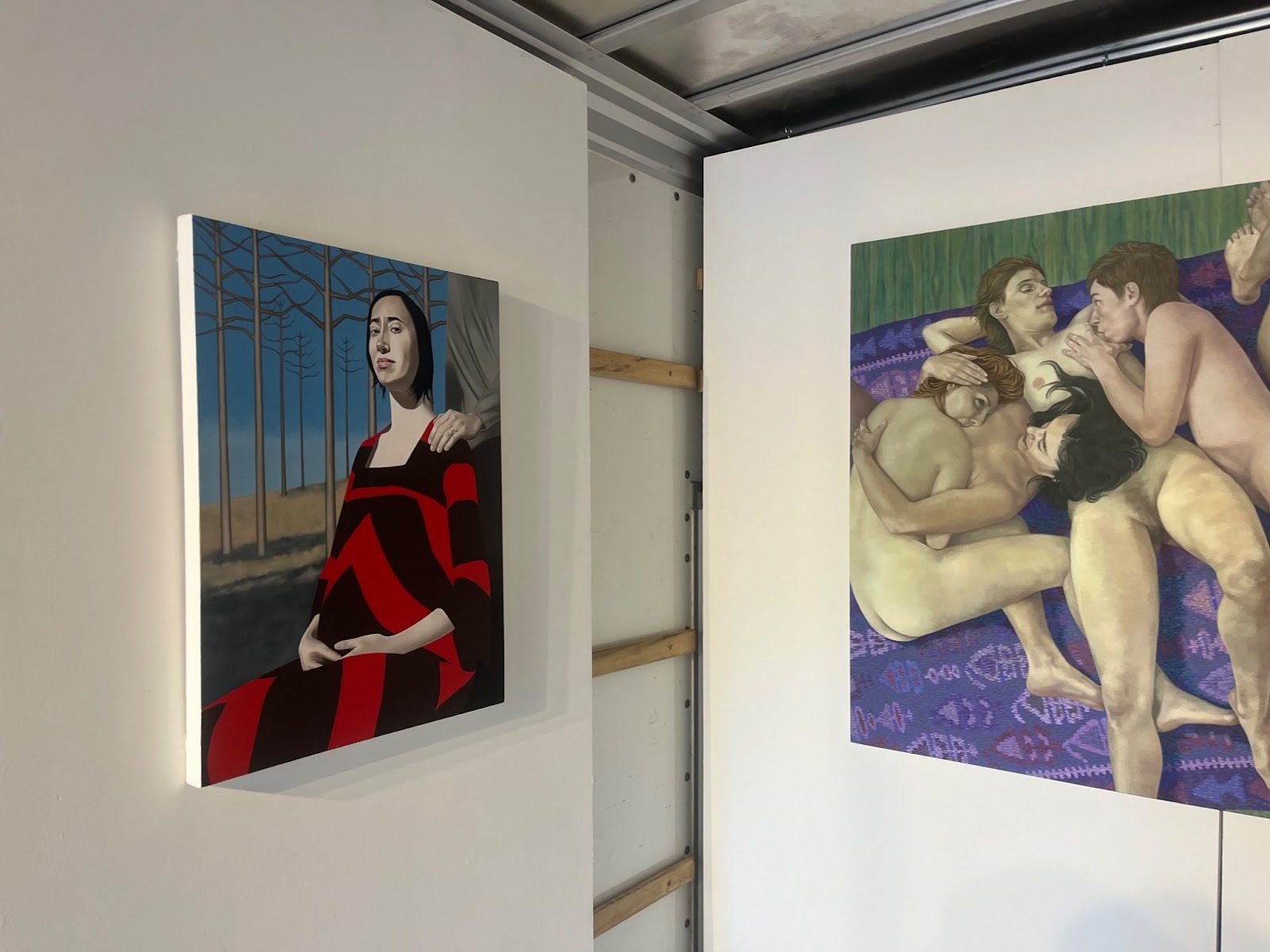
Have you ever been to an art exhibit in a moving truck? I have. My friend Lyra and I wanted to see how a U-Haul could be transformed into an art gallery. It was pretty cool, to say the least.
Transylvania professor of art Grace Ramsey showcased her work alongside University of Kentucky professor of art Rae Goodwin in one of Muse Collective’s “blink projects.” In this interview, Grace discusses the ideas behind the displayed pieces, the evolution of her creative process, and how her experiences contribute to her practice.
The Pop-Up at Blue Stallion Brewery
Grace said the Muse Collective reached out to her directly with an invitation to exhibit with Rae Goodwin. The show came together fairly quickly, which is typically how these pop-ups go.
Grace: I love these little U-Haul pop-up shows because when you’re in the space, you kind of forget that you’re in a U-Haul. The Muse Collective has been doing them for a while now, so they know how to outfit the truck with these hanging walls.
What makes a Grace Ramsey painting?
Kate: Would you describe yourself as a surrealist?

Grace: I don’t categorize myself as a surrealist because I kind of associate that with the movement itself, but most of my paintings incorporate surreal elements. I like to use the surreal, like magic, color, and pattern, to disrupt the realism and kind of allow the work to be interpreted by many kinds of people in many kinds of ways. When things get more detached from our reality, the language is more universal.
I also just think with art you can make anything, and with that kind of freedom, I’m more interested in getting weird, you know? I think that ritual, magic, color, and unknown forces are symbolic of being human. They open up doors and allow us to talk about things that are ineffable.
Grace explained that the works in this pop-up show came from a period when she relied heavily on photographic references, both those she took and those she found. She reflected that the realism of this approach was time-consuming, and capturing a subject’s likeness was the least interesting part of the process. Over time, she has shifted toward more stylized, imagined figures rather than basing her work on real models or photos.
That One Piece

Grace described the origin of one of her more controversial pieces, Latch. She recalled being in the throes of early motherhood, nursing her five-month-old daughter, Marigold, nonstop. While visiting friends in New Orleans, Grace began developing ideas for new work and asked her friends and their babies to pose for reference photos. After several shots were taken, one of her friends suggested the idea of people nursing each other, which became the main concept for the piece.
Grace: It’s coming from a truly nonsexual place. Of course, they’re naked women, kind of intertwined, and people see it as an “orgy.” However, if you look a little more closely, it’s really tender and nurturing. It’s really about, as women, our ability to feed one another and nurture each other and connect in this way that is so animal. There’s nothing that will ground you more and make you realize that you’re an animal than having a baby.
Me: Yes. Anytime I think about motherhood and what women go through… one hundred percent.
The Most Eye-Catching Piece (to Me)

Grace: This painting, Possess All That I Am, is inspired by paintings of the martyr Saint Agatha. There are several paintings out there that depict generally what’s happening here: a woman with no breasts, offering breasts on a plate or something up to God because she had her breasts cut off. Martyr paintings in general, I’m really interested in, especially because they often look very peaceful, but this terrible act of violence is happening to them.
Growing up as a devout Southern Baptist, many biblical stories and Christian art fascinate her and come up in her work. Although she is no longer Christian, Grace began her undergraduate studies intending to become a missionary and majored in Religious Studies. Over her college career and post-graduate life, she has come to redefine her values, which have shaped her into who she is today.
Your Evolution as an Artist and Teacher
In the evolution of her creative process, Grace has learned to let go of perfection and wholeheartedly trust her intuition. She acknowledges that details and meticulous planning have their place, especially for students with less experience.
Grace: Slowing down and being thoughtful is really something students should practice. As you gain experience, these things can be put aside. If people don’t plan a little bit, as soon as they hit a roadblock, they’ll change ideas. We want to be able to pursue an idea, even when it gets tough.