

Read everything if you want to become a poet.
—Nikky Finney
The poets…[are] the only people that know the truth about us.
—James Baldwin
When society is made of men who have no internal solitude it can no longer be held together by love: and consequently, it is held together by a violent and abusive authority.
—Thomas Merton
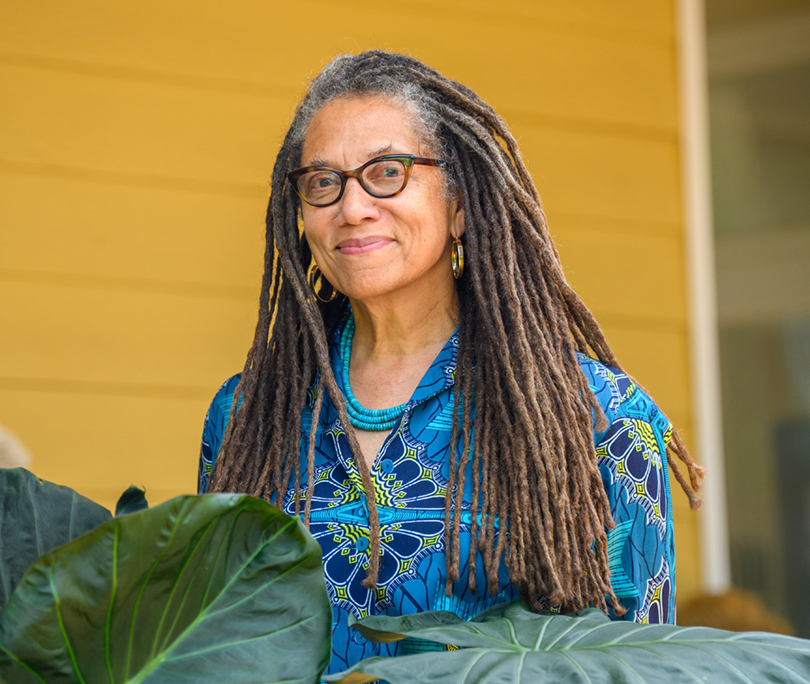
At award-winning poet Nikky Finney’s February lecture in Haggin Auditorium, she read from her 2020 piece on the late Congressman and Civil Rights leader John Lewis. Her essay, published on Literary Hub in 2020, feels even more relevant today.
It begins, “Dear John Robert Lewis, there was a colossal sweetness about you that some mistook for weakness. A sweetness, that seemed to power your actions and your life. …The love that, seems to me, fragments of which might have been found inside some of those books you always kept close in your back pack.”
Lewis was a part of the Nashville sit-ins and the Freedom Rides, and was present for Bloody Sunday in 1965. He served thirteen terms as a representative of Georgia starting in 1987. His “colossal sweetness” contrasted with the violence of those who opposed him. Finney follows his example. She needs his sweetness like a backpack which she can wear constantly.
Nikky Finney, originally from South Carolina, lived in Lexington for nearly three decades, working as a professor at the University of Kentucky. A founding member of the Affrilachian poets and 2011 winner of the National Book Award, Finney’s work explores Southern heritage and Black expression.
While John Lewis informs Finney’s activism, her writing influences include Thomas Merton and James Baldwin. Merton was a Trappist Monk living and writing in Bardstown, Kentucky, for most of his career and a proponent of pacifism; Baldwin was a Civil Rights activist and a prolific writer of both fiction and nonfiction, including Go Tell It On the Mountain.
Finney’s talk, part of the William R. Kenan Jr. lecture series, was titled “Poetry: The Influencer.”
Finney described influence as “indirect, without apparent exertion of force.” Her influences “arrived” and made “soft but intense impressions” on her. To influence, she said, is “to provide some kind of magical space to mingle, to mix, to test, to throw some idea or belief up into the air and then walk into it like a burst of brilliant powder.” We are influenced when we step into something that speaks to the part of us that was always there, but needed someone else’s words to recognize it.
Finney’s influences also make social commentary. The writers and thinkers she cites “have left us an atlas of words.” Though they wrote twenty, fifty, even close to a hundred years ago, they have given us direction that applies today. The “violent and abusive authority” that Merton contemplated—as well as the need for internal solitude—remains.
Perhaps the poets are the only ones who have this internal solitude. They are often able to discern what we might otherwise miss. In that sense, we can say that Finney arrived at Transy to share that truth with us.
Finney ended by reading the 1995 poem “Famous” by Palestinian-American poet Naomi Shihab Nye. I recommend listening to Finney read it via the livestream, beginning at 51:37. Notice where she pauses and how she enunciates each word. Or listen to your voice read the poem. In your head or aloud. Where does it pause and linger? What images does it create?
“Famous”
The river is famous to the fish.
The loud voice is famous to silence,
which knew it would inherit the earth
before anybody said so.
The cat sleeping on the fence is famous to the birds
watching him from the birdhouse.
The tear is famous, briefly, to the cheek.
The idea you carry close to your bosom
is famous to your bosom.
The boot is famous to the earth,
more famous than the dress shoe,
which is famous only to floors.
The bent photograph is famous to the one who carries it
and not at all famous to the one who is pictured.
I want to be famous to shuffling men
who smile while crossing streets,
sticky children in grocery lines,
famous as the one who smiled back.
I want to be famous in the way a pulley is famous,
or a buttonhole, not because it did anything spectacular,
but because it never forgot what it could do.
Finney’s lecture asked the audience who they want to be in the world. What is famous to you? What do you carry in your backpack? If there was a fire, what would you grab as you run out the door? What do you hold in your heart that gives you strength as you run? Either the strength to run faster–or the strength to turn around and save someone else still inside the burning building.
—
The following night was the 35th Anniversary of the Affrilachian Poets. The group was named after Frank X Walker’s poem “Affrilachia,” a term he coined because literary critics and scholars had forgotten African American Appalachians.
After the group’s preamble was read by Transy professor and poet Jeremy Paden, sixteen Affrilachian poets read their work. Poets, apparently, love to quote other poets. They also love to take off their poet hats and tell funny, personal stories about each other in their introductions. Many of the older poets, like Frank X Walker, Finney, and Crystal Wilkinson were mentors or teachers to the younger generation. They are interconnected, a close community who all influence each other. As Paden said, we “learn to read and write from and with others.”
When the poets spoke in verse, their voices became more resonant, more thoughtful. Nearly all of them said: “It’s good to be home.” Finney said it during her talk the night before.
But their poems sometimes seem to say the opposite. When a wasp attacks one honeybee, NitaJade read, all the others come buzzing in.
“Humanity,” Parneshia Jones read, “is traveling…with all our receipts.”
In his poem, Gerald L. Coleman said that right now, some people think “it’s safe to hate in the sunshine.”
Dr. Ricardo Nazario y Colón read that our American soil indicts us, it “drinks truth.”
Frank X Walker read perhaps the most famous piece of the night, his “Why I Don’t Stand.” In this poem, Walker explains that “My Old Kentucky Home” is not as peaceful as the anthem suggests. White Kentuckians were slave owners, and after abolition, the commonwealth was segregated. Even before then, Kentucky land was wrested from the indigenous people who lived here. Our soil drank the truth from which our bluegrass grows. History cannot be undone.
So how is it possible for these poets to say that it’s good to be home? How is it good? Why is it home?
There may be no clear answers to these questions. Perhaps the power of poetry is not that it provides answers, but that it asks questions and records truth. Perhaps the Affrilachian Poets ask us, the world is this way, how can we change it?
Who are we here at Transylvania? In the “26.6” years that she lived in Lexington, Nikky Finney observed a city that lives “the life of the mind.” A life we are especially equipped to live at Transy. The complexity of a liberal arts education allows us to read and respond to the reports these poets have brought us.
By living and writing here, Nikky Finney and the Affrilachian poets have had a profound influence on Lexington. They have created a home for other Affrilachian and minority poets, and pushed a place with a painful history to grapple with that pain and that history. Perhaps in doing so, it has become a place of beauty. So Lexington becomes home. Home is not always synonymous with comfort and familiarity. Home means complexity and struggle, too. Struggling to improve the places we love, and seeing our communities doing the same, is unifying and good.
So it is good to be home.