

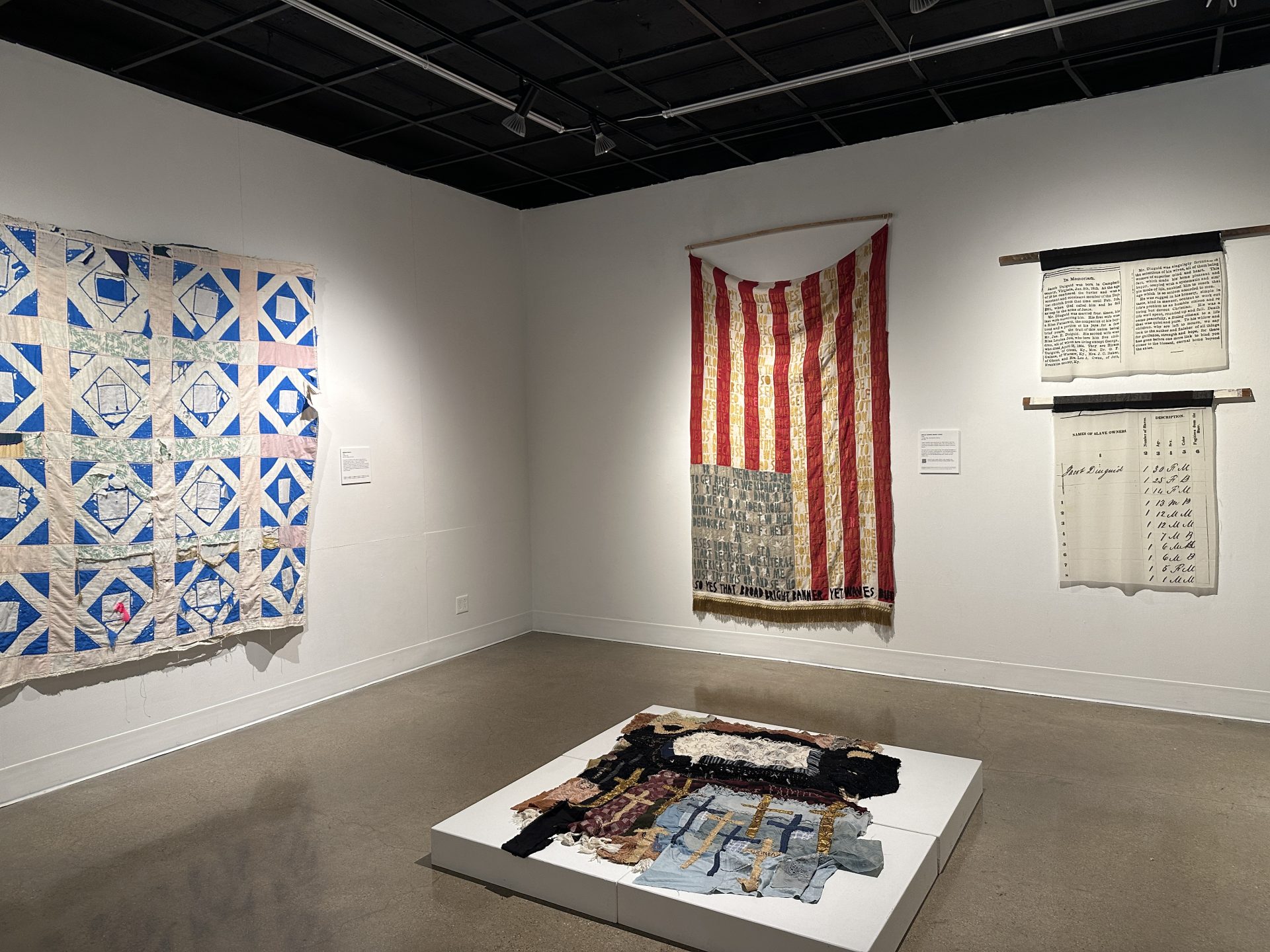
On Thursday, January 12th, Zak Foster spoke about his exhibition in Morlan Gallery, “Southern White Amnesia”, as a part of the Creative Intelligence series. The exhibition seeks to explore the hidden stories of white people that are often not passed down or told to future generations due to discomfort. Foster works with textiles, comparing them to our second skin, and embraces these relatable materials as a part of his storytelling journey.
Foster’s story begins with an interest in his ancestry, which led him to complete a DNA test and find he was related to both white people and black people. This was a perplexing truth, and he set the goal to seek more of how and why his ancestry looks like this.
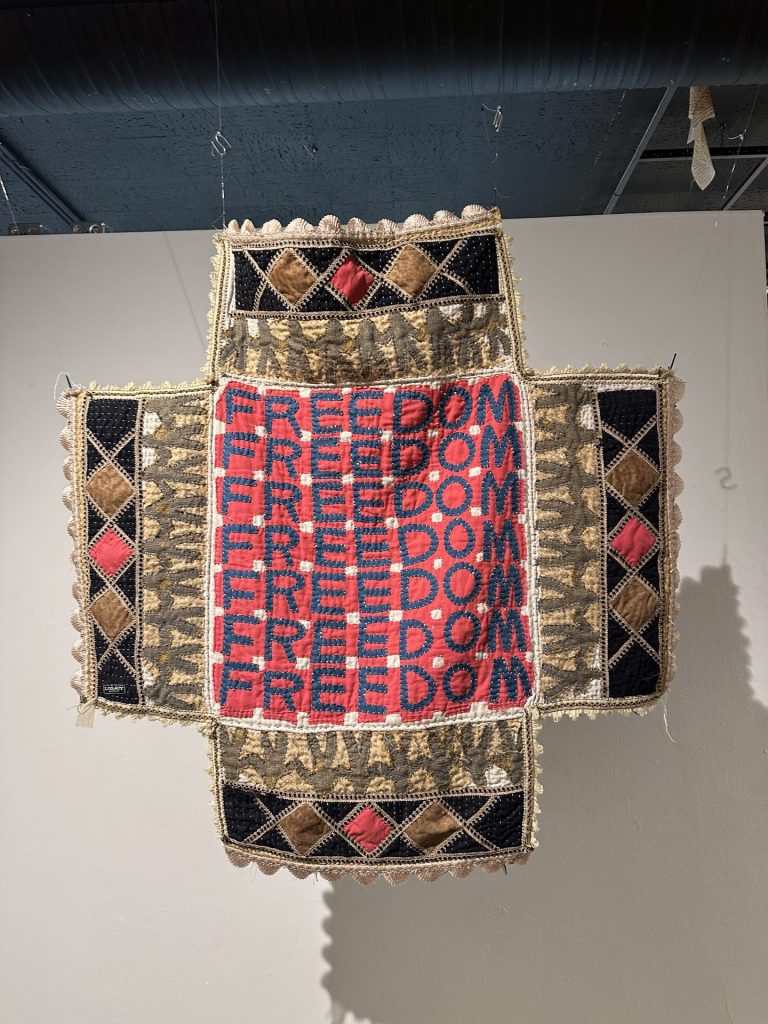
Foster discussed how he had no idea he was related to black people, and this uncertainty felt like something he should know. He then began this investigation into how some stories get told, and others do not. He brings in famous quilter Jessie Telfair and her Freedom quilt.
Jessie was a black woman in Georgia who was fired from her job for attempting to exercise her right to vote. After her job loss, she was encouraged to make a quilt out of her frustration– it is bright red with the words “Freedom” quilted seven times in blue. Foster recreated this freedom quilt titled “Jessie Telfair and the white man who fired her”. He describes how the words “freedom, freedom, freedom” were not said in a celebratory way. The quilts are very similar to Foster’s, including a patterned edge of humans holding hands with red and black diamonds above. Foster described how these cries of “freedom” were an act to hold America accountable for its alleged statement that all are free in America. Foster goes on to explain the back of the quilt, which is referred to as “the white man who fired her.” The back is simply the loose ends and stitching which make up the front of the quilt. He describes the back of the quilt as depicting the unfair reality of Telfair’s ancestors knowing her story, while the children of the white man who fired her live in ignorance of his actions.
“We don’t often have a lot of info on our family lineage- where they come from and who those people were.”
Next, Foster goes on to describe this silk chiffon piece titled “Appraisement.” This was a real document from after one of his ancestors had passed away, and the appraiser documented his remaining possessions. The list describes furniture, animals, and people who he enslaved. Foster describes how his third great-grandfather had this amazing obituary, which described him as a devout christian who was content to work out life’s problems. Yet, he participated in the enslavement of human individuals. His obituary was one sided— showing his amazing traits as a person, but leaving out the horrible things he did throughout this time on earth. Connecting back to Jessie Telfair and the white man who fired her, it is clear that the ancestors of white people oftentimes have to do real digging to find out who they truly are.
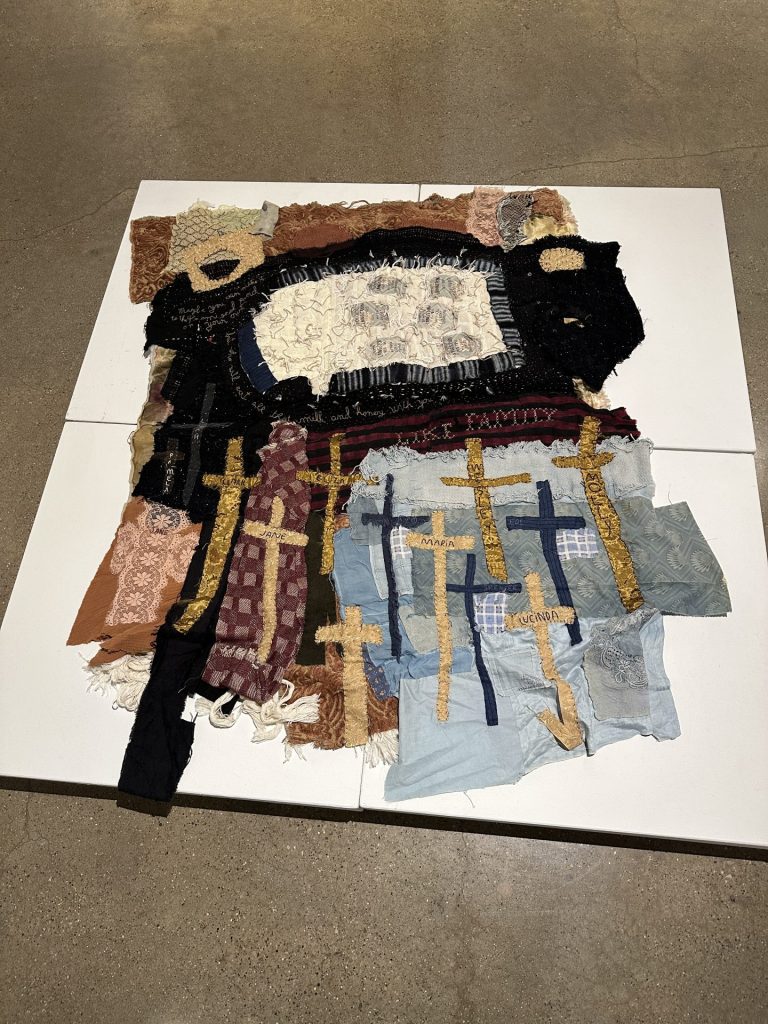
Foster continues his journey to better understand his ancestors and finds himself in Lawrence, South Carolina, to explore some family land and burial sites. He describes his experience at this burial site, where his family’s graves were fenced in. He illustrates their graves being innately carved with little cherubs and nice expressions. As he looked further, he found concave spots on the ground outside of the fenced in cemetery. He asked the tour guide, and she explained that this was where they buried the black people who worked for the family. Foster was then inspired to memorialize these individuals by creating a floor quilt called “Like Family”, which is known as a common expression to use for black workers. This quilt has a special sense of topography, which is used to really see how the whiteness was used as a gatekeeper— even in the afterlife. As Foster continues to explore his family history and dig into the harsh realities, he finds time and time again how the stories of black individuals are hidden and buried. Without a headstone to commemorate their death, the stories of these individuals are left to fade away.
Foster explains how you can’t cancel your own family. What he means by this phrase is that it can be difficult to hold your ancestors accountable, but it is necessary for us to do the work now. He then elaborates on the uncomfortable awkwardness of the research he was doing. These feelings were further channeled into creating a small, handmade doll for each slave-owning ancestor. He piled all of these ancestors together in an antique bed and made one doll for himself to represent the uncomfortable feelings that he had to work through. These dolls have an uneasy look to them, and the choice of dolls creates this action of humanizing his ancestors to further hold them accountable for their choices.
“My ancestors are now very clear on the harm they have caused in their life and working through open-hearted descendants to undo the injustices and harm that were perpetrated.”
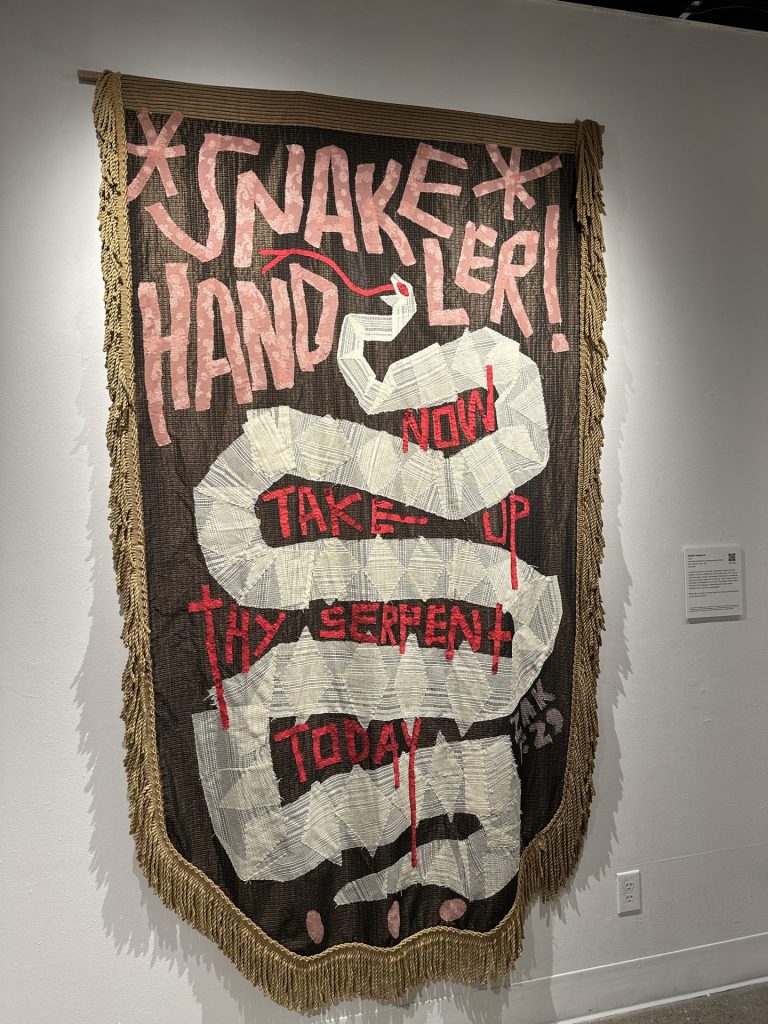
The quilt titled “The Snake Handler” describes more than ever that this work must be completed by the living. Foster came about this piece in a dream, in which he was handing off his poisonous snake back and forth with one of his ancestors. He described that when he woke up from the dream, he was the one holding the snake. Family history doesn’t fully disappear with its members. The passing of the snake exemplifies how it must be addressed by the living to not prolong its racist venom.
Foster’s incredible and meaningful work is all done through the medium of textiles. He further explains how we typically associate this type of work with a granny-like nature. Foster elaborates on why he chooses to work through the medium of textiles— describing that when we have this sense of softness and connection, it is here where we can open from a more vulnerable place and understand these difficult questions.