
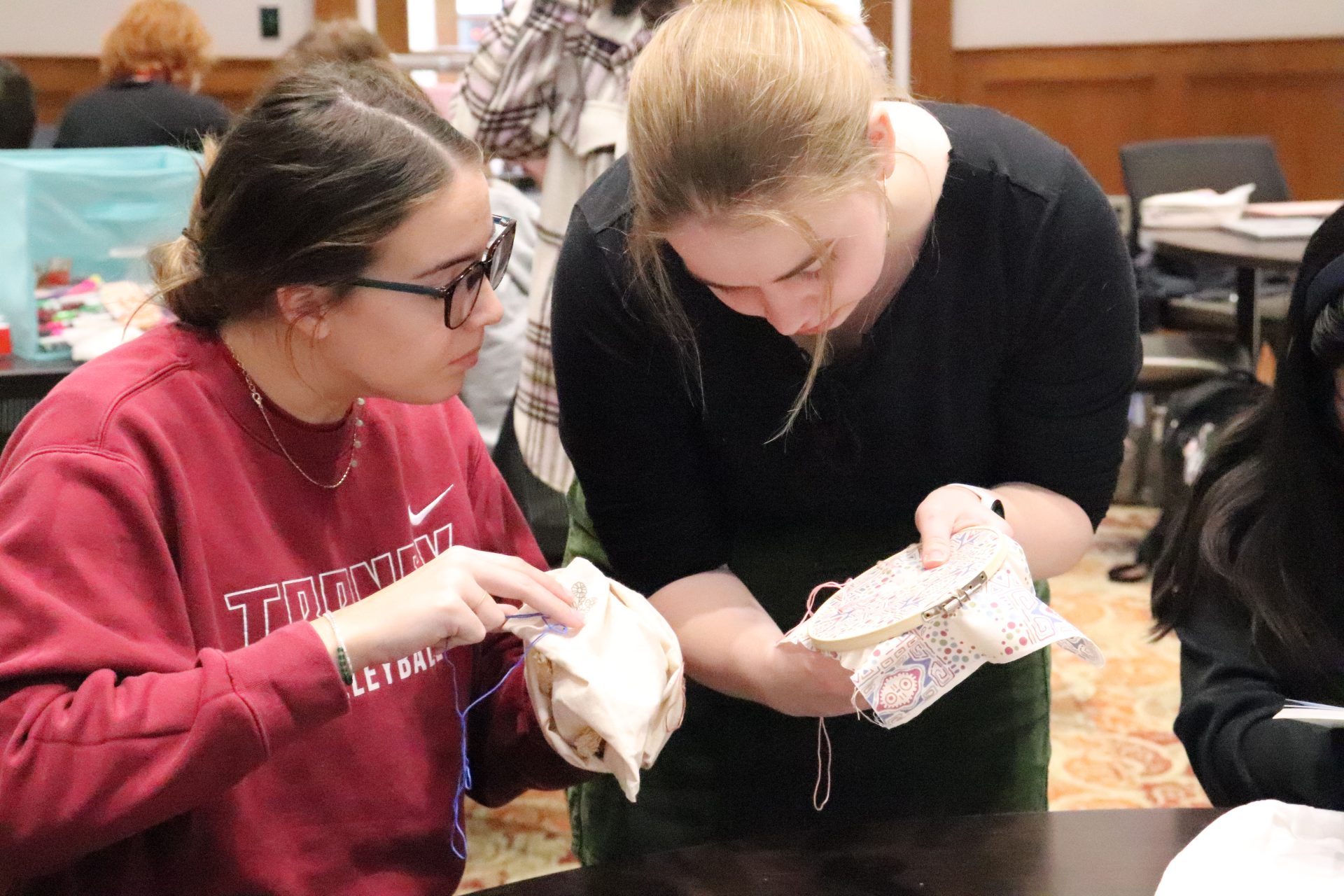
Human Intelligence (Hi!), a faculty-student working group, hosted its first DIY (“Do it Yourself”) event in the Pioneer Rooms on Wednesday, February 11, with a variety of crafts and activities.
Junior Hope Riester taught embroidery, senior Alice Beatty led a key-chain making workshop, and senior Sam Schultz organized students making posters focused on critiquing AI in higher education.
Periodically, painting professor Grace Ramsey would call out from the corner of the room: “Would you like to experience one minute of pure human connection?” She led a fun “DrawTogether” table, where participants had to draw another person in a continuous line without looking down at their paper, creating a wide variety of amusing portraits.
Hi! was started by art professor Kurt Gohde and creative writing professor David Ramsey last semester as a Faculty Learning Community (FLC). According to an email announcing what the group dubbed its “first Hi!DIY event,” the FLC “was founded this year to promote human-centered education, explore possibilities for embodied learning, take a critical look at AI in higher education, and create resources for students and faculty interested in AI resistance.”
Hi!, which meets roughly every two weeks, includes eight professors, along with eight students—which is unusual for FLCs at Transy.
“FLCs, by definition, are meant to be by and for faculty and instructors, with staff involvement as relevant,” said Bingham Center for Teaching Excellence co-director Melissa Fortner. “The Hi! FLC is the first to heavily involve students; we were happy to let Davey and Kurt experiment with adding students to the group.” FLCs have been hosted by the Bingham Center for Teaching Excellence since 2023. “The end goal is for each FLC to take what they’ve learned and share it with the wider community in some way,” said BCTE co-director Julie Perino.
Ramsey said that he and Gohde founded the group because they felt there weren’t enough resources available for those who felt passionately about AI resistance. “We knew there were a lot of faculty, staff, and students at Transy who were eager to think in a more critical way about the use of AI on campus and in higher education,” he said.
Sophomore Sophia Schmer was one of the initial students recruited to the group. “I joined Hi! because I feel strongly that AI reduces creativity and hinders the learning process, ” said Schmer. “Before joining, I was unaware of a lot of the facts and terminology behind AI in higher education, and now I feel much more prepared to argue against it. I’m also so grateful to participate in the rich discussions and to be surrounded by a group of people who also believe in the importance of human thinking and connection that AI undermines.”
Ramsey said that many professors who share these concerns are less interested in trying to “play cop” to enforce AI rules, and more excited about reasserting and reimagining values they believe are under threat. “Nearly all of the people in our group would probably be considered ‘anti-AI.’” he said. “But we called our group Human Intelligence because we wanted a positive vision focused on student-led, bottom-up, durable culture change—anchored in the core values of a liberal arts institution.”
That core mission led to an idea: Periodic HiDIY! events that would bring faculty, students, and staff together to share various skills, focusing on handmade practices and embodied learning. “One of the things I’ve been enjoying learning from Kurt is the ways he thinks about creativity specifically in relation to using his hands, as a sculptor,” Ramsey said. “And the beautiful part is that doing these embodied practices makes you think in a deeper way, because thought is embodied, too. A lot of professors, not just in studio art, are thinking about how we can bring embodied learning into the classroom. So our group decided: let’s start doing this, together, and learn as a community. The students took it from there.”
I attended the inaugural DIY event, which served free pizza from Mad Mushroom, and chatted with a few students and faculty about their experiences. When asked why they chose to attend the event I heard a wide variety of motivations for attending.
“I’m very against AI, and when I saw the Human Intelligence event and heard about it from some professors, I was very interested in seeing what it was all about,” first-year Chloe Cotton said. “I also really enjoy crafts and enjoy the community building of it.”
Cole Wright, a junior, said he only learned of the event twenty minutes before it started. “But as I thought about it, the message behind the event also stuck out to me,” he said. “I’m in a class right now called Cognitive Structures where we’ve been discussing a lot of the ethics behind AI… I don’t really have super solid answers about the future of AI, but I’d really like to see how this club develops over time because these issues are super pertinent today.”
Qian Gao, professor of Chinese literature, culture, and film studies, stopped by the event after receiving the email announcement. “I thought, ‘Wow, this sounds fun!’ Especially in an age when AI seems to be taking over everything!” Gao said she immediately connected the human-centered focus of Human Intelligence with the Chinese calligraphy she is teaching this semester.
“As a traditional but still prominent and popular art form of China, calligraphy embodies human agency, creativity, learning, discipline, moral character and aesthetic pursuit, all through the practice with brush and ink,” she said, “which also cultivates the human body to bring strength, mindfulness and tranquility into harmony.” Gao connected with Hi! leaders and is now planning to teach and showcase Chinese calligraphy at a future Hi!DIY event.
Grace Ramsey, the newest faculty member of Hi!, had one of the event’s biggest hits with her DrawTogether table.
“This drawing activity is really special because we’re around each other all the time but we rarely take a moment to really look at each other, really look into each other’s eyes,” she explained. “So what this does is make space to just be with another person and to really look at them, really see them. And also have fun—the nature of it is that we end up with a goofy portrait of someone else. It’s a moment to share with each other. The goal is to create more empathy with other people, and I really believe that comes from spending more intentional time together. And especially drawing can be a great way to foster empathy. Giving someone your full attention naturally fosters empathy. I feel like our world could use more of that.”
Sarah Harcourt Watts, director of religious life, said that a big part of her role on campus was fostering connection and community, which fits right in with Hi!’s mission.
“I have noticed that AI is a hindrance to human connection, and I love supporting anything on campus that builds it instead,” Watts said. “I’’m also a big fan of crafting and learning new things. I had so much fun learning needlepoint in a zero-pressure setting, and I’ve started my own little needlepoint project at home since. Working with my hands is the perfect antidote to spending too much of my time on screens. I’m so grateful that folks are having important conversations in Hi! and I’ve heard those conversations continue in other spaces.”
David Ramsey said these themes of attention and connection are what Hi! is all about. “The most successful thing about the event for me was just the warm vibe of people coming together,” said. “It was such a cozy zone.”
Departing the event, senior Kate Polson said, simply, “I needed that.”
What’s next for Hi!? Senior Sam Schultz, a student member of the group, described two key objectives in the coming weeks.
“The first goal is concrete: influence Transylvania University not to renew their huge contracts with generative AI companies next year,” he said. “We’ll be circulating a petition very soon and working to communicate campus opinion about AI to the administration. The second goal is to celebrate human intelligence, like with our first Hi!DIY event. We want to keep organizing events where Transy students can enjoy making art by hand together.”
For Schmer, Hi! and Hi!DIY events are happening in the perfect place: “I think Transy is exactly the school to foster this group because of its belief in the importance of education not only for future success, but to nurture the human spirit. I hope that we can harness the energy already here and direct it towards creative solutions for AI. I’d love to see tons of student engagement, shifting minds, and graduates with tools to conscientiously abstain from AI in the future as well as spread awareness.”