

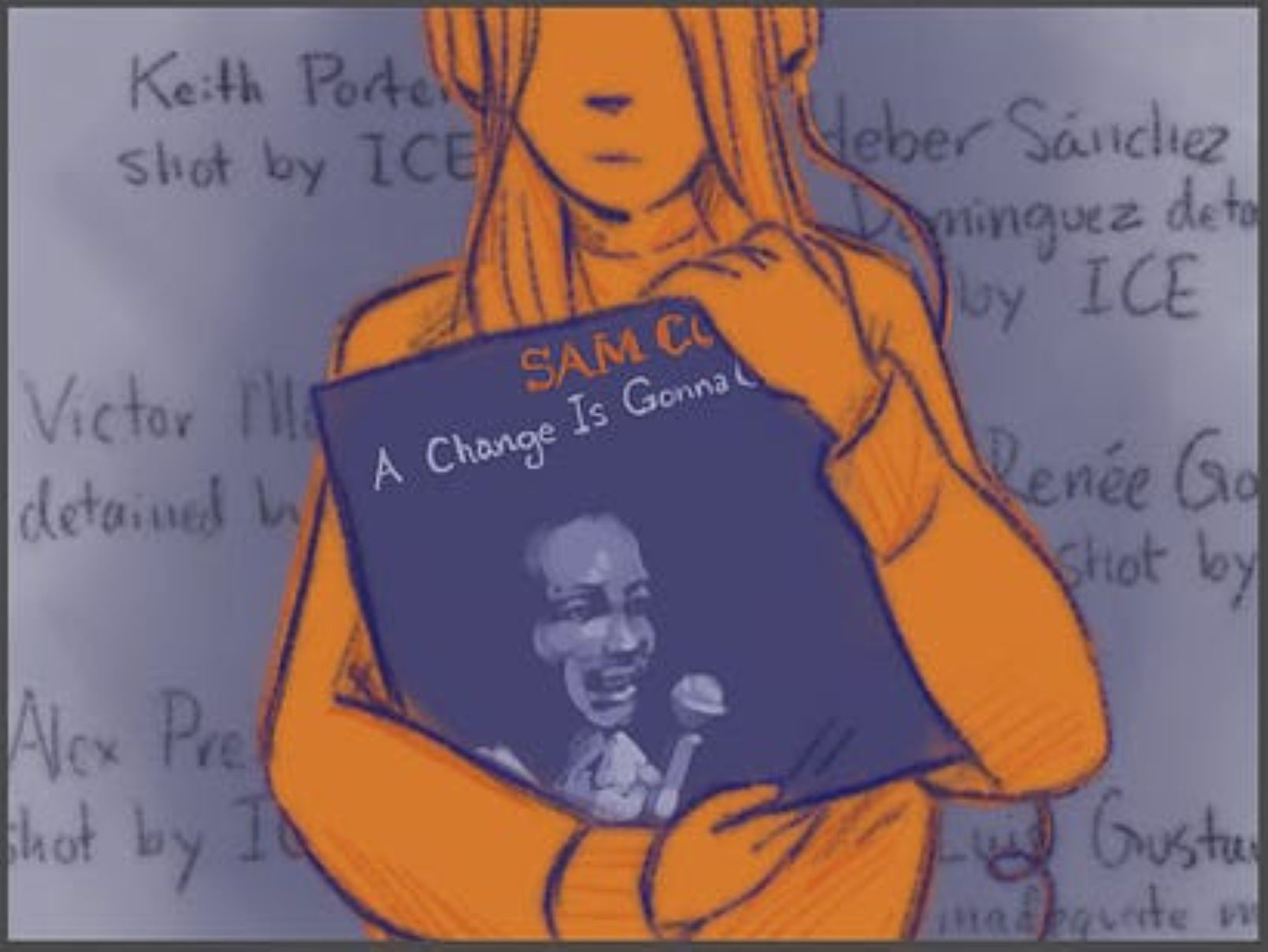
Music has always been a source of solace in my times of worry. As a toddler, I hummed “Swing Low Sweet Chariot” alongside my mother’s words as she protected me from closet monsters. In my awkward, middle-school angst, I screamed “Complicated,” echoing Avril Lavigne’s anger towards my drama-filled friend group. After my first heartbreak, I bawled Olivia Rodrigo’s “Traitor,” wondering how I would ever recover from the new-found loneliness.
As I’ve grown older and childhood troubles have shifted to trepidation reading the headlines, I’ve realized the monsters to fear aren’t in my closet, but running wild in American streets. So, as fear and hopelessness overcame me a few months ago while following ICE’s surge of terror, I turned to my familiar comfort.
Scrolling through the news, Sam Cooke’s “A Change is Gonna Come” has been an uplifting voice for me in a swarm of hatred and injustice. Cooke wrote the soulful song in response to the prejudices he experienced as an African-American man: “It’s been too hard livin’, but I’m afraid to die / ’Cause I don’t know what’s up there, beyond the sky.” Cooke’s painful words also resonate with the experiences of countless immigrants today, struggling with the cruelties and abuses of ICE.
In that sense, listening to Cooke is not a means of distraction, but a mechanism for deeper awareness of the horrors I read through every day. When I feel as though my opinions exist in a meaningless echo chamber, music acknowledges my fears and mirrors my worries through passionate lyrics. It consoles me and accompanies my solitary thoughts.
But it is not an escape. Sam Cooke’s voice doesn’t transport me to a utopian world away from Earth’s current inequities; rather, it gives me the endurance to face today’s calamitous truth. And the truth is terrifying.
The truth is that millions of dollars have been allocated to building the mass detention center Alligator Alcatraz. The truth is that Venezuelan and Salvadorian men have been sent to the mega-prison CECOT without due process. The truth is that ICE has been granted authority to enter homes without a judge’s warrant. The truth is that people living in America have been murdered at the hands of masked agents.
And the truth is that none of these things have occurred in secret. They have been publicly televised, and our so-called leaders have been shamelessly celebrating the perpetrators.
Silverio Villegas González was a 38-year-old father. He was from Mexico and working as a cook in Chicago when he attempted to flee ICE agents at a traffic stop. He allegedly dragged an agent with his car, but eyewitnesses said they never saw this take place (the agent himself later said his injuries were “nothing serious”). Silverio was shot with a bullet through his neck that rested in his chest. He died at Loyola University Medical Center, where cocaine was found in his system. His funeral was later held in his childhood home in Mexico. His casket was adorned with red and white roses, yellow lilies, and green foliage.
The truth is that Silverio Villegas González did not deserve to die on September 12, 2025.
Isaias Sanchez Barboza was a 31-year-old Mexican man. He was wearing camouflage and walking with a group of people in Rio Grande City, Texas, about five miles from the Mexican-American border. Border Patrol encountered the group and attempted to detain Isaias. After participating in an “active struggle” for two minutes, an agent shot Isaias three times. He later died at Starr County Hospital.
The truth is that Isaias Sanchez Barboza did not deserve to die on December 11, 2025.
Keith Porter was a father of two daughters. He was living in Los Angeles and firing his rifle into the air in celebration of the new year. An off-duty ICE officer lived in the same apartment complex as Keith, and claimed to respond to an “active shooter situation.” It’s hard to know what happened next; there were no cameras and authorities have released very little information to the public. All we know for sure is that when LAPD officers arrived on the scene, Keith, 43 years old, was on the ground, shot dead. Friends and family of Keith have said they hope he is remembered for his “joyful attitude” and being a “proud girl dad” and “the life of the party.”
The truth is that Keith Porter did not deserve to die on December 31, 2025.
Renée Good was a mother and a writer. She was warmly bundled up in a beanie while driving her maroon Honda on Portland Avenue in Minneapolis, where ICE agents were operating and their vehicle got stuck in the snow. When Renée stopped driving, her partner, Becca, went and stood behind the Honda to question and record the agents. Renée started backing up, and an agent attempted to open the Honda’s driver door. Another agent moved to the front-left of Renée’s car before she drove forward and steered to the right, away from the agent. The agent to the front-left of the car then fired three shots as Renée was driving away. Bullets struck her left forearm, her right breast, and the left side of her head. Immediately afterward, an agent called Renée a “fucking bitch.” This incident happened within the span of less than three minutes.
Bystanders pleaded with agents to allow a physician to check on Renée’s condition, but ICE refused, claiming they had medics on the way. She was denied medical care for six minutes after she was shot. Renée was pronounced dead soon after.
The truth is that Renée Good did not deserve to die on January 7, 2026.
Alex Pretti was an intensive care unit nurse. He worked in a Veterans Affairs medical center. On Nicollet Avenue in Minneapolis, Alex began to record an ICE agent with his phone, in a reported attempt to document a nearby detention. He was wearing a concealed and registered gun on his waist. After directing traffic, Alex tried to help a woman up from the ground who had been knocked down by agents. Alex and others were pepper sprayed. Alex then fell to the ground, and was tugged by the hood of his coat into the street by an agent. Agents then began to pin Alex down and punch him repeatedly before one drew a gun and removed Alex’s from his waist. One agent shot Alex, then another. Ten shots were fired within five seconds. He passed away at the scene.
The truth is that Alex Pretti did not deserve to die on January 4, 2026.
Heber Sánchez Domínguez, Víctor Manuel Díaz, and Luis Gustavo Núñez Cáceres were all immigrants who died in ICE detention centers.
Heber, a Mexican immigrant, was found hanging by his neck in his detention room.
Víctor, a Nicaraguan immigrant, also died in his detention room. Agents claimed his death was a suicide, but Victor’s brother told ABC News, “I don’t believe he took his life. He was not a criminal. He was looking for a better life and he wanted to help our mother.”
Luis Gustavo, a Honduran immigrant, suffered from a heart-related death. His brother wrote, “Sadly, his life was cut short due to the lack of adequate medical care while he was in ICE custody.”
The truth is that these men did not deserve to die.
Reading these stories has been one of the most difficult and deflating things I’ve done in a long time. Scrolling through pictures of the men and women, now gone, who were once alive and well, left an excruciating pain in my chest.
Keith taking a selfie with his grandmother. Renee’s curly hair flowing at the beach. Alex crouching on a wilderness hike. Heber smiling in his orange hoodie. Each photo captured carefree moments, each subject tragically naive of what would happen next.
The photos are a reminder that each of these lives are a universe in themselves. They had an entire family and personality and history before their unjust demise. They once feared the monsters in their childhood closets and cried over juvenile relationships. They were human. They had joys and hardships. They endured. But now their existence has been reduced, in the headlines, to the label of yet another “ICE victim.”
But their lives were more than their victimhood. Something is wrong with us if we simply see them as a name in a list of those abused by ICE, without considering the previous worlds these people once woke up to every day. Like all of us, they were flawed. Like all of us, they tried to grow, and failed sometimes, and tried again. They had mothers and fathers and sons and daughters. They had reasons to continue searching for a better life. They were, each of them, their own universe.
Let us remember them, and their stories: Silverio Villegas González and Isaias Sanchez Barboza. Keith Porter and Renée Good. Alex Pretti and Heber Sánchez Domínguez. Víctor Manuel Díaz and Luis Gustavo Núñez Cáceres. Remember the totality of their identities and lives. Remember their names, and fight for a better world. For everyone.
Being alive today is a never-ending whirl of intimidation and distress, but we have the power to incite change, through protest and speech and care. My form of opposition is grounded in both writing and listening. I was inspired to compose this article by Sam Cooke and his steadfast words: “It’s been a long, / a long time comin’, / but I know / A change gon’ come / Oh yes it will.” Listening to Cooke’s voice, I am filled with the strength to endure and refuse to succumb to hopeless melancholy. I am fueled by the rage of generations who have suffered through injustice. I am empowered to speak out.
A change must come, and I know it will.